

On this page
Between 1811 and 1814 Joseph von Fraunhofer passed sunlight through a prism and found hundreds of dark lines, according to a 2024 review by Maíz Apellániz, Negueruela and Caballero; we told that story in Fraunhofer and the dark lines in sunlight. The same review says several astronomers looked at star spectra in the decades that followed, but sorting them into classes had to wait until the 1860s. That step came from an Italian Jesuit in Rome, and it gave astronomy its first system for sorting stars.
Who was Angelo Secchi?
Angelo Secchi was born in Reggio Emilia in 1818, joined the Jesuit order in Rome in 1833, and took charge of the observatory of the Roman College in 1850, according to the Catholic Encyclopedia entry on Secchi. The same entry says he died on 26 February 1878, and that his book on the stars, *Le Stelle*, appeared in Milan in 1877.
How did Secchi classify star spectra?
Secchi observed and classified at least 4,000 stars at the Collegio Romano in the 1860s, according to the 2024 review by Maíz Apellániz and colleagues. It says his key idea was to look at a large sample of spectra so he could group them into classes with many stars in each. A historical review by Sunetra Giridhar notes that he did this visually, looking at each star's spectrum through a prism rather than photographing it.
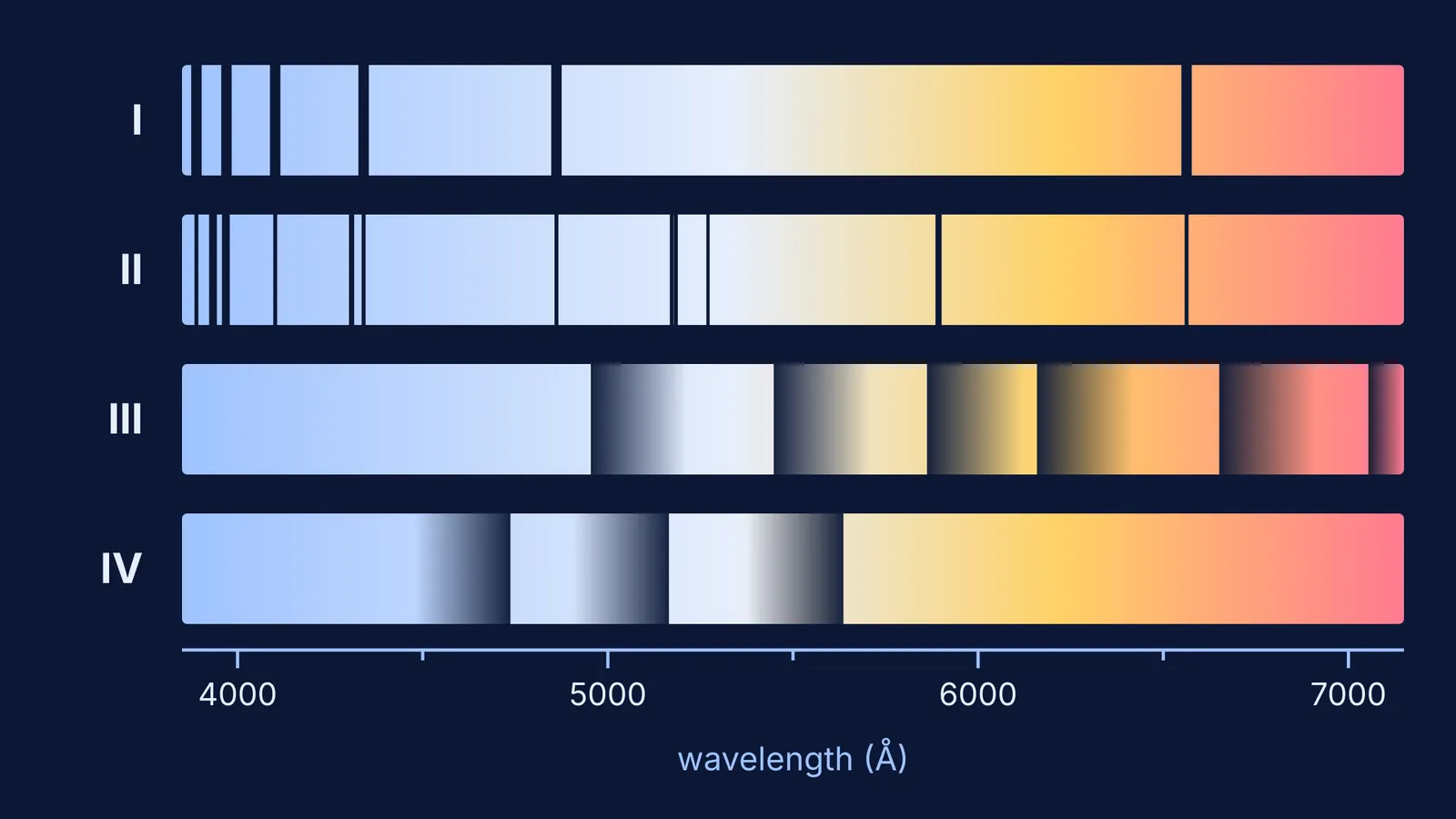
The 2024 review describes his five classes. He started with three and added the other two later:
Class I: white or bluish stars with a few strong hydrogen lines on a fairly clean spectrum.
Class II: yellow stars with many narrow metallic lines, like the Sun.
Class III: orange and red stars crossed by wide bands from metallic oxides.
Class IV: red stars with bands from carbon compounds, today called carbon stars.
Class V: stars like class I, but with bright hydrogen lines in emission.
An exhibit from Italy's national astrophysics institute, INAF, lists Vega and Sirius as class I, the Sun and Pollux as class II, and Betelgeuse and Antares as class III. It shows a pencil sketch from about 1863 of the spectrum of Altair, which Secchi placed in class I.
The Maíz Apellániz review credits him with correctly identifying hydrogen as the element behind those lines, and with suggesting that high pressure broadened them in Sirius.
How did Secchi's classes become OBAFGKM?
Harvard took over with photographs. The 2024 review says the first Harvard catalogue, the Draper Memorial Catalogue of 10,351 stars, used Williamina Fleming's letters: Secchi's class I became A to D, class II became E to L, class III became M and class IV became N.
The same review says Fleming, Antonia Maury and Annie Jump Cannon, led by Edward Pickering, then reworked the system, and that it led to the sequence OBAFGKM. The Giridhar review says the Henry Draper Catalogue, published between 1918 and 1924, gave spectral classifications for 225,300 stars. You can read how Cannon settled that order in Annie Jump Cannon and the OBAFGKM order.
The 2024 review notes that Secchi's blue-white, yellow and red classes are now known to follow a falling temperature scale. What came next, sorting stars by brightness as well as type, is the story of the Hertzsprung-Russell diagram.
Can you sort a spectrum like Secchi?
Try it on the diagram above, asking in order:
Are there bright lines standing out above the rainbow? Then it is class V.
Are there wide dark bands? Look at their sharp edge, the band head. As a 2026 survey paper by Li and colleagues explains, titanium oxide bands absorb most just to the red side of their head, and C2 carbon bands just to the blue side. Sharp edge toward blue, fading to red means class III; sharp edge toward red, fading to blue means class IV.
No bands? A few thick hydrogen lines and little else means class I.
Many thin lines, including the sodium D pair and the calcium H and K lines from the table of Fraunhofer lines, means class II.
Now check your answers against the modern labels. Altair is class I to Secchi and type A7 V today, according to the INAF exhibit. The Sun is class II to Secchi and a G2 V star today, as the 2024 review notes. Betelgeuse and Antares sit in class III, which Fleming's scheme turned into M.
What can students learn from Secchi's method?
Secchi's habit works on problem sets. Before you solve ten numericals, sort them by what you notice first: which law, which quantities, which trap. Then solve one from each group and see whether the groups hold.
If the hydrogen lines in this story feel abstract, the Fermi Concept Library has a lesson for every concept in physics and chemistry, each with its place in the map. For ideas that are easier to see than to read, the Fermi Simulation Lab has interactive simulations.
Next time you see the letters OBAFGKM, remember that they began with one person in Rome, sorting thousands of stars by eye.


