

On this page
When you glance up from a book to the clock on the wall, your eye adjusts automatically to keep both objects in focus. This rapid transition is called the power of accommodation. Whether you are studying for a physics exam or just reading a menu, your eyes are constantly performing complex optical adjustments.
What is the power of accommodation?
Accommodation is the eye lens's ability to adjust its optical power to maintain a clear image as an object's distance changes. The human eye has a crystalline, elastic lens suspended behind the pupil. By changing its physical shape, the lens alters its focal length to bend incoming light rays exactly onto the retina at the back of the eye.
Light rays from a distant object, like a mountain or a cloud, enter the eye perfectly parallel. They require relatively little bending to converge on the retina. However, light rays from a near object, like a smartphone screen, are diverging (spreading out) as they hit the eye. These diverging rays require much sharper bending to focus on the same spot. The eye's ability to switch between these two modes is what we call accommodation.
How do ciliary muscles control the eye lens?
The eye relies on a mechanical sequence involving a ring of tissue called the ciliary muscle, and the suspensory ligaments (zonules) that hold the lens in place. To change focus, the eye uses a mechanical paradox: the muscles must contract for near vision and relax for far vision.
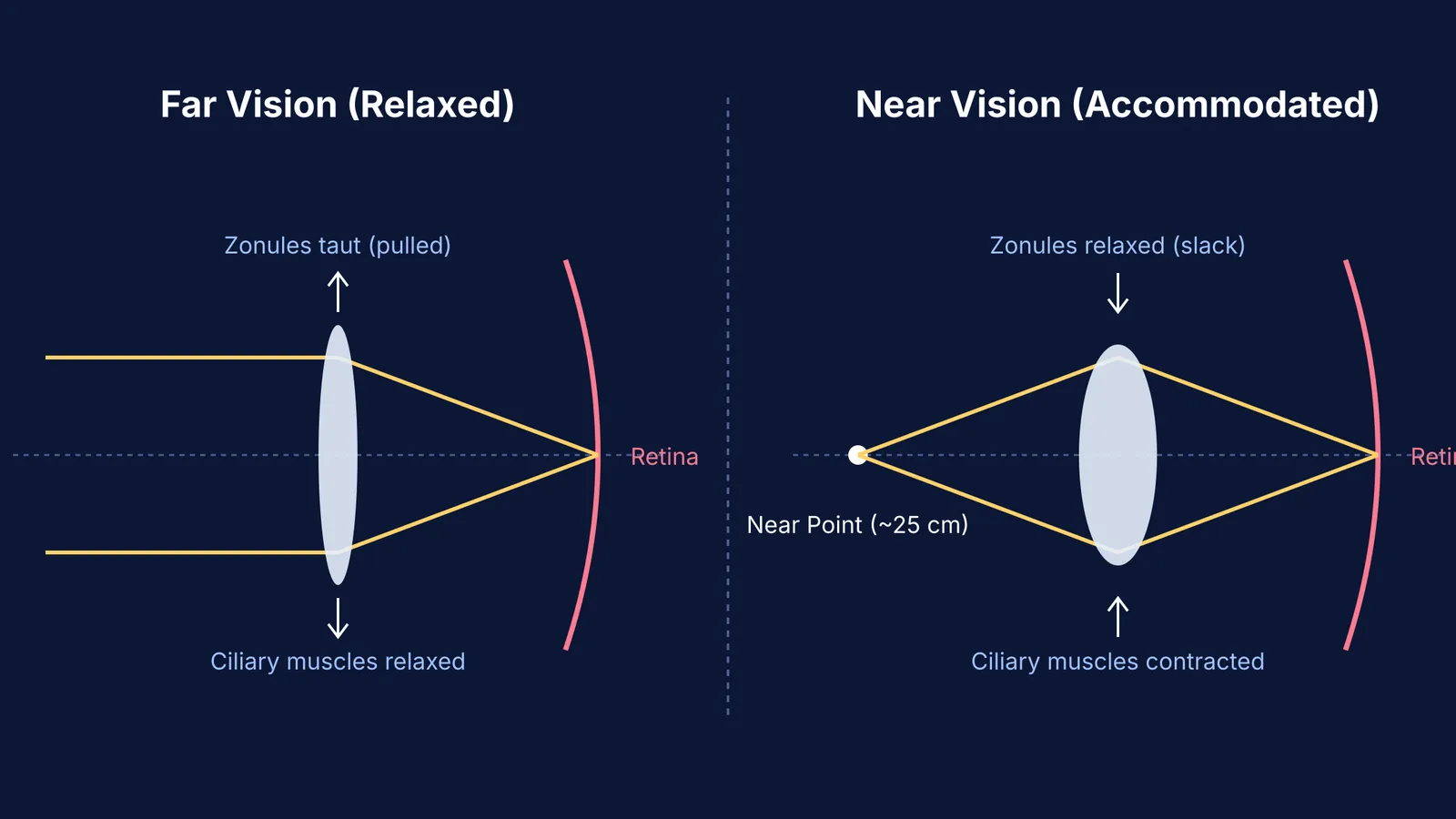
Viewing distant objects: The ciliary muscles relax. This relaxation pulls the suspensory ligaments taut. The tension pulls on the edges of the lens from all sides, flattening it and decreasing its optical power. This long focal length brings the parallel rays to a sharp focus.
Viewing nearby objects: The ciliary muscles contract. Because they form a ring around the lens, contraction moves the muscle inward, which releases the tension on the suspensory ligaments. Freed from that outward pull, the natural elasticity of the lens causes it to bounce back into a thicker, more spherical shape. This increases the optical power by up to 15 dioptres in young humans (Wikipedia)), allowing the eye to strongly bend diverging rays onto the retina.
Visualizing these invisible muscles helps clarify the underlying physics. Instead of simply memorizing paragraphs about ligaments and dioptres, you can use the Fermi Simulation Lab to see the ciliary muscles contract and the lens bulge in real time. Interacting with a dynamic simulation builds a much stronger foundation for understanding the human eye and its defects than static diagrams can.
What is the near point?
There is a mechanical limit to how much the ciliary muscles can contract and how much the lens can thicken. The closest distance at which you can see an object clearly without experiencing eye strain is called the near point, or the least distance of distinct vision.
For a healthy young adult with normal vision, the standard near point is 25 cm (Wikipedia). This 25 cm value is the reference seeing distance used in physics formulas to calculate magnifying power. If you bring an object closer than 25 cm, the ciliary muscles cannot contract any further to compensate, and the image on your retina becomes blurred.
As you age, the crystalline lens gradually loses its natural elasticity. This condition is known as presbyopia. Even if the ciliary muscles contract perfectly, the stiff lens can no longer thicken enough for near vision, pushing the near point further away. This biological change is why older adults often hold books at arm's length or rely on convex reading glasses, applying the exact same principles you would use to correct ray optics sign conventions on paper.
A practical test: find your own near point
You can test your own power of accommodation and locate your near point in a few seconds. This is a great active learning exercise to try at your desk.
Hold a printed page or a book straight out at arm's length. The text should be perfectly sharp.
Slowly bring the book closer to your face, keeping your focus firmly on a single printed word.
Stop moving the book exactly when the word begins to blur, or the moment you feel a slight, uncomfortable strain in your eyes.
Hold the book still and have a friend or parent measure the distance from the page to your eye with a ruler.
If you are a child or young adult, that distance will typically be about 10 cm (Wikipedia)). For your parents or teachers, the measured distance might be 50 cm or more. This straightforward test is a direct, physical measurement of how much elasticity remains in your eye lens and how effectively your ciliary muscles are doing their job.


