

On this page
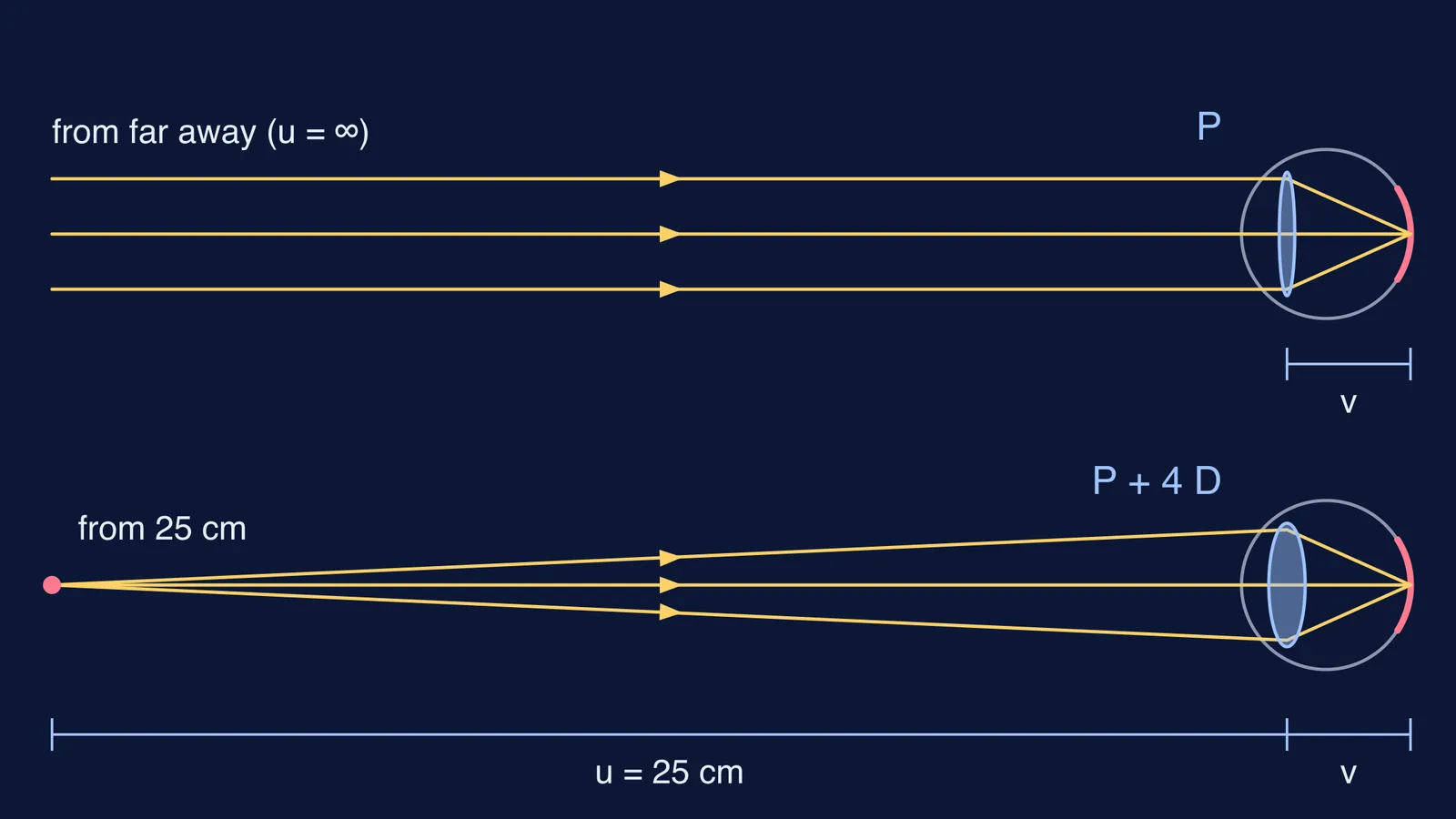
Look up at the board, then down at your notebook, and your eye refocuses. The NCERT Class 10 Science chapter on the human eye describes what happens: for near objects the ciliary muscles contract, the eye lens becomes thicker and its focal length decreases. By how much does the power change? For a normal eye going from infinity to 25 cm, the answer is +4 dioptres, and you can prove it in one line.
What is the change in power of the eye lens when looking from far to near?
The power of a lens is P = 1/f, and its SI unit is the dioptre, where 1 D = 1 m⁻¹ (NCERT Class 12 Physics, Ray Optics).
For a young adult with normal vision, the near point is about 25 cm and the far point is infinity (NCERT Class 10 Science).
Now use the lens formula, 1/v − 1/u = 1/f = P. The image always has to land on the retina, and the retina does not move, so v is the same in both cases. Only u changes.
Far object: u = −∞, so 1/u = 0 and P(far) = 1/v.
Near object: u = −0.25 m, so P(near) = 1/v + 1/0.25 = 1/v + 4.
Change: P(near) − P(far) = +4 D.
Can you check it with real numbers?
The NCERT Class 10 chapter gives the eyeball's diameter as about 2.3 cm. Treat the whole eye as one lens and take a round lens-to-retina distance of v = 2 cm, a little less than that diameter, to keep the arithmetic easy.
Far object: P = 1/0.02 m = 50 D, so f = 2 cm.
Near object at 25 cm: P = 50 + 4 = 54 D, so f = 1/54 m ≈ 1.85 cm.
Change: +4 D, while the focal length shortens by only about 0.15 cm.
Try v = 2.3 cm and you get 43.5 D and 47.5 D: still a 4 D difference. One caveat: NCERT notes that most of the refraction happens at the outer surface of the cornea, and that the crystalline lens "merely provides the finer adjustment of focal length required to focus objects at different distances on the retina". So the 4 D is the change the lens has to supply, not its total power.
How do exam questions change the numbers?
The general rule, with distances in metres, is: change in power = 1/(near distance) − 1/(far distance). Some common versions:
Infinity to 25 cm: 4 − 0 = +4 D.
2 m to 25 cm: 4 − 0.5 = +3.5 D.
25 cm to infinity (near to far): −4 D. The power falls as the ciliary muscles relax and the lens thins.
Watch for three traps:
Centimetres. 1/25 is 0.04, not 4. Convert to metres first, or use the shortcut in our post on finding lens power when the focal length is in centimetres.
Signs. In the Cartesian sign convention, u is negative, so −1/u is positive. Dropping a minus sign turns +4 D into −4 D.
Power versus focal length. The question asks for the change in power, not focal length.
If your sign keeps flipping, the Fermi Problem Library has worked problems with a step-by-step solver that explains the reasoning rather than printing an answer, so you can see the line where the sign went wrong.
Is 4 dioptres a lot for a teenager's eye?
No. The most power the eye can add is its amplitude of accommodation. A 2023 review in the British and Irish Orthoptic Journal by Munsamy and colleagues uses Hofstetter's formulas to estimate the expected amplitude for a child of a given age. The average is 18.5 − 0.3 × age, and the minimum is 15 − 0.25 × age.
For a 16-year-old, those formulas give an average of about 13.7 D and a minimum of 11 D, so 4 D is well within range. The review notes that the formulas came mostly from adults, and found they may overestimate for children aged six, nine, 10 and 11, so treat them as a guide. NCERT adds that the power of accommodation usually decreases with age (presbyopia). For more, read our explainer on the power of accommodation and the ciliary muscles.
This is physics, not a diagnosis. If close reading strains your eyes or the board looks blurry, see an optometrist.
A 30-second check before you write the answer
Write down that v is fixed, because the retina does not move.
Convert every distance to metres.
Take 1/near distance minus 1/far distance.
Read the sign: positive means the power increases, as it must for a closer object.
To see the lens change shape, read our walkthrough of how the lens changes shape for near vision. If the lens formula itself feels shaky, the Fermi Concept Library gives each concept its own lesson. Then try the 2 m version yourself.


