

On this page
When you look up from a book to watch a distant aeroplane, or observe the night sky as explained in Atmospheric refraction: why stars twinkle and planets don't, your eyes refocus almost instantly. This continuous, automatic adjustment of the eye's focal length to keep a sharp image on the retina is called the power of accommodation.
Unlike a camera, which moves its glass lenses back and forth to change focus—a rule of optics explored in Why a lens's object and real image are at least 4f apart—the human eye relies on a flexible, living lens. By changing its shape, the eye alters its optical power to bend light rays by just the right amount.
How do ciliary muscles change the lens curvature?
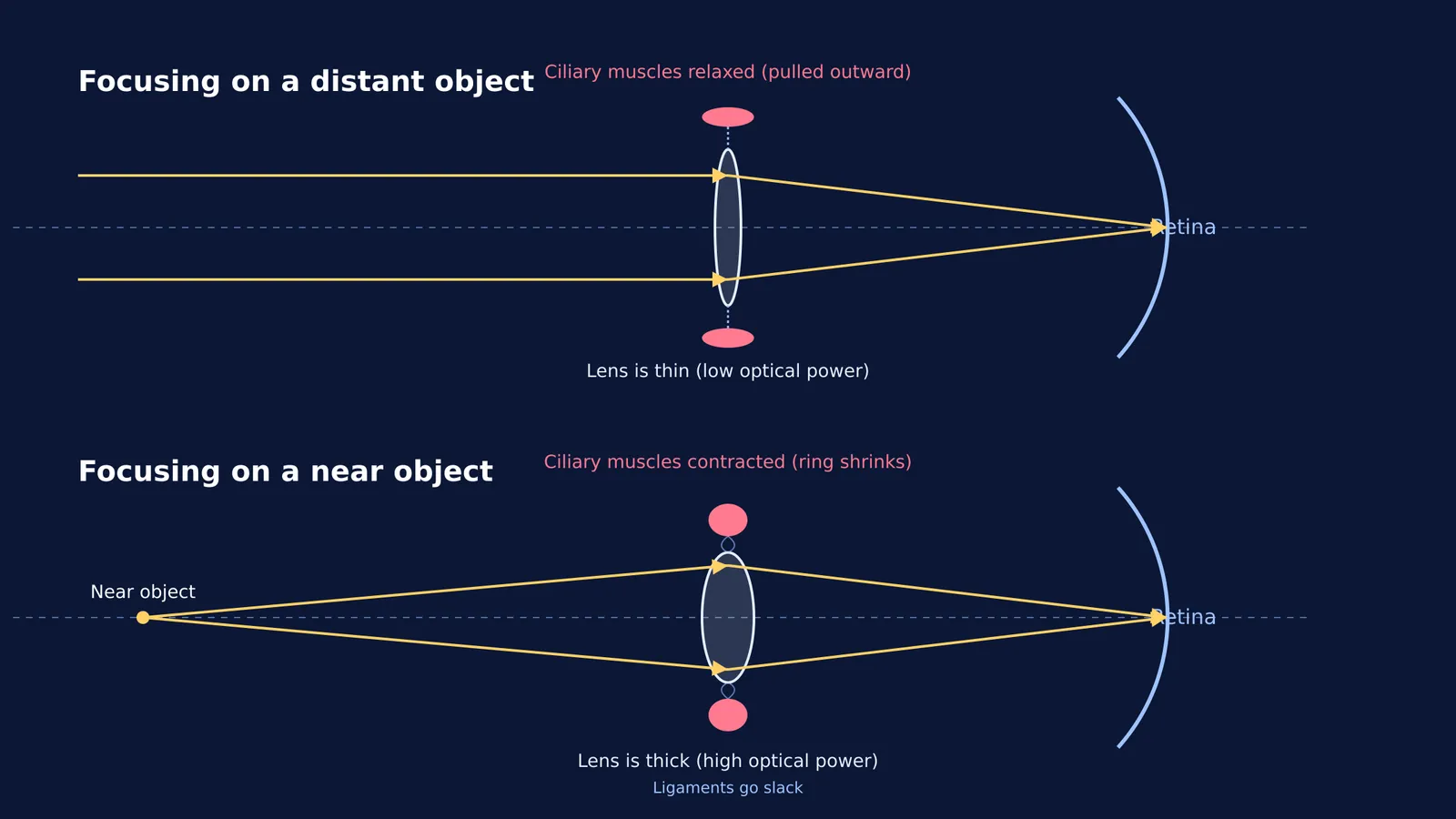
The mechanism behind this change is driven by a ring of smooth muscle tissue called the ciliary muscle, which acts on suspensory ligaments (zonules) attached to the lens (Source)).
For distant vision: When you look at something far away, the ciliary muscles relax. This expands the muscular ring, pulling the suspensory ligaments tight. The tension flattens the elastic lens, decreasing its curvature and optical power so that parallel light rays focus exactly on the retina.
For near vision: When you look at something close, diverging light rays enter the eye. To focus them, the ciliary muscles contract, shrinking the ring. The suspensory ligaments go slack, allowing the lens to spring into a thicker, more convex shape. This increases the curvature and refractive power of the lens.
If you struggle to picture how changing a lens's thickness shifts the point where light rays converge, interactive simulations for the ideas that are easier to see than to read are available in the Fermi Simulation Lab.
What is the power of accommodation in diopters?
Optometrists measure the eye's refractive power in diopters (D), which is the reciprocal of the focal length in metres. The difference between the maximum and minimum optical power of an eye is its amplitude of accommodation.
A young, healthy human eye can achieve a dramatic change of approximately 15 diopters (Source)). This immense flexibility allows a young person to focus on objects from infinity down to a near point of about 6.5 cm to 10 cm.
For standard optical calculations and clinical references, the least distance of distinct vision—the closest distance at which a person with normal vision can comfortably read—is defined as 25 cm, or 250 mm (Source).
We built the Fermi Concept Library to map every concept in physics, chemistry and biology, each with its own lesson, so you can trace how definitions like the least distance of distinct vision connect across textbook chapters.
Why does the near point move away with age?
As people grow older, they often find they have to hold menus or phones further away to read them. This condition is called presbyopia.
Presbyopia happens because the crystalline lens gradually loses its elasticity and hardens (sclerosis) over decades, and the ciliary muscles may also lose some strength (Source)). Even when the ciliary muscles fully contract, the stiff lens can no longer bulge enough to provide the high optical power required for near vision.
The decline is predictable: while accommodative amplitude is 7–10 diopters in young adults, it drops to about 0.5 diopters by age 50 (Source). The near point steadily recedes past the comfortable 25 cm mark, meaning the person will need reading glasses or bifocals to add the missing refractive power.
It is an inevitable part of human ageing. As of 2015, an estimated 1.8 billion people globally (around 25% of the population) were affected by presbyopia, and eventually 100% of the population experiences it to some degree as they age (Source).
When you stare at a book or a screen, your ciliary muscles are held in a continuous state of contraction to keep the lens thick. Over time, this continuous muscular effort causes eye fatigue. Looking into the distance forces the ciliary muscles to relax entirely, allowing the lens to flatten and giving your eyes a much-needed break before your next study sprint.


