

On this page
Look up on a clear night and the stars flicker while Jupiter shines steadily. Class 10 students are asked to explain this, along with early sunrise and the flattened Sun at the horizon, in two- and three-mark answers. This post explains all three from one idea, then checks NCERT's "2 minutes" with numbers anyone can verify.
Is atmospheric refraction in the 2026-27 syllabus?
The topic is section 10.5 of the NCERT Class 10 Science chapter The Human Eye and the Colourful World (Reprint 2026-27). The CBSE Class X Science curriculum for 2026-27 lists, for this chapter, "Refraction of light through a prism, dispersion of light, scattering of light, applications in daily life (excluding colour of the sun at sunrise and sunset)". It does not name atmospheric refraction separately, although the NCERT section is still printed, so ask your teacher whether your school's tests include it. JEE Main and NEET-UG do not list it by name; their optics units cover refraction in general.
What is atmospheric refraction?
NCERT starts with something you can watch: objects seen through hot air above a fire seem to waver. Hot air is less dense than the cooler air above, and has a slightly lower refractive index. Because the air keeps moving, the bending keeps changing, and so does the apparent position of what you see.
The whole atmosphere does the same thing on a larger scale. Air gets thinner with height, so its refractive index falls gradually. Starlight entering it bends continuously towards the normal, so a star appears slightly higher than it really is, most noticeably near the horizon.
Why do stars twinkle?
NCERT's explanation has three parts:
The atmosphere bends starlight, and the amount of bending keeps changing because the air is never still.
So the star's apparent position shifts slightly from moment to moment.
A star is so far away that it is effectively a point of light. As its light path wavers, the amount reaching your eye flickers, and the star looks brighter, then fainter.
Why don't planets twinkle?
Planets are much closer, so they appear as small discs, not points. NCERT treats a planet as a collection of many point sources. Each one flickers, but their variations average out, so the total light reaching your eye stays steady.
How different are the sizes? NASA's Jupiter fact sheet gives its apparent diameter from Earth as 30.5 to 50.1 seconds of arc. For a star, take the Sun, which NASA's Sun fact sheet gives as 1,919 arcseconds across from 1 astronomical unit. Moved to a sample distance of one million astronomical units, its apparent size shrinks in proportion: 1,919 ÷ 1,000,000 ≈ 0.002 arcseconds. Even at its smallest, Jupiter looks about 16,000 times wider than that.
Why does the Sun rise about 2 minutes early?
NCERT states that the Sun is visible about 2 minutes before actual sunrise and about 2 minutes after actual sunset, where actual sunrise means the Sun really crossing the horizon. You can check that figure.
The US Naval Observatory's sunrise and sunset definitions use an average refraction at the horizon of 34 arcminutes. In other words, the atmosphere lifts the image of the Sun by about 34′ when it sits on the horizon.
Worked example: checking the 2 minutes
The sky turns 360° in about 24 hours, so the Sun moves 360° ÷ 24 = 15° per hour, which is 15 arcminutes per minute.
At the equator around an equinox, the Sun rises straight up from the horizon. Time to climb 34′ = 34 ÷ 15 ≈ 2.3 minutes.
At latitude 30°, the Sun rises on a slanted path, and only 15 × cos 30° ≈ 13 arcminutes per minute of its motion is upward. Time = 34 ÷ 13 ≈ 2.6 minutes.
So "about 2 minutes" is right in the tropics, and the gain grows at higher latitudes. Day length gains about twice this, since sunset is delayed too. NOAA's solar calculator glossary adds that changes in air pressure, humidity and other quantities mean the exact effect cannot be predicted.
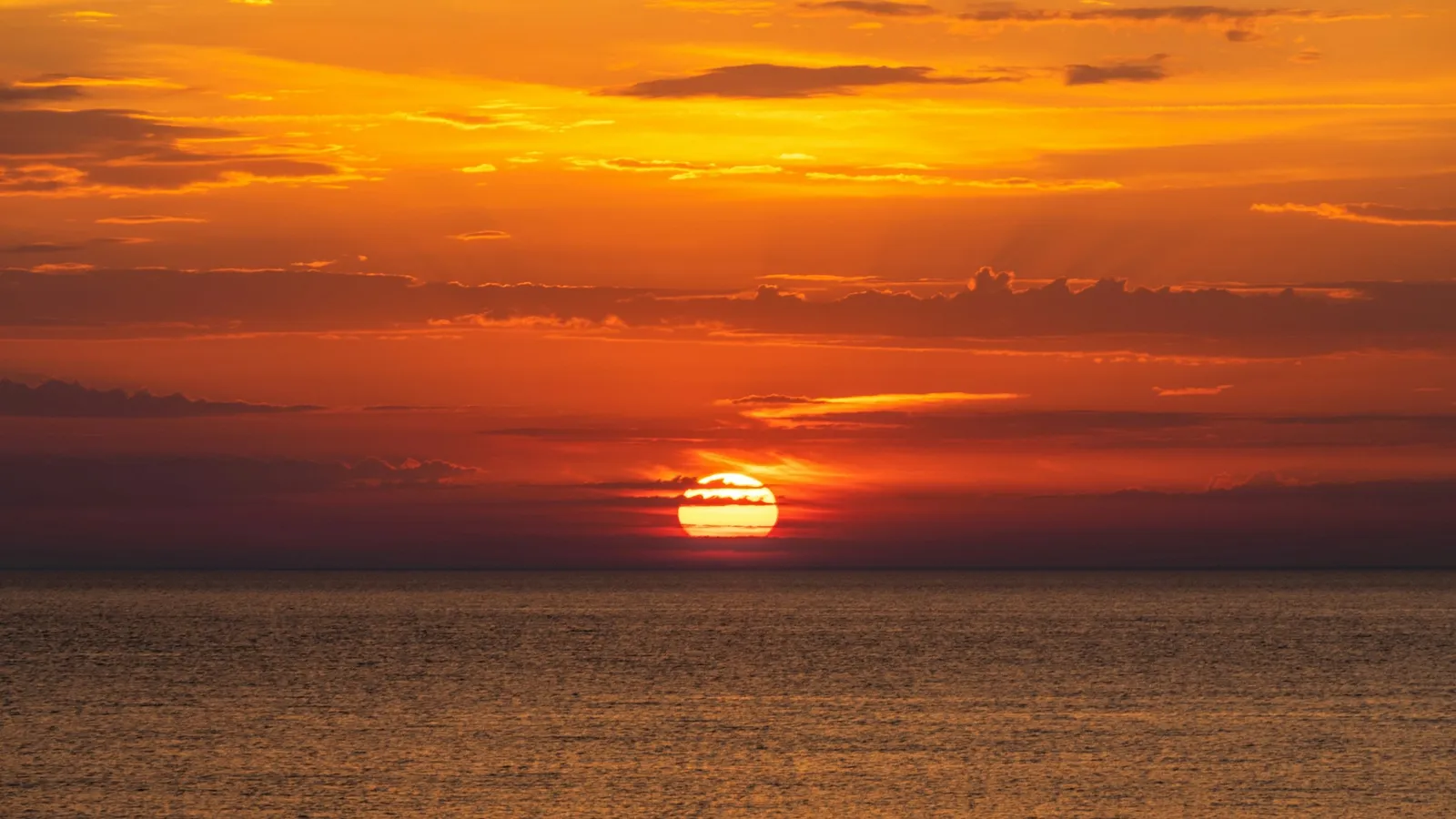
One more surprise: NASA's 1,919 arcseconds is about 32 arcminutes, less than 34. So when the Sun's lower edge seems to touch the horizon, the whole disc is, geometrically, just below it. NCERT also notes that the flattened look of the Sun at sunrise and sunset comes from the same effect.
Which mistakes cost marks?
Blaming scattering for twinkling. Scattering explains the blue sky; twinkling is refraction.
Saying planets don't twinkle because they don't make their own light. The reason is that they are extended sources.
Saying stars appear lower. Refraction makes them appear higher.
Leaving out "changing". Steady bending would shift a star, not make it twinkle. The atmosphere must keep changing.
Our post on scattering of light and the rainbow covers the other half of this chapter, and defects of the human eye covers the first half.
A practice routine
Write the twinkling answer in three numbered steps, then the planet answer in two.
Draw NCERT Figures 10.9 and 10.10 from memory, marking actual and apparent positions.
Redo the worked example for latitude 20°.
On the next clear night, compare a bright star near the horizon with one high overhead, and note which twinkles more.
If bending light is hard to picture, the Fermi Simulation Lab has interactive simulations for ideas that are easier to see than to read.
Tonight, find one planet and one bright star, and watch them side by side for a minute.


