On this page
Two of the most common questions in CBSE Class 10 optics sound similar but have different answers. The sky is blue because of scattering. A rainbow forms because of dispersion and reflection inside raindrops, not scattering. This post explains both with numbers you can check, and the mistakes that mix them up.
What is scattering of light?
When light meets small particles, some of it is sent off in other directions. The NCERT Class 10 chapter The Human Eye and the Colourful World introduces this through the Tyndall effect: a beam of sunlight entering a smoky room or a misty forest becomes visible because the particles scatter it. NCERT adds that the colour of the scattered light depends on particle size. Very fine particles scatter mainly blue light, larger particles scatter longer wavelengths, and large enough particles make the scattered light look white.
The topic is part of CBSE Class 10 Science. It is not listed in the optics unit of the JEE (Main) 2026 syllabus, though the refraction and dispersion behind rainbows are.
Why is the sky blue?
The molecules of air are much smaller than the wavelength of visible light. For scatterers this small, HyperPhysics gives Lord Rayleigh's result: scattered intensity is proportional to 1/λ⁴. Rayleigh published his analysis in 1871 in On the light from the sky, its polarization and colour.
Worked example. Compare blue light at 450 nm with red light at 700 nm.
Ratio of scattered intensity = (700/450)⁴ = (1.556)⁴ ≈ 5.9.
Blue light is scattered almost six times as strongly as red. Light scattered sideways towards your eyes from all over the sky is therefore rich in blue. NCERT adds that if the Earth had no atmosphere there would be no scattering and the sky would look dark, as it does to passengers flying at very high altitudes.
Why are clouds white and sunsets red?
Cloud droplets are much larger than air molecules. HyperPhysics notes that scattering from them is almost independent of wavelength across the visible range, so all colours are scattered about equally and clouds look white or grey. This matches NCERT's point that large particles scatter white light.
At sunrise and sunset, sunlight crosses much more air to reach you. Along that long path most of the blue is scattered out of the direct beam, so the light that arrives directly is mostly the longer wavelengths, and the Sun looks reddish. NCERT lists the reddening of the Sun at sunrise and sunset among the effects of scattering.
How does a rainbow form?
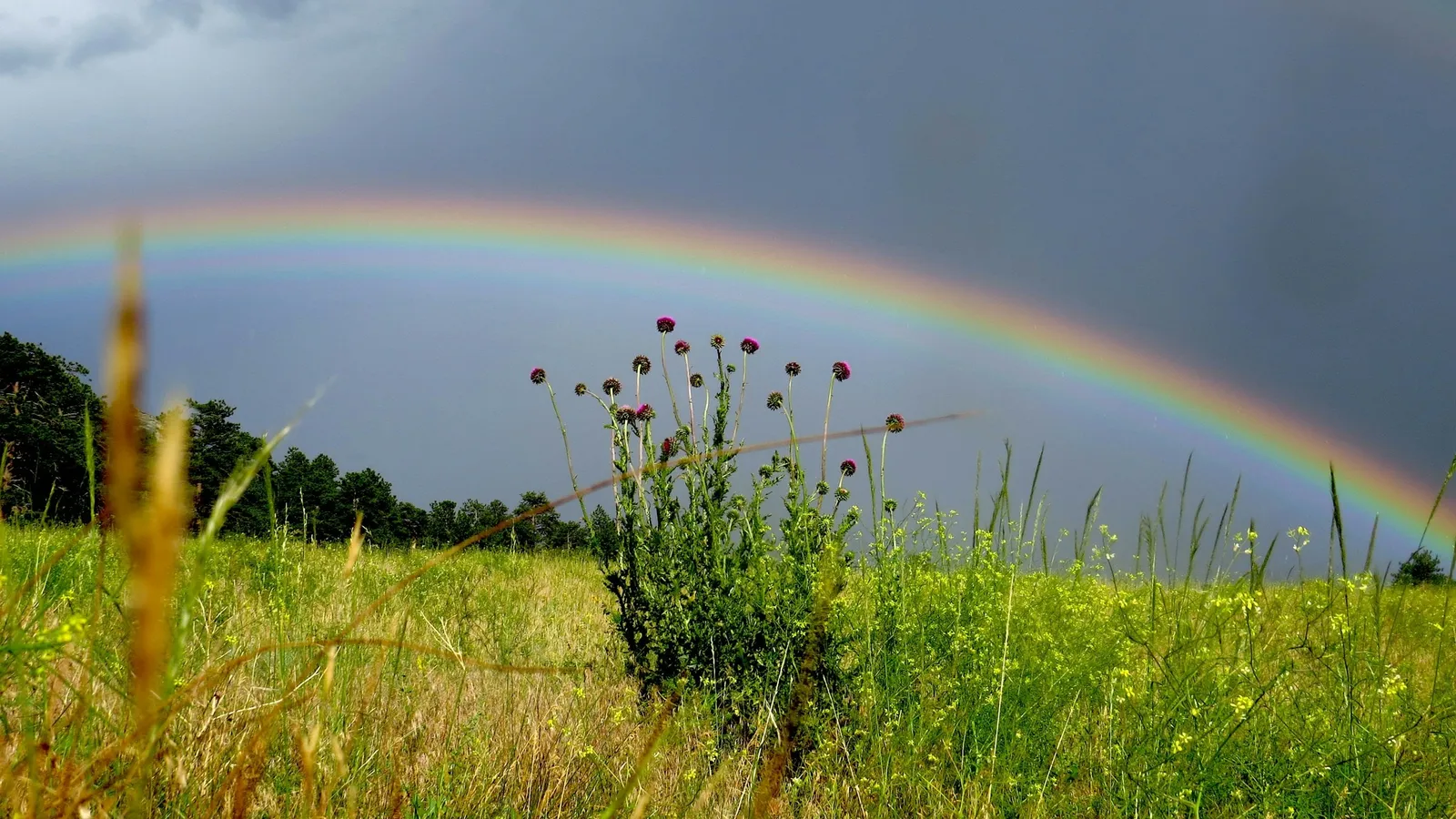
NCERT explains that a rainbow is a natural spectrum caused by dispersion of sunlight by tiny water droplets. Each droplet acts like a small prism: light refracts on entering, reflects once inside, and refracts again as it leaves. Because the refractive index of water is slightly different for each colour, the colours come out at slightly different angles. A rainbow is always formed in the direction opposite to the Sun.
How far from that opposite point should you look? Robert Greenler of the University of Wisconsin-Milwaukee, answering in Scientific American, says to look about 42 degrees from the antisolar point (marked by the shadow of your head) for the primary bow, and about 51 degrees for the fainter secondary bow.
Worked example: where does 42° come from?
Light enters a spherical drop at angle i, refracts to angle r, reflects once and leaves. The total deviation is D = 180° + 2i − 4r. Rays bunch up where D is smallest, and that happens when cos²i = (n² − 1)/3. Take n = 1.33 for water, the value in the NCERT Class 10 table in Light: Reflection and Refraction.
cos²i = (1.33² − 1)/3 = (1.769 − 1)/3 = 0.256, so cos i = 0.506 and i = 59.6°.
sin r = sin 59.6° / 1.33 = 0.862/1.33 = 0.648, so r = 40.4°.
D = 180 + 2(59.6) − 4(40.4) = 180 + 119.2 − 161.6 = 137.5°.
The angle from the antisolar point is 180° − 137.5° = 42.5°.
That matches Greenler's 42°. Violet light has a slightly larger refractive index, which gives a slightly smaller angle, so violet is on the inside of the bow and red on the outside.
Common mistakes and how to avoid them
Saying the rainbow is caused by scattering. It is caused by dispersion, refraction and internal reflection.
Saying the sky is blue because it reflects the sea. The sky is blue over deserts too. It is molecular scattering.
Getting the λ⁴ ratio upside down. Shorter wavelength scatters more, so the ratio is (λ_red/λ_blue)⁴, which is larger than 1.
Looking for a rainbow towards the Sun. Keep the Sun behind you.
C. V. Raman studied a different kind of scattering, where the colour of light changes. Our profile of C. V. Raman and the Raman effect explains the difference.
A practice routine
Explain the blue sky, white clouds and red sunset in one sentence each, naming particle size in each.
Work out the λ⁴ ratio for three pairs of wavelengths.
Repeat the 42° calculation with n = 1.34 and check that the angle shrinks.
Draw the path of one ray through a raindrop, labelling each refraction and the reflection.
If dispersion and refraction are the weak links, the Fermi Concept Library covers every concept in physics, chemistry, biology, mathematics and computing, so you can revise refraction through a prism before returning here.
On the next sunny day, stand with the Sun behind you and spray a fine mist from a hose to find your own 42° bow.