On this page
On 28 February 1928, working in Calcutta, C. V. Raman found that light scattered by a clear substance is not quite the same light that went in. A small part of it comes out with a different wavelength. The Nobel Prize biography of Raman gives that date for the discovery, and Raman and K. S. Krishnan reported it in *Nature* that year as "A New Type of Secondary Radiation".
Two years later Raman received the 1930 Nobel Prize in Physics, unshared, "for his work on the scattering of light and for the discovery of the effect named after him". His affiliation at the time was Calcutta University.
What did Raman discover?
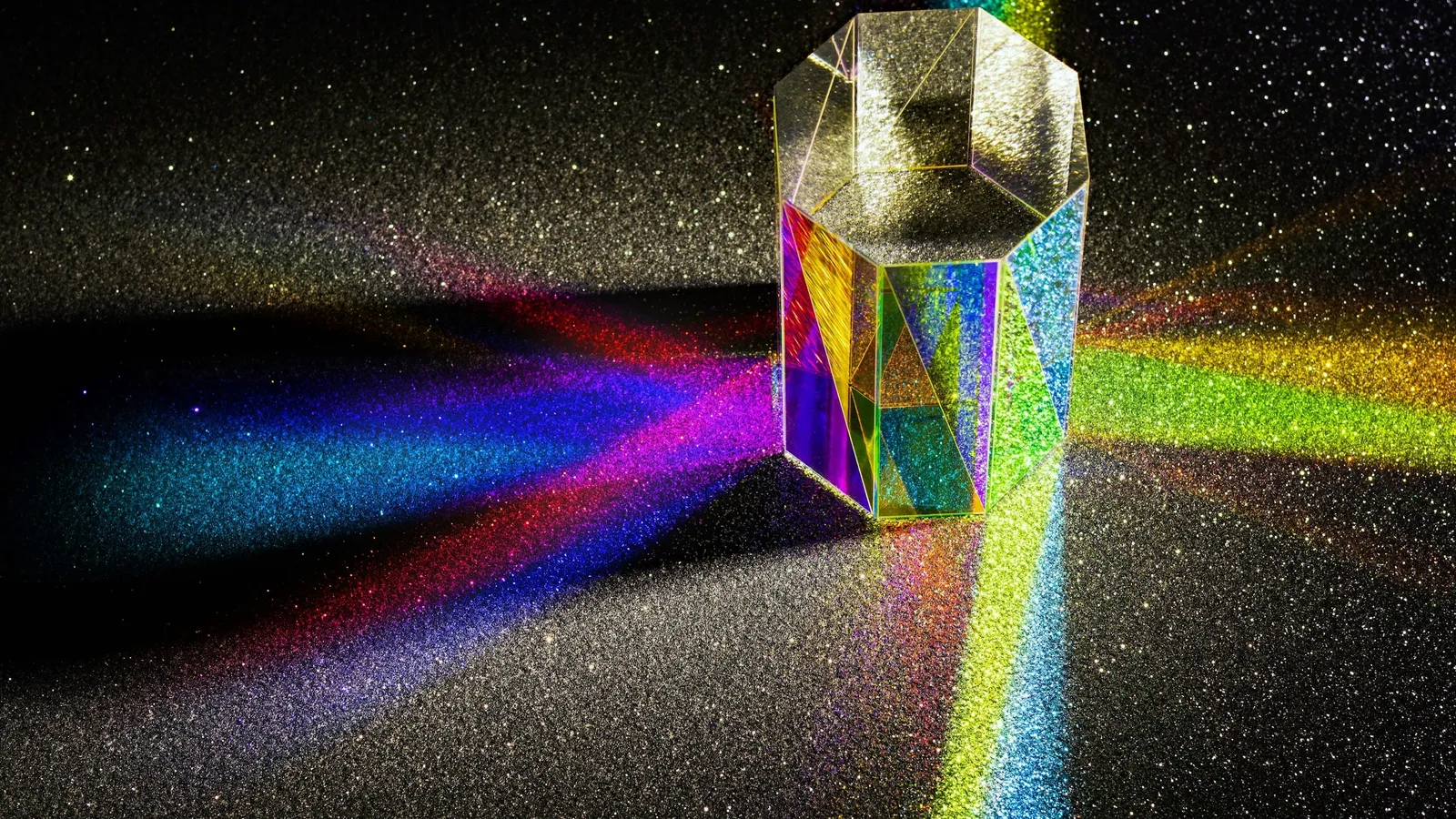
When light meets particles smaller than its wavelength, such as molecules in a gas, it spreads out in different directions. Most of that scattered light keeps its original wavelength. The Nobel Prize summary explains the new part: a small portion of the scattered light acquires other wavelengths, because some of the incoming photons' energy is transferred to a molecule, raising it to a higher energy level. The Government of India's National Science Day explainer (PIB, 2024) puts it the same way: most scattered light is unchanged, and a small part has different wavelengths, which is the Raman effect.
The physics in one worked example
You already have every tool you need from Class 12 modern physics.
A photon's energy is E = hc/λ. Lower energy means longer wavelength.
A molecule can only vibrate with certain fixed amounts of energy. Call one of those steps ΔE.
If the photon hands ΔE to the molecule, the scattered photon leaves with E minus ΔE, so its wavelength gets longer.
Spectroscopists measure these shifts in wavenumbers (1/λ, in cm⁻¹), because energy is proportional to 1/λ and the shift then becomes a simple subtraction. Here is an illustrative example with round numbers:
Incoming light: λ = 500 nm, so 1/λ = 1/(500 × 10⁻⁷ cm) = 20,000 cm⁻¹.
Suppose the molecule's vibration takes up 1,000 cm⁻¹.
Scattered light: 20,000 − 1,000 = 19,000 cm⁻¹, so λ = 1/19,000 cm ≈ 526 nm.
Green-blue light in, slightly greener light out. The photon lost about 5% of its energy (1,000 out of 20,000). The reverse can also happen: a molecule that is already vibrating can give energy to the photon, which then comes out with a shorter wavelength.
Why does India celebrate National Science Day on 28 February?
According to the PIB explainer, the National Council for Science and Technology Communication asked the Government of India in 1986 to designate 28 February as National Science Day, and the first one was celebrated on 28 February 1987. The day commemorates the discovery, which Raman made in the laboratory of the Indian Association for the Cultivation of Science in Kolkata, and each year it carries a theme with science communication activities across the country.
What can a student learn from Raman's path?
The Nobel biography tells a story of steady work on one family of questions. Raman was born in Tiruchirappalli on 7 November 1888, entered Presidency College, Madras, in 1902, and topped his BA in 1904 with the gold medal in physics. Because a science career did not look promising then, he joined the Indian Finance Department in 1907 and did research in his spare time at the Indian Association for the Cultivation of Science. He took the Palit Chair of Physics at Calcutta University in 1917. In 1922 he published work on the "Molecular Diffraction of Light", the first of a series of investigations with collaborators that led to the 1928 discovery. Along the way he wrote on why the sea looks blue, in a 1921 *Nature* note titled "The Colour of the Sea".
Three habits stand out, and you can copy them this term:
Keep one question alive for months. Raman's published work on light scattering ran from at least 1921 to 1928. Pick one idea from your syllabus that puzzles you and keep a page of notes on it.
Measure, do not just admire. Write down what you would expect before you check, as in the worked example above.
Use the time you have. Raman did serious research while holding a government job. Twenty focused minutes a day on a question you care about adds up.
If photon energy and wavelength still feel slippery, the Fermi Concept Library has a lesson for each concept in physics and chemistry, and the Fermi Simulation Lab has interactive simulations for ideas that are easier to see than to read.
For another Indian scientist whose habits are worth studying, read our piece on Srinivasa Ramanujan's notebooks and practice. Parents can find ideas in encouraging curiosity at home.