

On this page
Play the same pipe organ in a cold hall in January and again on a hot afternoon in May, and it will not sound the same. Nobody retuned the pipes; the air inside them changed. Here is the physics, a worked example, and the traps that cost marks in JEE Main and board exams.
Why does temperature change an organ pipe's frequency?
An organ pipe sounds when the air column inside it forms a standing wave. For a pipe open at both ends the fundamental frequency is v/2L, and for a pipe closed at one end it is v/4L, where v is the speed of sound and L is the length, as set out in the NCERT Class 11 physics chapter on waves.
The same chapter gives the speed of sound in a gas as v = √(γP/ρ), Newton's formula with Laplace's correction. For an ideal gas, P/ρ = RT/M, so v = √(γRT/M). Pressure drops out. The speed of sound in air is proportional to the square root of the absolute temperature, measured in kelvin.
NCERT's table puts the speed of sound in air at 331 m/s at 0 °C and 343 m/s at 20 °C (NCERT, Table 14.1). Humidity also nudges the speed a little; we cover that in how temperature and humidity change the speed of sound.
Doesn't the pipe get longer when it warms up?
It does, but barely. Johan Liljencrants, writing on sound speed and pipe tuning, puts the expansion of tin, lead and zinc at 20 to 30 parts per million per °C. He estimates that effect at some 60 times smaller than the change in sound speed, and in the opposite direction, so for practical purposes the length stays fixed.
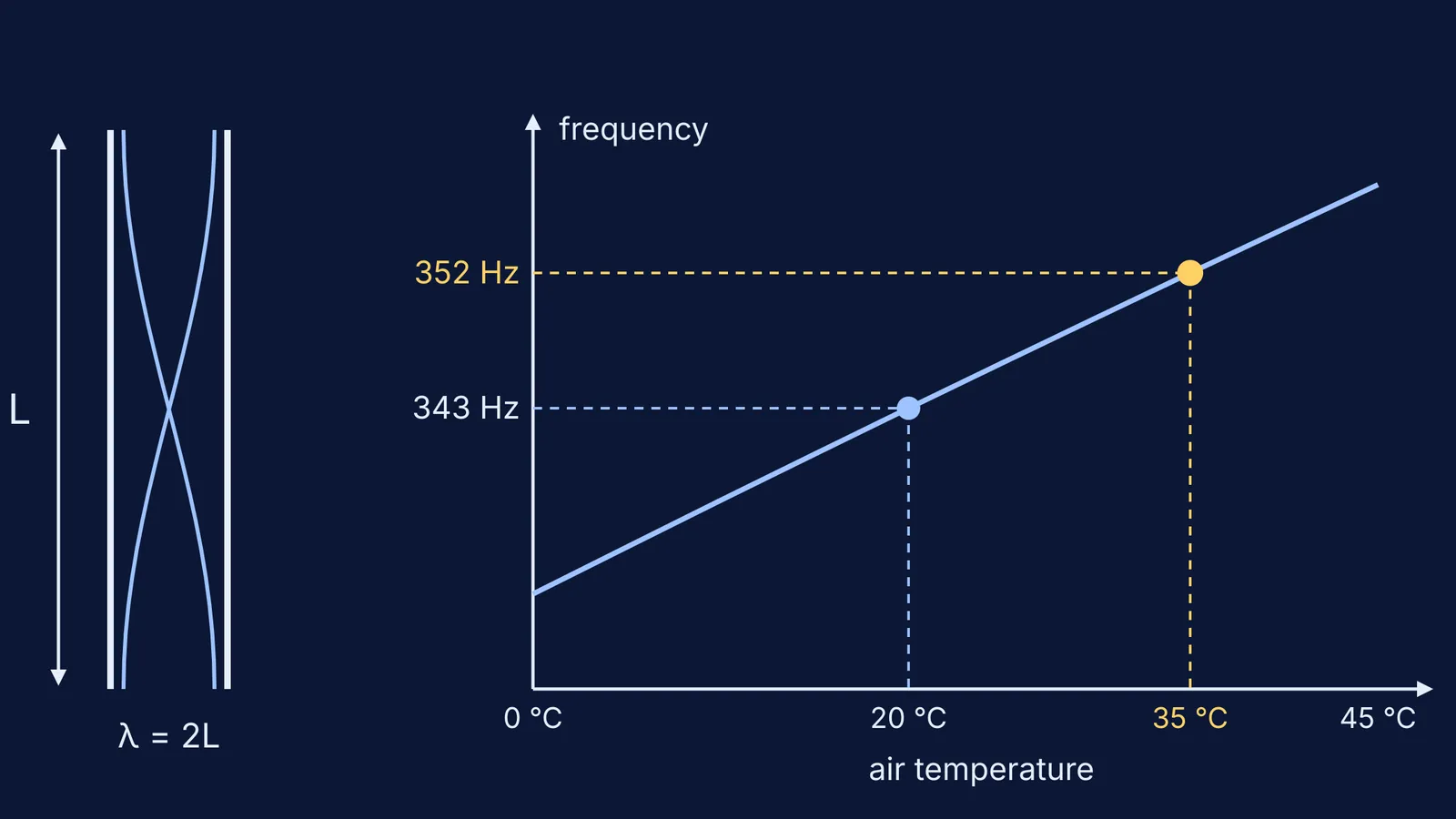
So the pipe's length fixes the wavelength: λ = 2L for an open pipe's fundamental. The air fixes the speed. Since f = v/λ, a faster v with the same λ means a higher f.
How much does an organ go sharp per degree?
Musicians measure small pitch changes in cents: an octave is 1200 cents, and a semitone is 100 cents (Liljencrants).
In dry air, the pitch of flue pipes rises about 3 cents per °C, a quarter semitone (25 cents) for every 8 °C, according to Liljencrants. Reed pipes usually drift less: typically maybe 70% as much in his estimate, though anywhere from 0 to 100% depending on design, because the reed's materials barely respond to temperature but the air column it works with does.
The effect is sensitive enough that the body heat of the organ tuner can affect the tuning, notes the Wikipedia article on pipe organ tuning.
Worked example: one open pipe at 20 °C and 35 °C
Take an open organ pipe 0.50 m long, and use NCERT's 343 m/s at 20 °C from the waves chapter.
Cool hall, 20 °C (293 K): f = v/2L = 343 / (2 × 0.50) = 343 Hz.
Warm day, 35 °C (308 K): v = 343 × √(308/293) = 343 × 1.0253 ≈ 351.7 m/s.
Same pipe, same L: f = 351.7 / 1.00 ≈ 351.7 Hz. The pitch rose by about 8.7 Hz, or 2.5%.
In cents: 1200 × log₂(351.7/343) ≈ 43 cents, close to Liljencrants's rule of 3 cents per °C × 15 °C = 45 cents.
A 10 °C winter morning (283 K) goes the other way: 343 × √(283/293) ≈ 337.1 Hz, about 30 cents flat.
For small changes there is a shortcut: Δf/f ≈ ΔT/(2T). Here 15/(2 × 293) ≈ 2.6%, near the exact 2.5%. A closed pipe shifts by exactly the same fraction, because v/4L and v/2L both scale with v.
Which mistakes cost marks in pipe-temperature problems?
Most lost marks come from set-up errors. Check these against the NCERT waves chapter:
Celsius inside the square root. √(35/20) suggests a 32% jump in speed; convert to kelvin first.
Changing L or λ when only the air changed. The standing-wave pattern stays the same.
Mixing up open and closed pipes. The fractional shift is the same, but the frequencies are not; see simulating open and closed organ pipe harmonics.
Treating a string like a pipe. A string's wave speed is √(T/μ), set by tension, not by the air.
Changing the air column instead of the air. Adding water changes L, which is a different problem: how a closed pipe partly filled with water changes frequency.
If the ratio set-up keeps going wrong, the Fermi Problem Library has worked problems with a step-by-step solver that explains the reasoning rather than printing an answer. If the √T step itself feels shaky, the Fermi Concept Library gives each physics concept its own lesson and its place in the map.
Try it yourself: pick a pipe length, look up your city's typical summer and winter temperatures, and redo steps 1 to 4.


