

On this page
If you have ever listened to a church organ or blown across the top of a glass bottle, you have heard acoustic resonance in action. The physics of organ pipes is a classic study of how air columns trap sound waves to create distinct musical notes. Whether a pipe is open to the atmosphere at both ends or sealed at one end fundamentally changes the wavelengths that can fit inside it. To predict the exact frequencies an instrument will play, you need to understand how the boundaries of the pipe force the air into specific standing wave patterns.
What are the boundary conditions of an open pipe?
When sound waves travel down a tube and reflect off the ends, they interfere with one another to form a standing wave. For a wave to sustain itself, it must perfectly fit the physical boundaries of the pipe.
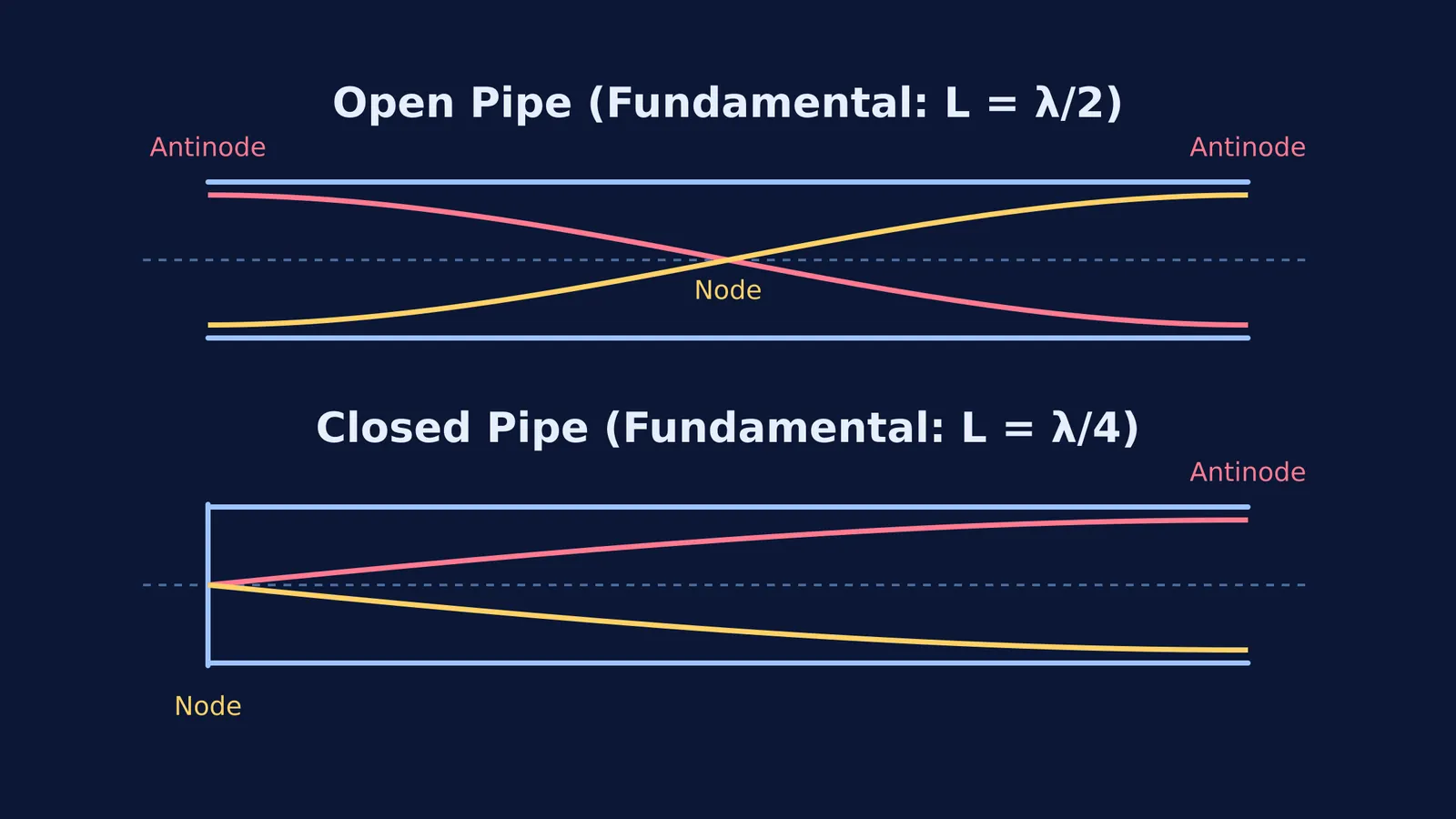
An open pipe is open at both ends. Because the air is free to move, these points always become displacement antinodes—areas of maximum air movement. The simplest wave that can fit inside an open pipe (the fundamental) has an antinode at each end and a single node exactly in the middle.
Because an antinode-to-antinode distance equals exactly half a wavelength, the length of the pipe (L) is equal to half the wavelength (λ/2). We can find the fundamental frequency using the speed of sound (v ≈ 343 m/s) with the formula f = v / 2L, a relationship detailed by Boston University physics resources. If you need a refresher on how the air particles oscillate, our guide on displacement and pressure waves in sound breaks down the 90-degree phase shift between them.
Open pipes can support any standing wave that has antinodes at both ends. This allows them to produce all integer harmonics—the fundamental (f), the second harmonic (2f), the third harmonic (3f), and so on.
Why does a closed pipe produce only odd harmonics?
A closed pipe is sealed at one end and open at the other. The rigid boundary at the closed end completely stops the air from moving, forcing a displacement node. The open end, as always, acts as a displacement antinode.
The simplest standing wave that satisfies these two mismatched boundaries is a quarter of a wavelength (λ/4). This changes the mathematics: the fundamental frequency of a closed pipe becomes f = v / 4L.
This boundary mismatch also restricts which harmonics can form. An even harmonic (like 2f or 4f) would require either two nodes or two antinodes at the ends, which is physically impossible if one end is sealed and the other is open. Therefore, a closed pipe can only produce odd harmonics (1f, 3f, 5f). The lack of even harmonics gives closed-pipe instruments like the clarinet their distinct acoustic tone.
If you are having trouble visualizing how these waves form and reflect, the Fermi Simulation Lab has interactive simulations for the ideas that are easier to see than to read. You can also explore how to learn waves with simulations to cement your understanding of interference.
How do you compare pipes of the same length?
When an exam question asks you to compare an open and a closed pipe of the exact same physical length, the fundamental frequencies reveal a strict ratio.
Because the closed pipe's fundamental wavelength (4L) is exactly twice as long as the open pipe's fundamental wavelength (2L), its frequency is exactly half. As explained by HyperPhysics, this means that a closed pipe will always sound exactly one full octave lower than an open pipe of the same length.
This simple rule is a staple of competitive exam questions. If you are preparing for physics entrances, you can practice applying these rules by calculating standing waves in strings and pipes.
Problem-solving checklist for exam questions
When solving acoustic resonance problems, run through this quick checklist before calculating:
Check the pipe ends: Is it open at both ends (using f = v / 2L) or closed at one end (using f = v / 4L)?
Check the frequency ratio: Remember that a closed pipe sounds an octave lower (half the frequency) than an identical open pipe.
Identify the harmonic number: If the problem asks for the third harmonic, multiply the fundamental by 3. If it asks for the second overtone of a closed pipe, remember to skip the even numbers—the first overtone is the 3rd harmonic, and the second overtone is the 5th harmonic.
Apply the end correction: In real-world physics, the antinode does not stop exactly at the rim of the pipe. As HyperPhysics details, if the problem provides the radius (r) of the pipe, add 1.2r to the physical length of an open pipe (0.6r at each end), or add 0.6r for a closed pipe, to find the effective acoustic length.


