On this page
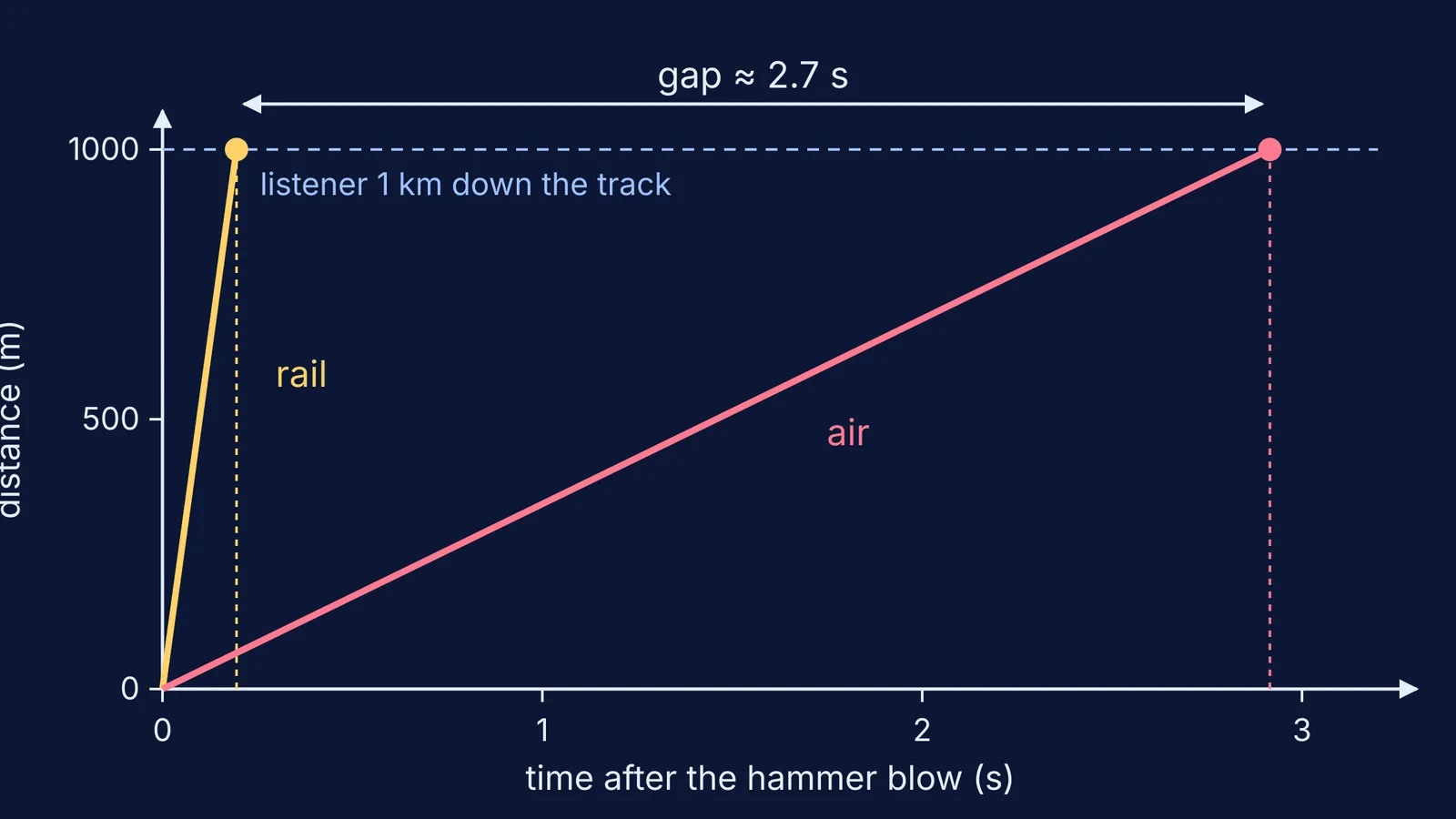
Picture a long, empty stretch of track. A worker strikes the rail with a hammer one kilometre away. If you could hear both paths, you would hear the blow twice: a ring through the steel almost at once, then the familiar bang through the air about 2.7 seconds later. The rail sound wins because sound moves through iron roughly fifteen times faster than through air (5,130 m/s against 343 m/s in the HyperPhysics table of sound speeds).
Why does sound travel faster in a steel rail than in air?
Sound is a pressure wave: each bit of the material pushes on the next. How fast that push travels depends on two things: how stiffly the material resists being squeezed or stretched, and how much mass has to be moved. For sound in a solid, the speed is v = √(Y/ρ), where Y is Young's modulus and ρ is the density, as the OpenStax University Physics chapter on the speed of sound/Book:_University_Physics_I_-_Mechanics_Sound_Oscillations_and_Waves_(OpenStax)/17:_Sound/17.03:_Speed_of_Sound) sets out.
Steel is far denser than air, which on its own would slow sound down. But steel is also enormously stiffer, and the stiffness wins by a wide margin. For the full comparison across solids, liquids and gases, see our explainer on why sound travels fastest in solids.
Here are the measured values:
The speed of sound in air at 20 °C is 343 m/s (HyperPhysics table of sound speeds).
The speed of sound in iron is 5,130 m/s (HyperPhysics).
The speed of a longitudinal wave in bulk steel is 5,960 m/s (OpenStax/Book:_University_Physics_I_-_Mechanics_Sound_Oscillations_and_Waves_(OpenStax)/17:_Sound/17.03:_Speed_of_Sound)).
Divide and you get 5,130 ÷ 343 ≈ 15 and 5,960 ÷ 343 ≈ 17. So sound in a rail travels roughly 15 to 17 times faster than in air; the exact figure depends on the metal and the kind of wave. In an exam, use whatever value the question gives you.
How big is the gap between the two sounds?
Use time = distance ÷ speed for each path, with 343 m/s for air and 5,130 m/s for the rail (HyperPhysics). For a listener 1,000 m from the hammer:
Through the rail: 1,000 ÷ 5,130 ≈ 0.195 s.
Through the air: 1,000 ÷ 343 ≈ 2.915 s.
Gap: 2.915 − 0.195 ≈ 2.72 s.
With these speeds, every second of gap means about 368 m of track. That is close to, but not the same as, the 343 m per second you use for counting the seconds between lightning and thunder. Light from lightning arrives practically instantly; sound in steel still takes some time, so each second of gap covers a little more track.
How do you find the rail length from the time gap?
This is the version that turns up in textbook exercises: "A man hears two sounds 2 s apart from a hammer blow on a rail. Find the length." Work it in four steps:
Write both times: t(air) = L ÷ v(air) and t(rail) = L ÷ v(rail).
The air sound is the late one, so subtract: Δt = L ÷ v(air) − L ÷ v(rail).
Take L out as a common factor: L = Δt × v(air) × v(rail) ÷ (v(rail) − v(air)).
Put in the HyperPhysics speeds: L = 2.0 × 343 × 5,130 ÷ (5,130 − 343) = 2.0 × 1,759,590 ÷ 4,787 ≈ 735 m.
Check it the other way: 735 ÷ 343 ≈ 2.143 s and 735 ÷ 5,130 ≈ 0.143 s, so the gap is 2.000 s. If your answer doesn't survive this check, a sign or a fraction has slipped.
If you keep subtracting the times the wrong way round or lose L while rearranging, the Fermi Problem Library has worked problems with a step-by-step solver that explains the reasoning rather than printing an answer. For a longer derivation of the rod formula itself, read speed of sound in a solid rod: why steel beats air.
Can you try this at home safely?
Never put your ear to a railway track. Trains are quieter and faster than they seem, and a working line is no place for an experiment.
You can hear the same physics on a smaller scale:
Press one ear to one end of a long wooden or metal table, or a long metal railing in a park.
Ask a friend to tap the far end lightly with a coin.
Listen, then lift your head and listen to the same tap through the air.
The tap through the solid usually sounds crisper and louder. You won't hear two separate sounds, though: across 2 m of table the air path takes only about 6 ms (2 ÷ 343, using the HyperPhysics air speed), far too short for your ear to split into two events. The double bang needs a much longer run of continuous metal, like a rail.
If Young's modulus or longitudinal waves still feel shaky, the Fermi Concept Library gives each concept in physics its own lesson and shows where it sits in the map. Try the 2-second rail problem again tomorrow without notes; if you get 735 m, the method is yours.