

On this page
Have you ever pressed your ear against a railway track to hear an approaching train? You would hear the rumble through the metal long before the sound reaches you through the air. Sound is a mechanical wave—it needs a medium to travel through, and different materials carry it at drastically different speeds.
In air at room temperature (20 °C), sound travels at 343 m/s. But in a thin steel rod, it races along at roughly 5,000 m/s. To understand why sound in steel is about 15 times faster than in air, we have to look at the formula for the speed of a longitudinal wave in a solid rod.
Why is the speed of longitudinal wave in solid rod dependent on Young's modulus?
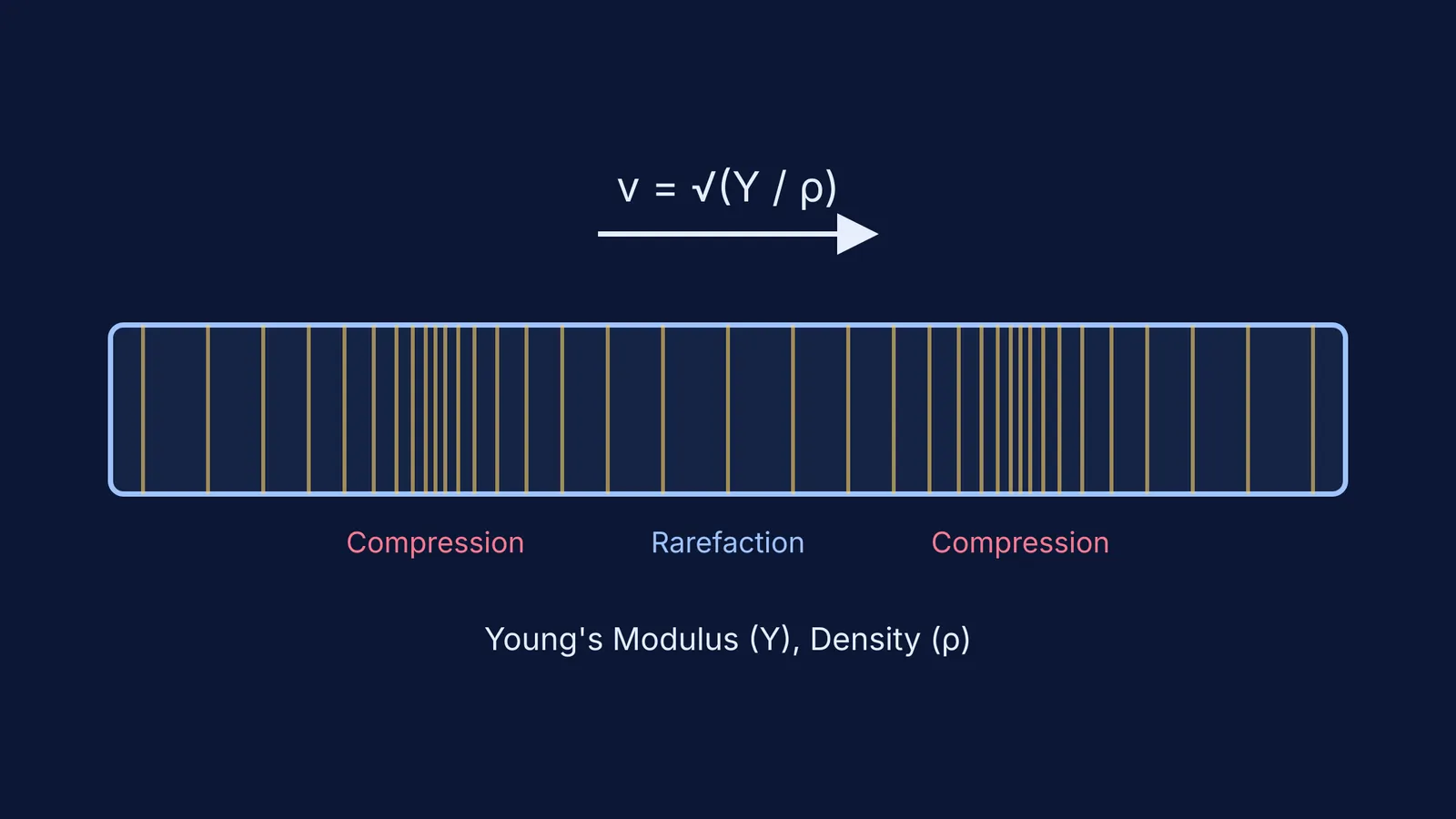
Sound waves are longitudinal. As the wave passes through a medium, it compresses the particles together and then pulls them apart, creating alternating regions of compression and rarefaction. For the wave to propagate, the material must resist this deformation and snap back into place.
The speed of sound v in a thin solid rod is given by:
v = √(Y / ρ)
Two competing properties battle to determine this speed:
Young's modulus (Y): This measures the stiffness of the solid. A stiffer material snaps back faster, propelling the wave forward at a higher speed.
Density (ρ): This measures the inertia of the material. Heavier atoms are harder to accelerate, so a higher density slows the wave down.
If you struggle to picture how compression waves move through a lattice of atoms, the Fermi Simulation Lab has interactive simulations for the ideas that are easier to see than to read.
Why is sound in steel 15 times faster than in air?
You might think that because steel is heavy, sound would struggle to move through it. But the metal's immense stiffness easily overpowers its density.
Let's plug the typical values for steel into our formula:
Young's modulus of steel (Y) is about 200 × 10⁹ N/m² (or 200 GPa).
Density of steel (ρ) is about 7,850 kg/m³.
Calculating the speed gives:
v = √(200 × 10⁹ / 7850) ≈ 5,047 m/s
Compared to the 343 m/s speed of sound in air, sound in a thin steel rod is roughly 14.7 times faster. (Note that in a bulky block of steel, where the sides cannot expand slightly to accommodate the compression, sound travels even faster—at nearly 5,940 m/s).
How do you solve solid rod wave problems for JEE Main and NEET-UG?
Problems asking you to calculate or compare the speed of sound in solids are common in competitive exams. When dealing with these questions, keep three things in mind:
Check your units: Young's modulus must be in N/m² (Pascals) and density in kg/m³. A common trap is giving density in g/cm³; you must multiply by 1,000 to convert it to kg/m³.
Phase differences: Remember that displacement and pressure are out of step. You can read our guide on displacement and pressure waves in sound to see why they have a 90° phase shift.
Other uses of Young's modulus: The same Y that dictates wave speed also governs how much a material stretches under force, such as a rod stretching under its own weight.
If you keep getting stuck on the calculations or unit conversions, the Fermi Problem Library has worked problems with a step-by-step solver that explains the reasoning rather than printing an answer.


