

On this page
When you study wave mechanics for exams like the JEE or NEET, you quickly learn that sound waves need a medium to propagate. Unlike light, which can travel through the vacuum of space, sound relies on particles physically bumping into one another. But a common question always arises: why does sound travel fastest in solids?
If you picture a solid block of steel, it is heavy, dense and rigid. Common sense might suggest that a dense material would be harder to move, acting like a thick wall that slows the wave down. However, the exact opposite happens. To understand why, we have to look past the macroscopic weight of the material and focus on the microscopic atomic bonds. Sound is a mechanical wave that passes kinetic energy from one particle to the next. In a gas, particles are far apart and collide randomly; in a solid, atoms are locked in a tight, highly ordered lattice.
How do we calculate the speed of sound?
The speed of a mechanical wave in any medium depends on a constant tug-of-war between two physical properties: elasticity (how strongly the material resists deformation and snaps back) and inertia (how heavy and sluggish the individual particles are). The general mathematical formula used in physics to describe this relationship is v = √(E/ρ), where E is the elastic property and ρ (rho) represents the density.
For a solid medium, the relevant elastic property is Young's modulus, giving the specific formula v = √(Y/ρ) (which you might recall from calculating a rod stretching under its own weight). For a liquid, it is the bulk modulus. For gases, the calculation involves the pressure and the adiabatic index of the gas. The relationship is straightforward: the stiffer the material (a higher numerator), the faster the wave propagates. Conversely, the denser the material (a higher denominator), the slower the wave travels.
What is the density paradox?
This formula brings us to a frequent point of confusion for students, often called the density paradox. According to the OpenStax University Physics textbook, density on its own actually *slows sound down*. Because denser materials have more mass per unit volume, they possess more inertia. It takes more force and more time to accelerate heavier particles.
If you compare two gases at the exact same temperature, sound travels faster in the lighter one than the heavier one. For example, your voice sounds high-pitched if you inhale helium because sound travels faster in light helium than it does in heavier atmospheric air. We explore a similar mass effect when finding the average molar mass of a gas mixture.
So why do dense solids transmit sound faster than light gases? The secret is that as you move from a gas to a liquid and then to a solid, the elasticity increases by a massive amount. The jump in stiffness completely overpowers the increase in density.
Why does sound travel fastest in solids?
Sound travels fastest in solids because they have an incredibly high elastic modulus. Their constituent atoms are bound tightly together by strong intermolecular forces, acting like stiff microscopic springs. When a sound wave compresses one atom in a solid lattice, that atom instantly pulls on its neighbour. There is virtually no delay.
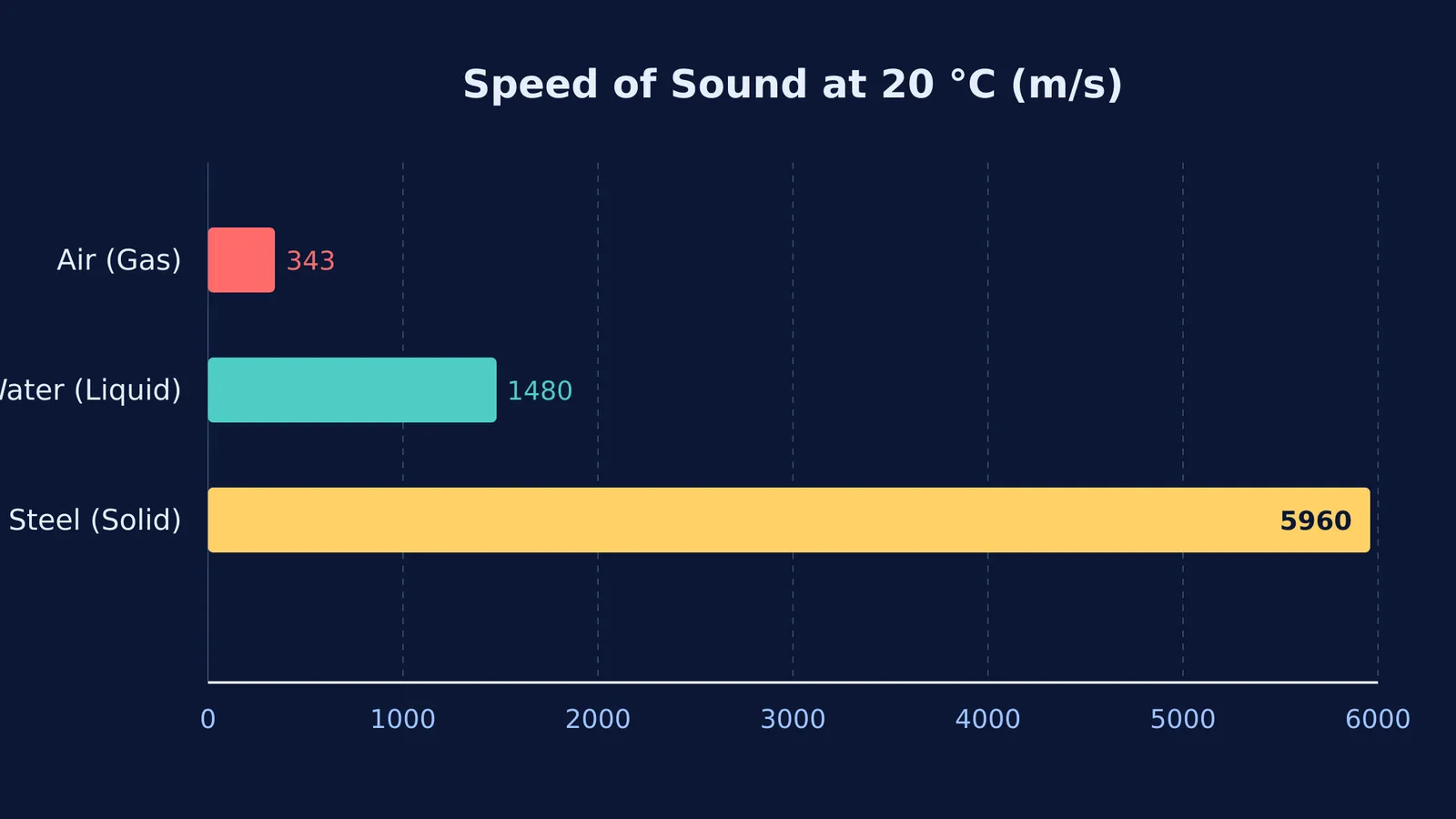
We can see the final result in the numbers from OpenStax University Physics. At a room temperature of 20 °C, the speed of sound in air is 343 m/s. In liquid water, which is much less compressible than air, the sound speeds up to 1480 m/s. In structural steel, the extreme stiffness of the metallic bonds rockets the speed to a staggering 5960 m/s. (These numbers apply to longitudinal displacement and pressure waves in sound; transverse waves travel differently, and only solids can support them).
If you want to review the elasticity of different materials, the Fermi Concept Library holds every concept in physics, chemistry, biology, mathematics and computing, each with its own lesson and its place in the map. Tracing how a formula connects to physical properties visually can clear up this density paradox instantly.
How can you predict relative sound speeds?
If you face a multiple-choice question in a competitive exam asking you to rank the speed of sound across several different media, you do not need to memorize a table of values. Instead, use this reliable three-step checklist:
Check the phase first: Always apply the rule Solid > Liquid > Gas. The immense jump in elasticity between states of matter almost always dictates the result. A dense solid will beat a light gas every time.
Check the density (same phase): If the materials are in the same phase (like two gases or two liquids), the lighter, less dense one wins. Sound travels faster in hydrogen gas than it does in oxygen gas.
Check the temperature (for gases): Hotter gas molecules move faster and collide much more frequently. Because they are already moving rapidly, sound travels faster in warm air than it does in freezing air.
By looking at the strength of the atomic bonds rather than just the weight of the material, you will consistently arrive at the correct answer.


