On this page
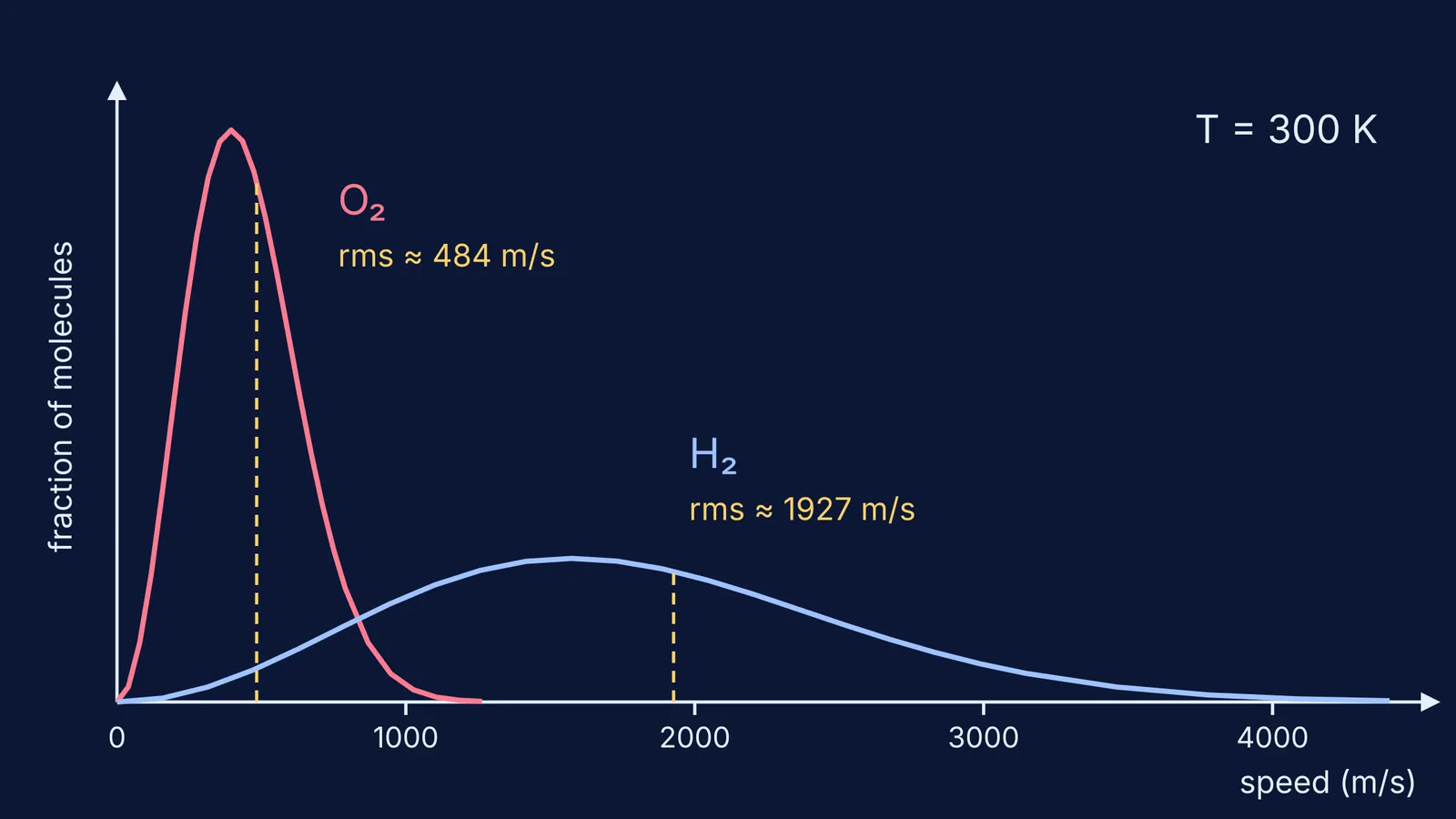
Put hydrogen and oxygen in two flasks at the same temperature and ask which molecules move faster. The answer is hydrogen, by a factor of about four. This is a standard Class 11 kinetic theory question. Once you see why the factor is four, you can solve it in one line without touching the gas constant.
Why does hydrogen move faster than oxygen at the same temperature?
Temperature fixes the average kinetic energy of a gas molecule, whatever the gas. OpenStax University Physics, Volume 2 states that the average kinetic energy of a molecule is directly proportional to its absolute temperature and is independent of the type of molecule.
So at the same temperature, an H₂ molecule and an O₂ molecule carry the same average ½mv². The oxygen molecule is much heavier. To have the same kinetic energy, the lighter hydrogen molecule has to move faster.
The root-mean-square speed is v_rms = √(3RT/M), where R is the gas constant, T is the absolute temperature and M is the molar mass in kg/mol (OpenStax). Because M sits under a square root in the denominator, v_rms scales as 1/√M.
How do you compare the rms speed of hydrogen and oxygen?
Write the formula for each gas and divide. R and T are the same for both, so they cancel. With rounded molar masses of 2 g/mol for H₂ and 32 g/mol for O₂ (CIAAW atomic weights):
v(H₂) / v(O₂) = √(M(O₂) / M(H₂)) = √(32 / 2) = √16 = 4
Oxygen is 16 times heavier, and speed depends on the square root of mass, so hydrogen is 4 times faster.
For the precise figure, use the abridged standard atomic weights from IUPAC's Commission on Isotopic Abundances and Atomic Weights: 1.0080 for hydrogen and 15.999 for oxygen. That makes M(H₂) = 2.016 g/mol and M(O₂) = 31.998 g/mol, a mass ratio of 15.87 and a speed ratio of 3.98. Textbooks such as OpenStax Chemistry 2e use the rounded value of 4.
Worked example: what are the actual speeds at 300 K?
Here is the calculation at 300 K (27 °C), using R = 8.314 J mol⁻¹ K⁻¹ from NIST's CODATA value of the molar gas constant.
Convert molar masses to kg/mol: H₂ = 0.002016 kg/mol, O₂ = 0.031998 kg/mol.
Find 3RT once: 3 × 8.314 × 300 = 7,483 J/mol.
Hydrogen: 7,483 / 0.002016 = 3.71 × 10⁶ m²/s², so v_rms ≈ 1,927 m/s.
Oxygen: 7,483 / 0.031998 = 2.34 × 10⁵ m²/s², so v_rms ≈ 484 m/s.
Check the ratio: 1,927 / 484 ≈ 3.98, which matches the shortcut.
As a sanity check, OpenStax works out the rms speed of nitrogen at 293 K as 511 m/s (OpenStax). Nitrogen (28 g/mol) is a little lighter than oxygen, and 293 K is a little cooler than 300 K, so a value just above oxygen's 484 m/s is what you should expect.
For a full chapter recap of rms speed, degrees of freedom and specific heats, see our guide to the kinetic theory of gases.
What mistakes cost marks on this question?
Most slips here come from units and labels, not the physics. In v_rms = √(3RT/M), OpenStax takes M in kg/mol and T as absolute temperature. Check these:
Molar mass in g/mol. Putting 2 instead of 0.002 into √(3RT/M) gives a speed too small by a factor of √1000, about 31.6.
Temperature in °C. The formula needs kelvin. 27 °C is 300 K.
Atoms instead of molecules. Hydrogen gas is H₂ (2 g/mol), not H (1 g/mol). Using 1 and 32 gives a wrong ratio of about 5.7.
Speed versus energy. At the same temperature, the two gases have the same average kinetic energy. Only the speeds differ.
Which speed? Average, rms and most probable speeds all scale as √(T/M), so the hydrogen-to-oxygen ratio is 4 for each of them.
A common twist turns the question around: at what temperature would oxygen have the same rms speed as hydrogen at 300 K? Equal speeds need equal T/M, so T(O₂) = 16 × 300 = 4,800 K.
If you get the right formula but the wrong number, the Fermi Problem Library has worked problems with a step-by-step solver that explains the reasoning, so you can see where the units went wrong.
Where does the 1/√M rule show up next?
The same square-root law appears in Graham's law. OpenStax Chemistry 2e states that the rate of effusion of a gas is inversely proportional to the square root of its molar mass, and uses exactly this pair: hydrogen effuses four times as rapidly as oxygen. Practise it with our Graham's law numericals on rates and molar mass.
It also explains why light gases leak away from small bodies in space. Our post on why the Moon has no atmosphere compares rms speed with escape velocity.
Each gas has a spread of speeds, not one speed. If that spread is hard to picture from the formula, the Fermi Simulation Lab has interactive simulations for ideas that are easier to see than to read.