

On this page
Graham's law questions give volumes, times or mixtures, but they all use one ratio and one definition of rate. Here is each type, worked with numbers you can check.
What does Graham's law of effusion say?
Effusion is the escape of gas molecules through a very small hole into an empty space, while diffusion is the gradual mixing of gases, as defined in this LibreTexts chapter on Graham's laws/02:_Properties_of_Gases/2.09:_Graham's_Laws_of_Diffusion_and_Effusion).
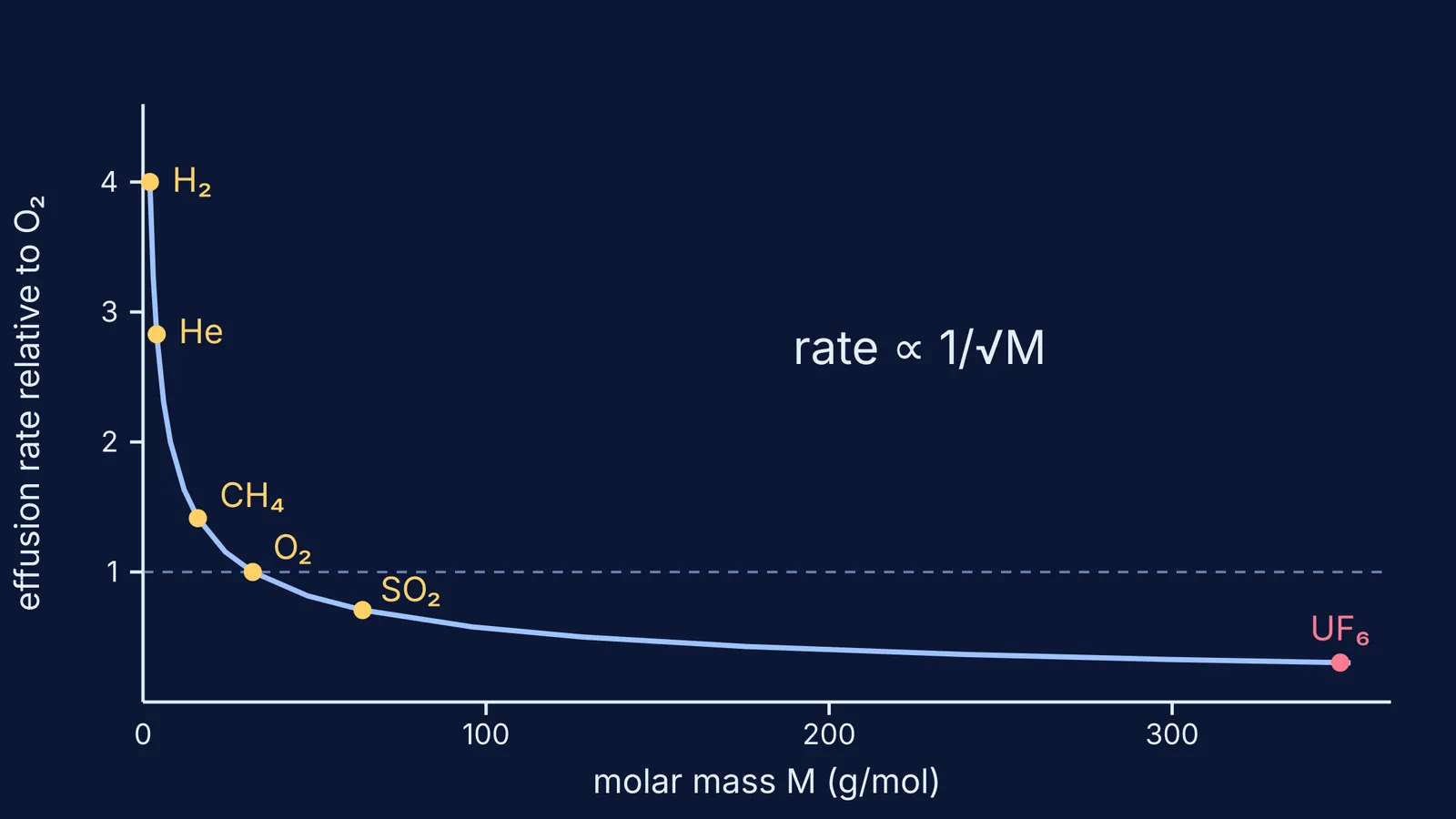
Graham's law: the rate of effusion of a gas is inversely proportional to the square root of its molar mass (OpenStax Chemistry 2e, section 9.4).
At the same temperature and pressure, rate A / rate B = √(M_B / M_A). The kinetic-theory expression in Richard Fitzpatrick's notes on molecular effusion shows the number of molecules escaping per second is proportional to the pressure and to 1/√m.
How do you handle rates by volume, moles or time?
Rate means amount divided by time, where the amount is a volume (at the same conditions) or moles, the same kind for both gases. For a fixed amount, the time taken is inversely proportional to the rate, a point OpenStax makes for diffusion.
Worked example 1 (equal amounts). 100 mL of O2 effuses in 60 s. How long does 100 mL of H2 take under the same conditions?
rate H2 / rate O2 = √(32 / 2) = √16 = 4.
Same volume, so time is inversely proportional to rate: t(H2) = 60 / 4 = 15 s.
Worked example 2 (moles). 0.50 mol of SO2 (M = 64) effuses in 60 s. How many moles of O2 effuse through the same hole in 60 s?
rate O2 / rate SO2 = √(64 / 32) = √2 = 1.414.
Same time, so moles scale with rate: n(O2) = 0.50 × 1.414 = 0.71 mol.
How do you find molar mass from effusion data?
Square both sides of Graham's law: M_unknown = M_known × (rate known / rate unknown)². OpenStax's own example finds that a gas effusing 1.66 times faster than CO2 has a molar mass of 44.0 ÷ (1.66)² = 16.0 g/mol, which is methane (OpenStax).
Worked example 3 (neither amount nor time is equal). 100 mL of O2 effuses in 30 s. Under the same conditions, 75 mL of gas X effuses in 45 s. Find M of X.
rate O2 = 100 / 30 = 3.33 mL/s; rate X = 75 / 45 = 1.67 mL/s.
rate X / rate O2 = 0.50.
M(X) = 32 / (0.50)² = 32 × 4 = 128 g/mol.
The trap is comparing 30 s with 45 s directly when the volumes differ.
How do you solve gas-mixture enrichment questions?
In a mixture, each gas escapes at a rate proportional to its partial pressure divided by √M, which follows from applying Fitzpatrick's effusion formula to each gas separately. Partial pressure tracks mole fraction, so the escaping gas is richer in the lighter component.
Worked example 4. A mixture holds He (M = 4) and CH4 (M = 16) in a 1 : 3 mole ratio. What is the composition of the gas that first effuses?
n(He) / n(CH4) escaping = (1 / 3) × √(16 / 4) = (1 / 3) × 2 = 2 / 3.
Mole fraction of He = 2 / (2 + 3) = 0.40.
One pass lifts helium from 25% to 40%.
Uranium enrichment uses the same idea. The LibreTexts chapter/02:_Properties_of_Gases/2.09:_Graham's_Laws_of_Diffusion_and_Effusion) gives the molar masses as 349.03 g/mol for 235-UF6 and 352.04 g/mol for 238-UF6, a rate ratio of √(352.04 / 349.03) = 1.0043. One step takes natural uranium from 0.720% to 0.723% uranium-235. OpenStax adds that many stages are joined in a cascade to reach the 2-5% needed for reactors (OpenStax).
Worked example 5: how many ideal stages to reach 3%? Each ideal stage multiplies the 235 : 238 ratio by 1.0043.
Start: 0.72 / 99.28 = 0.007252. Target: 3 / 97 = 0.03093.
Required factor = 0.03093 / 0.007252 = 4.265.
Stages n: (1.0043)^n = 4.265, so n = ln 4.265 / ln 1.0043 ≈ 1.450 / 0.00429 ≈ 338.
That is an ideal minimum; real stages separate less, so real cascades need more.
What mistakes cost marks in Graham's law numericals?
Putting the molar masses upside down.
Comparing times when the amounts differ (example 3).
Forgetting to square when solving for M.
Ignoring mole fractions in a mixture (example 4).
If a mixture's molar mass is where you get stuck, our guide to the average molar mass of a gas mixture works through it, and the weighted Cv method for γ of a gas mixture uses the same mole-fraction habit.
If you keep picking the wrong method, the Fermi Problem Library has worked problems with a step-by-step solver that explains the reasoning rather than printing an answer. If the gap is the idea itself, partial pressure or mole fraction, the Fermi Concept Library gives each concept its own lesson.
Redo examples 3 and 5 tomorrow without looking; 128 g/mol and about 338 stages means you have the method.


