

On this page
When we look at the Moon, its sharp craters and black skies tell a story of a world without air. To understand why the Moon lacks an atmosphere while Earth maintains a thick blanket of nitrogen and oxygen, we have to look at the battle between gravity and thermal energy.
What is the Moon's escape velocity?
Gravity holds gases to a planet, and escape velocity (v_e) is the minimum speed a molecule needs to break free from that pull. Because of its relatively small mass, the Moon's escape velocity is a mere 2.38 km/s. By comparison, Earth's escape velocity is much higher, sitting at 11.18 km/s.
But a low escape velocity does not immediately banish all gases. To see whether an atmosphere will stay or float away, we must compare the planet's gravitational grip to how fast the gas molecules are actually moving.
How does RMS speed compare to escape velocity?
In any gas, molecules are in constant, random motion driven by heat. We measure their typical speed using the root-mean-square (v_rms) formula: v_rms = √(3RT/M), where R is the gas constant, T is the temperature in Kelvin, and M is the molar mass in kg/mol.
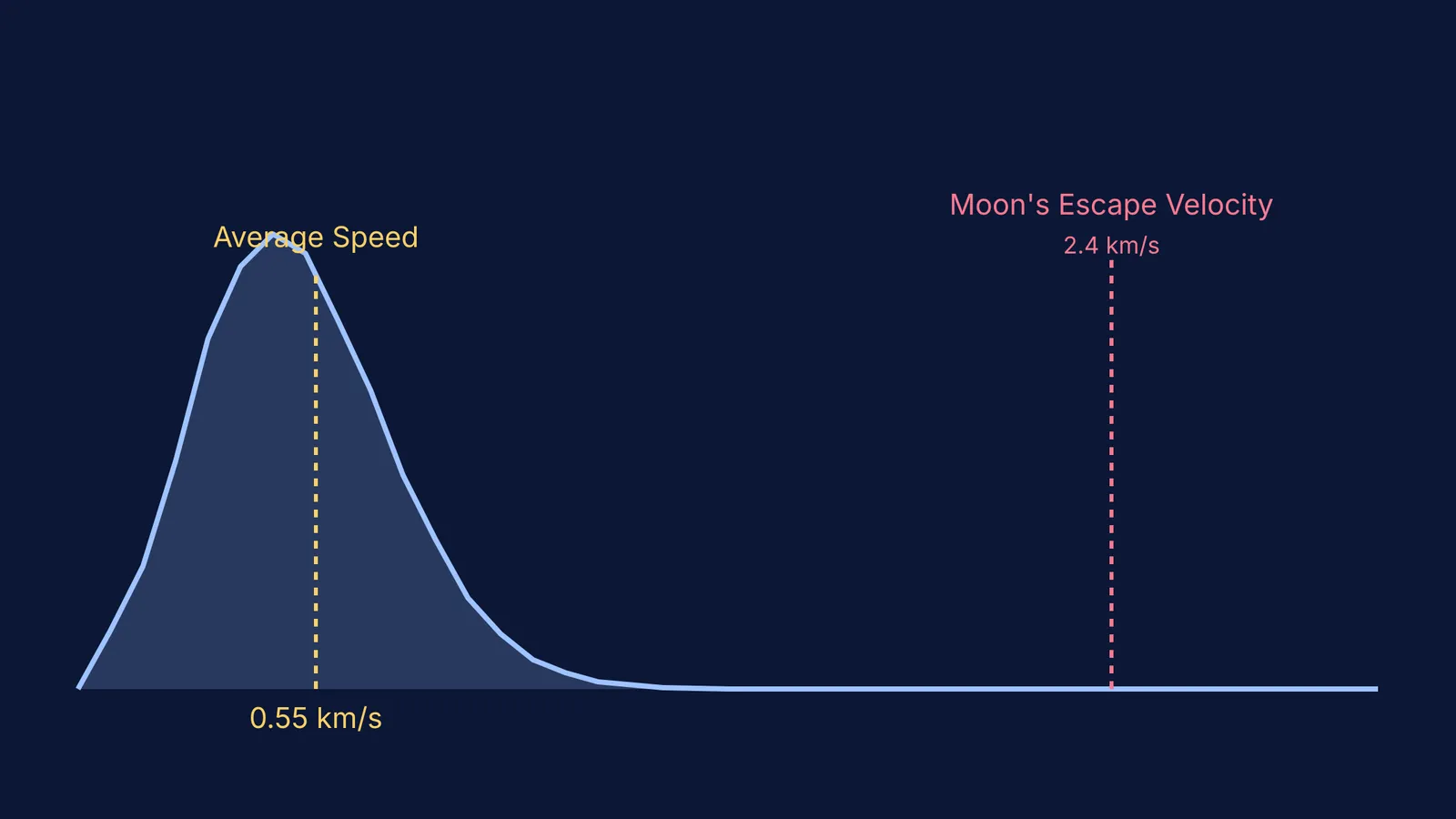
During the lunar day, the surface bakes under the Sun. The Moon's daytime equator temperature can reach up to 390 K. If we imagine a heavy gas like oxygen (molar mass 0.032 kg/mol) on the Moon at this temperature, we can calculate its average speed. Plugging the numbers in, the v_rms of oxygen at 390 K is approximately 0.55 km/s.
At first glance, this seems perfectly safe. Oxygen's average speed of 0.55 km/s is well below the Moon's 2.38 km/s escape limit. So why doesn't the Moon have an oxygen atmosphere?
Why the Moon has no atmosphere: The 1/6 rule
The answer lies in the fact that gases do not travel at a single uniform speed. Their speeds follow a curve called the Maxwell-Boltzmann distribution. While the bulk of the molecules move near the average speed, a small percentage exists in a high-speed "tail" that extends far beyond the average.
Even though oxygen's average speed on the Moon is only 0.55 km/s, a tiny fraction of those molecules are moving at 2.4 km/s or faster. These fastest molecules fly off into the vacuum of space. As they leave, the remaining molecules collide and redistribute their energy, pushing new molecules into the high-speed tail. This slow but continuous leak is known as Jeans escape.
Astronomers use a simple rule of thumb for this process. A celestial body will lose a gas over the age of the solar system if the gas's average speed is greater than one-sixth of the body's escape velocity.
For the Moon, one-sixth of 2.38 km/s is just 0.40 km/s. Because oxygen's average speed (0.55 km/s) exceeds this strict 0.40 km/s threshold, it steadily leaks away. Lighter gases, like hydrogen and helium, move even faster and escape much sooner. Over billions of years, this invisible leak left the Moon completely bare.
On Earth, the story ends differently. At Earth's average surface temperature of 288 K, the v_rms of oxygen is roughly 0.47 km/s. Earth's escape velocity is 11.18 km/s, and one-sixth of that is about 1.86 km/s. Since 0.47 km/s is safely below 1.86 km/s, Earth's oxygen molecules never reach the escape threshold in significant numbers, keeping our atmosphere locked securely in place.
Putting the rule to work
Visualising how a gas behaves as its temperature shifts can be tricky. When you are Converting PV, PT and VT graphs or working out the γ of a gas mixture, the core idea remains the same: temperature directly defines the kinetic energy and speed of the molecules.
Often, physics problems will ask you to calculate the temperature at which a specific gas will start escaping a planet. To solve these, you set the v_rms equal to v_e / 6, plug in the planet's escape velocity and the gas's molar mass, and solve for T. Remember to always use the molar mass in kg/mol (like 0.032 for oxygen, not 32) when using the standard gas constant.
If you are struggling to picture the Maxwell-Boltzmann tail or why some molecules always outrun the average, the Fermi Concept Library maps out the kinetic theory of gases so you can see exactly where the equations come from. If you keep getting tangled in the molar mass conversions for RMS speed calculations, Fermi's AI tutor can work out what you already know and build a plan for the session, stepping through the algebra until the physics clicks.


