

On this page
Two polaroid sheets, one turning slowly over the other: the light fades, goes dark at a quarter turn, then comes back. A simulation lets you run this as a real test. Below are the numbers to predict, a plan for checking them, and why a third sheet brings light back through two crossed ones.
What does Malus's law say about two polaroids at an angle?
A polariser passes only the part of the light's electric field that lies along its transmission axis. OpenStax University Physics states the result as Malus's law: I = I₀cos²θ, where I₀ is the intensity of the polarised light reaching the second sheet and θ is the angle between its polarisation direction and the sheet's axis.
There is one step before that. Ordinary light from a bulb or the Sun is unpolarised, and the same OpenStax chapter notes that the first filter polarises it along its axis and cuts its intensity by a factor of 2. So if the source gives intensity I₀, the light leaving the first polaroid has I₀/2, and only after that does cos²θ apply.
What intensity do you get at 0, 45 and 90 degrees?
Start with unpolarised light of intensity I₀. After the first polaroid you have I₀/2. Now turn the second polaroid:
0°: cos²0° = 1, so I₀/2 gets through. The sheets are parallel and the second one takes nothing away.
30°: cos²30° = 0.75, so 3I₀/8 gets through.
45°: cos²45° = 0.5, so I₀/4 gets through, half of what left the first sheet. OpenStax gives this same 50% figure at 45°.
60°: cos²60° = 0.25, so I₀/8 gets through.
90°: cos²90° = 0, so nothing gets through. OpenStax puts it plainly: when the axes are perpendicular, no light is passed by the second filter.
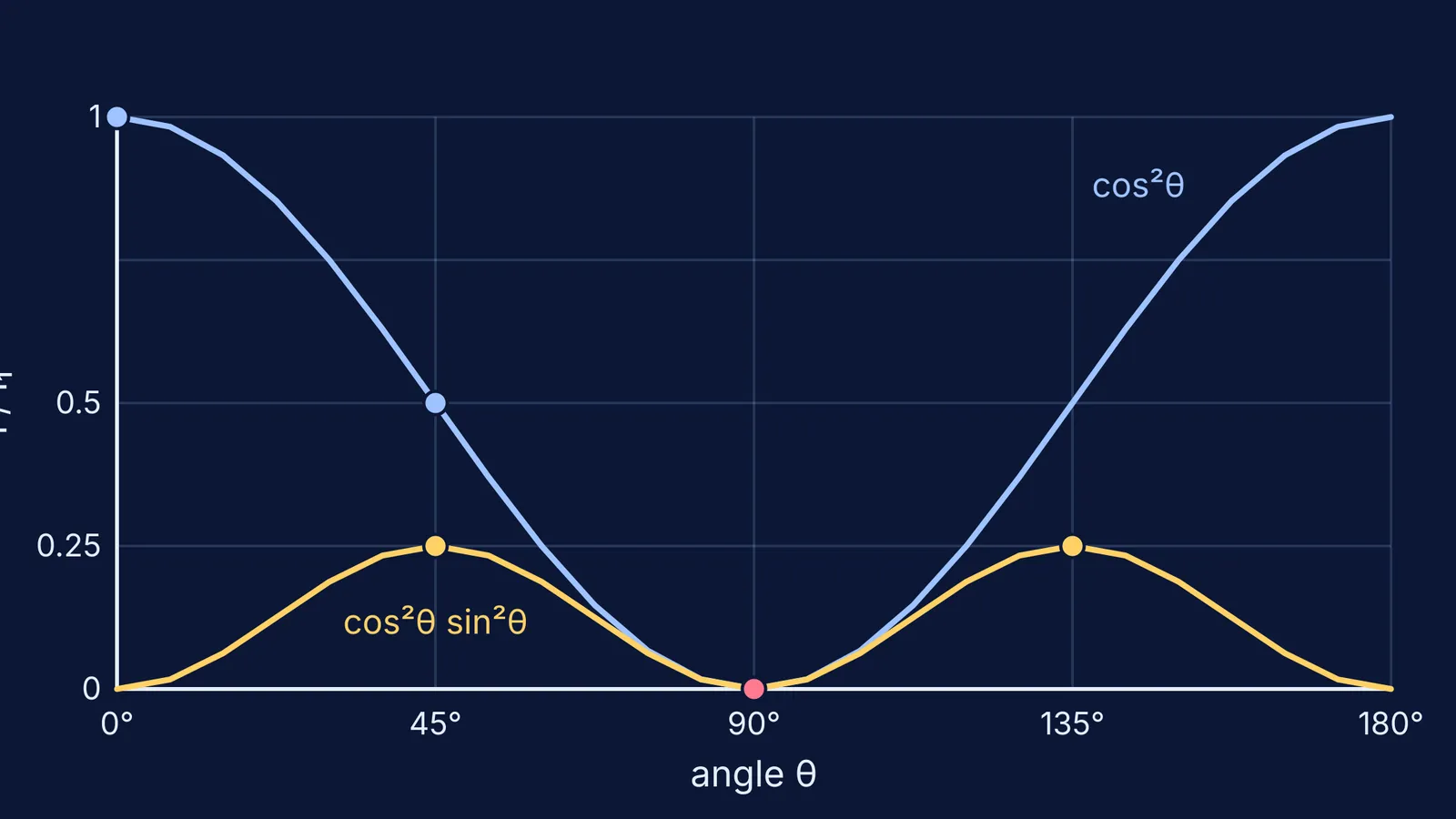
The fall is not linear: the curve is flat near 0° and steep in the middle.
Why does a third polariser between crossed ones let light through?
Two crossed polaroids are dark. Slide a third in between at 45° and light appears. HyperPhysics explains this by applying Malus's law twice. The key point: a polariser does not just block light, it also leaves the light polarised along its own axis. In steps:
Unpolarised I₀ meets the first polaroid (at 0°): I₀/2 leaves, polarised at 0°.
The middle polaroid is at 45° to that: I₀/2 × cos²45° = I₀/4 leaves, now polarised at 45°.
The last polaroid is at 90°, which is 45° from the middle one: I₀/4 × cos²45° = I₀/8 leaves.
HyperPhysics gives the result for a middle polariser at 45° between crossed ones: 25% of the light is transmitted. By the steps above, that is 25% of the light leaving the first sheet, or I₀/8 of the original unpolarised light. Without the middle sheet, the light reaching the last one was at 90° to its axis. With it, the light arrives at 45°, and part of it can pass.
For a middle sheet at any angle θ to the first one, the light leaving the last sheet is (I₀/2)cos²θ sin²θ. That is zero at 0° and 90° and largest at 45°, which is the gold curve in the graph at the top of this post.
How do you test Malus's law in a simulation?
Predict first, check second:
Write your predictions for 0°, 30°, 45°, 60° and 90° as fractions of I₀ before touching anything.
Set two polarisers, rotate the second in 15° steps and note the intensity reading at each step.
Divide each reading by the reading at 0°. Compare with cos²θ from Malus's law. If your 45° value is near 0.5 and your 60° value near 0.25, the law holds.
Cross the two sheets at 90°. Then add a third between them and rotate it from 0° to 90°. Predict where the light will be brightest before you look.
Check the peak against I₀/8, and test one odd angle such as 30°: (I₀/2) × 0.75 × 0.25 = 3I₀/32.
To watch angle and brightness change together, the Fermi Simulation Lab has interactive simulations for ideas that are easier to see than to read. When a three- or four-sheet problem goes wrong, the Fermi Problem Library has a step-by-step solver that explains the reasoning, so you can find where the angle slipped.
Real polaroid sheet leaks a little: the Wikipedia article on polarisers gives an extinction ratio of around 1:500 for Polaroid.
Where to go next
For exam-style practice, try our guide to single-slit diffraction and Malus's law problems. For the sheet's history, read Edwin Land and the sheet polariser, and for when a model beats a picture, see simulations versus static diagrams.
Predict the 45° value, then rotate the sheet and see if you were right.


