

On this page
Many wrong interference answers come from blending three numbers into one: the extra distance one wave travels, the phase lag it causes, and the half wave a reflection can add. Ask an AI tutor to name each separately and you can catch its mistakes and your own.
Why do path difference and phase difference get mixed up?
Path difference is a length: how much farther one wave travels than the other to reach the same point. Phase difference is an angle: how far out of step the two waves are when they meet there.
The two are linked by Δφ = 2π × Δx / λ, as set out in Learning Introductory Physics with Activities (Oregon State University). A path difference of one full wavelength gives a phase difference of 2π, and half a wavelength gives π.
In OpenStax University Physics, Volume 3, the double-slit conditions are Δl = mλ for constructive interference and Δl = (m + ½)λ for destructive interference. Both are written in terms of path. Trouble starts when a question gives you phase, or when a reflection changes the phase without changing the path. For a refresher, see our explainer on constructive and destructive interference conditions.
When does a reflection add half a wave?
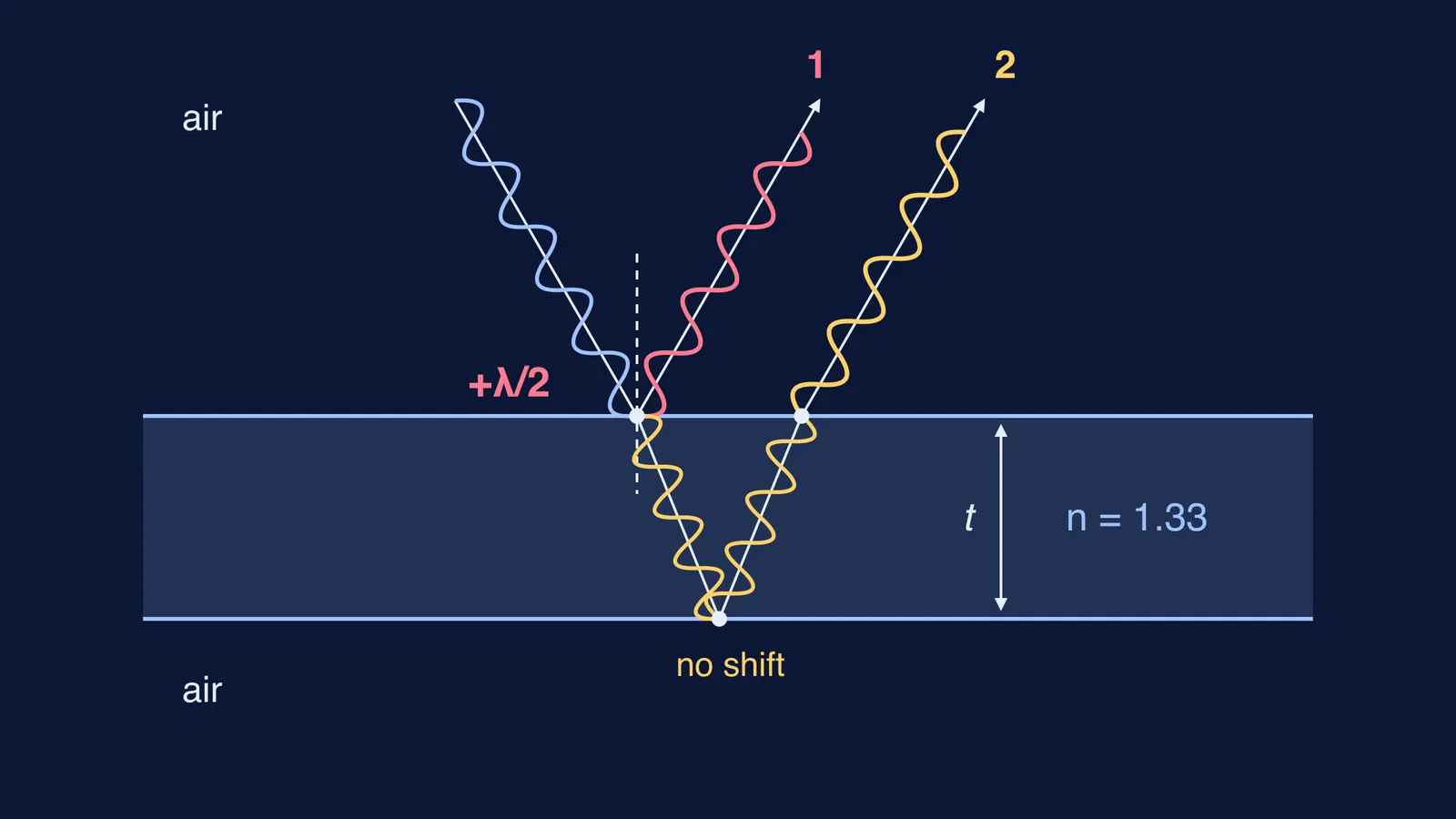
The rule from OpenStax's chapter on thin films is short. Light undergoes a 180° (π radian) phase change when it reflects at an interface beyond which the medium has a higher refractive index. No phase change happens when it reflects off a medium of lower refractive index. The same page notes that this flip is equivalent to ±λ/2 of extra path.
So for every reflection, ask one question: is the light bouncing off something with a higher n than the medium it is travelling in? Then count the flips:
0 or 2 flips: the usual conditions hold. Use 2nt = mλ for bright and 2nt = (m + ½)λ for dark.
1 flip: the conditions swap. Use 2nt = (m + ½)λ for bright and 2nt = mλ for dark.
Here 2nt is the optical path difference at normal incidence. OpenStax explains that the second ray travels about 2t farther, inside a film where the wavelength is λ/n.
What should you type into the AI tutor?
Paste the question, then add this:
"Give the path difference first, as a length, and show where it comes from (d sin θ, 2t, 2nt)."
"Convert it to a phase difference using Δφ = 2πΔx/λ, as a separate line."
"List every reflection. For each one, name the two media and their n, and say whether it adds half a wave."
"Count the flips, then say which condition (mλ or (m + ½)λ) means bright and which means dark."
"Only now solve for the unknown."
If the tutor merges two steps, ask it to redo them separately. For more on how to frame physics doubts, read what to ask an AI tutor for JEE physics doubts.
Worked example: how do you check the AI's answer?
Test the tutor and yourself on three cases. In both film cases, 550 nm light arrives at normal incidence.
Double slit. With λ = 600 nm and a path difference of 1.5 μm, Δx = 2.5λ. So Δφ = 5π, an odd multiple of π, and the point is dark. No reflections are involved, so there are no flips to count.
Soap film in air (n = 1.33). At the top surface, light goes from air into the film, so n rises and there is one flip. At the bottom surface, light goes from the film into air, so n falls and there is no flip. That is one flip, so bright reflection needs 2nt = (m + ½)λ. The thinnest bright film is t = λ/(4n) = 550/5.32 ≈ 103 nm.
Coating (n = 1.38) on glass (n = 1.52). n rises at both surfaces, so there are two flips, and they cancel. Dark reflection needs 2nt = (m + ½)λ, so the thinnest dark coating is t = λ/(4n) = 550/5.52 ≈ 99.6 nm.
The two films come out at almost the same thickness, but one is bright and the other dark. Only the flip count separates them. If an AI gives the same reasoning for both, it has skipped step 3. Our piece on why soap bubbles show colours applies the soap-film case to white light.
Can an AI tutor show the flip instead of just stating it?
Seeing the reflected wave turn upside down makes the rule stick. Fermi's AI tutor decides whether to explain, ask or show, and can draw the figure or run the simulation while checking your understanding, so you can ask it to show the top-surface flip. The Fermi Simulation Lab has interactive simulations for ideas that are easier to see than to read.


