

On this page
When you look closely at a soap bubble floating in the air, its surface swirls with iridescent pinks, blues, and yellows. But soap and water are mostly transparent. So where do these colours come from, and why do they suddenly disappear just before the bubble bursts?
The answer lies in how light behaves when it hits a very thin boundary, a phenomenon known in physics as thin-film interference.
Why do soap bubbles show colours?
A soap bubble is essentially a water sandwich. It consists of a microscopic layer of water trapped between two layers of soap molecules. When white light—which contains all the colours of the visible spectrum—shines on the bubble, it hits two distinct boundaries.
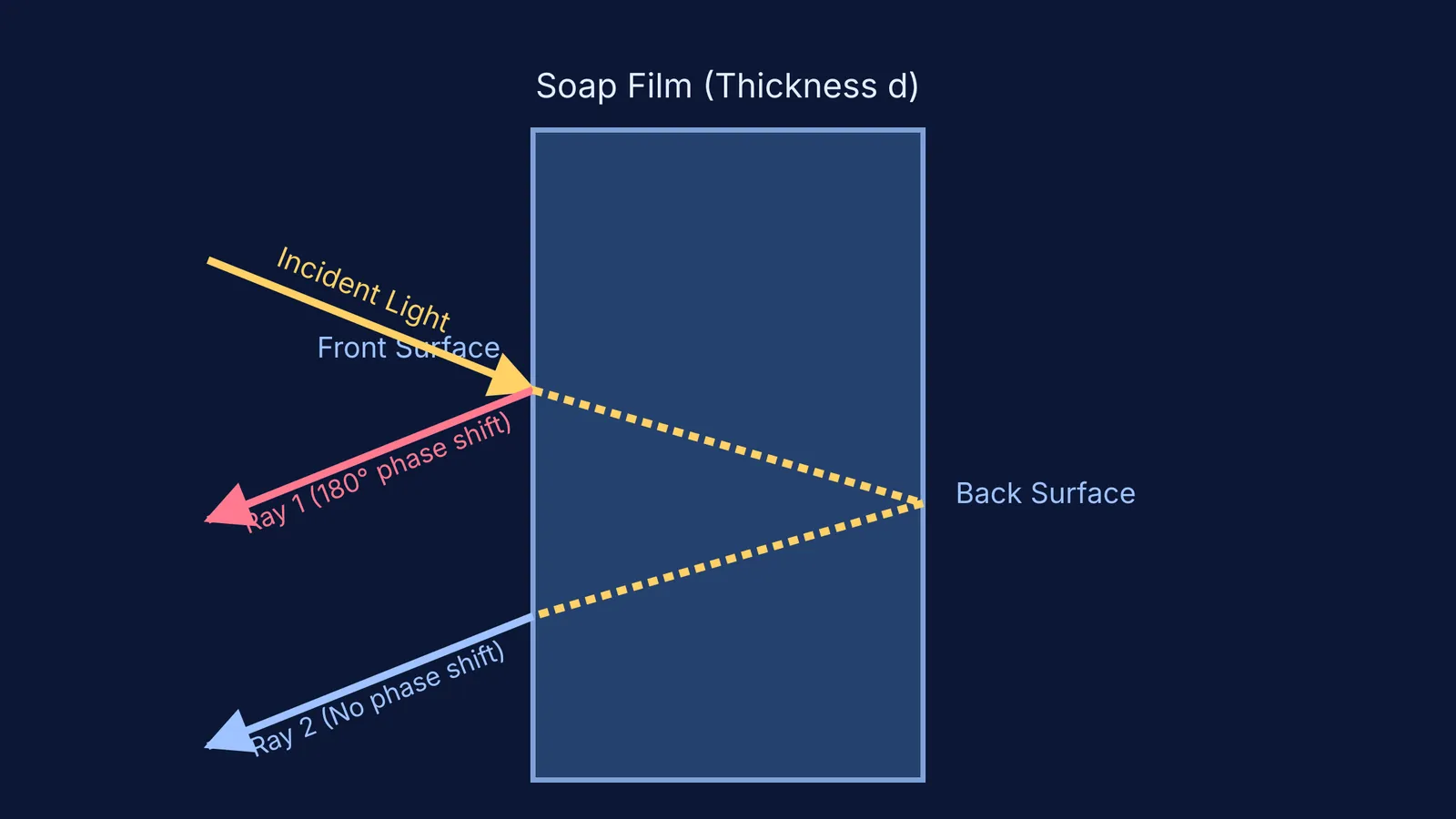
Some of the light reflects immediately off the outer front surface of the soap film. The rest of the light passes through the water layer, hits the inner back surface, and reflects outward.
When these two reflected light waves meet back in the air, they overlap. Because the light from the back surface had to travel slightly further (twice the thickness of the film), the two waves are now out of step. Depending on the exact thickness of the film and the viewing angle, the peaks and troughs of these waves will either line up to reinforce a specific colour (constructive interference) or cancel each other out (destructive interference).
This is the same principle you use when converting between path difference and phase difference in wave optics. Unlike dispersion in a glass prism, which separates colours by bending them at different angles, thin films filter white light by cancelling specific wavelengths out entirely.
How does film thickness change the colour?
The visible light spectrum ranges from roughly 400 to 700 nanometres in wavelength. Because the path difference depends strictly on how far apart the two surfaces are, the colour you see tells you exactly how thick the bubble is at that spot.
As gravity pulls the water downward and evaporation takes its toll, a bubble becomes thinner at the top and thicker at the bottom. This varying thickness creates distinct horizontal bands of colour:
Thick regions: The thicker parts of the film tend to reflect blue and green light.
Intermediate regions: As the film thins out, it cancels out the green light, leaving the film magenta.
Thin regions: As it thins further, the colours change to yellow and violet.
If you find it hard to picture how the two waves overlap, the Fermi Simulation Lab has interactive simulations for wave optics and other ideas that are easier to see than to read.
Why does the bubble turn black before popping?
If you watch a soap bubble carefully as it hangs in the air, you will notice a dark spot forming at the very top just seconds before it bursts.
As the water continues to drain away, the film at the top becomes much thinner than the wavelength of visible light, eventually reaching a thickness of just a few molecules. Because the film's thickness is practically zero, the light reflecting from the back surface travels almost no extra distance.
However, because the front reflection underwent a 180-degree phase shift and the back reflection did not, the two waves emerge completely opposite to one another. The peak of one wave meets the trough of the other perfectly, causing the waves to cancel each other out.
No light is reflected back to your eye, so the top of the bubble appears completely clear or black against a dark background. The moment you see this black film, you know the bubble has become too thin to hold itself together.
The Flat Film Test
The easiest way to see this relationship between thickness and colour is to remove the spherical shape of the bubble entirely and test a flat film.
Make the frame: Bend a piece of wire (like a paperclip) into a loop with a handle.
Dip and hold: Dip the loop into a strong soap solution, then hold it perfectly still and completely vertical in a well-lit room.
Watch the bands: Gravity will pull the water downward immediately. You will see horizontal stripes of blue, magenta, and yellow form and slowly slide down the frame as the top thins out.
Spot the black edge: Focus on the top rim of the wire. After a minute or two, a distinct black band will form across the top. The film has reached its minimum structural limit, and it will pop shortly after.


