

On this page
Two waves meet at a point. Do they add up to a bright spot or cancel into darkness? It comes down to one number: how much farther one wave travelled than the other, counted in wavelengths. Get this rule straight and many Young's double-slit questions in CBSE boards, JEE Main and NEET-UG become much easier to set up.
What are the conditions for constructive and destructive interference?
The NCERT Class 12 Physics chapter on Wave Optics gives the rule for two coherent sources S1 and S2 vibrating in phase, at any point P:
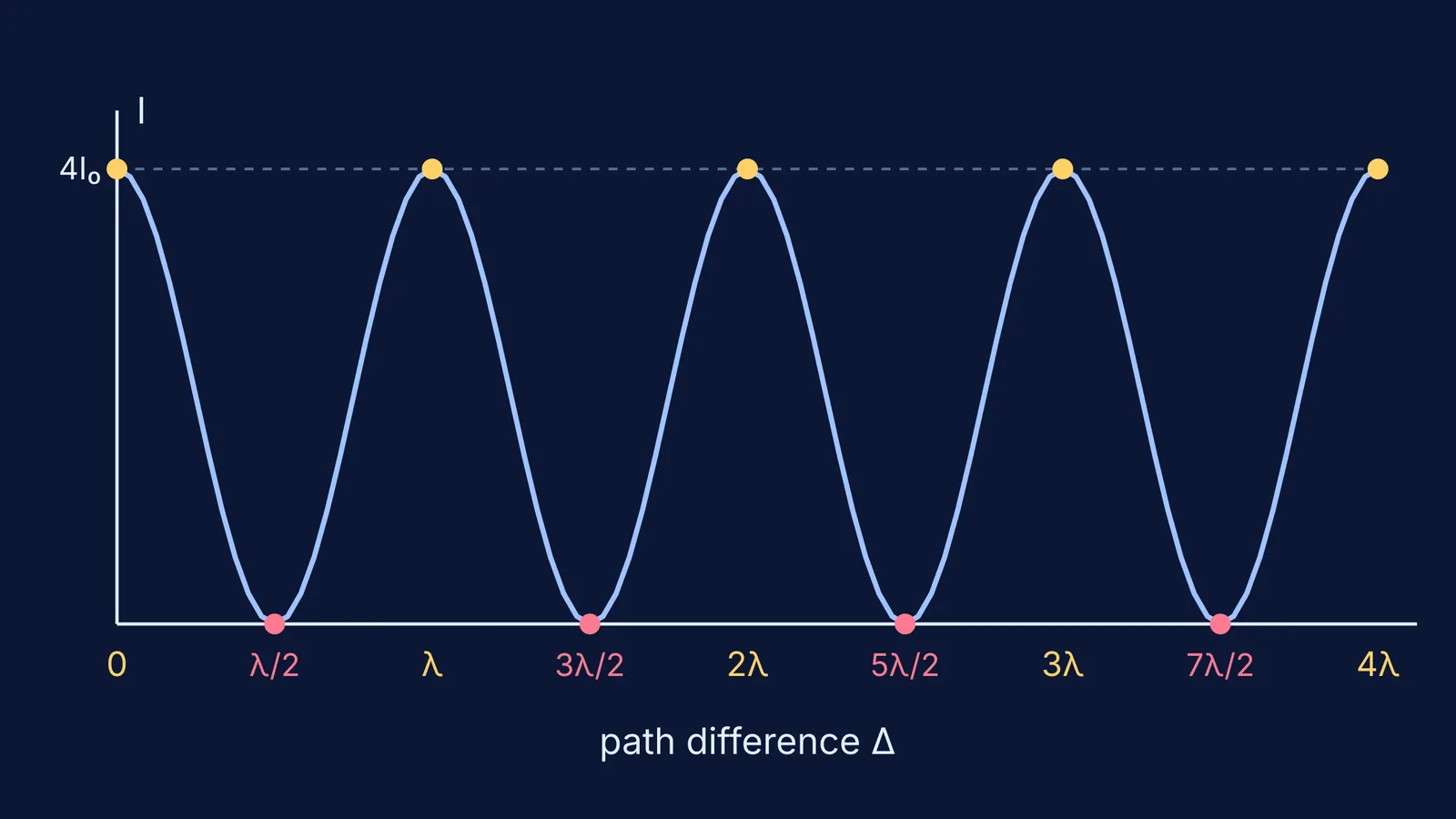
Constructive (bright): path difference S1P ~ S2P = nλ, with n = 0, 1, 2, 3 and so on. The intensity is 4I₀, where I₀ is the intensity from one source alone.
Destructive (dark): path difference S1P ~ S2P = (n + ½)λ. The intensity is zero.
The reason is phase. One wavelength of extra path is a phase difference of 2π, so crest meets crest again; half a wavelength is a phase difference of π, so crest meets trough. For any phase difference φ, the same NCERT chapter gives I = 4I₀cos²(φ/2), the curve at the top of this page. OpenStax University Physics writes the same conditions as Δl = mλ for constructive and Δl = (m + ½)λ for destructive interference.
Why must the sources be coherent and in phase?
Two sources are coherent when the phase difference between their waves at a point does not change with time, as NCERT Wave Optics defines it. If that phase difference jumps about rapidly, the bright and dark spots move too fast to see, and the screen shows an average intensity of 2I₀ everywhere. NCERT notes that light from an ordinary source such as a sodium lamp changes phase abruptly in times of the order of 10⁻¹⁰ seconds, which is why two separate lamps never give fringes. Thomas Young got round this in his 1801 double-slit experiment by lighting both slits from a single source (OpenStax).
The in-phase part matters too. If the sources start half a cycle apart, that built-in phase difference of π flips everything: nλ now gives dark and (n + ½)λ gives bright. Check the starting phase before you apply the rule.
Worked example: bright, dark or in between?
Two in-phase coherent sources emit light of wavelength 600 nm. Classify three points.
Path difference 1.8 μm: 1.8 ÷ 0.6 = 3, a whole number, so the point is bright, with intensity 4I₀.
Path difference 2.1 μm: 2.1 ÷ 0.6 = 3.5, so the point is dark, with zero intensity.
Path difference 1.95 μm: 1.95 ÷ 0.6 = 3.25, neither. The phase difference is 2π × 3.25 = 6.5π, and cos²(3.25π) = ½, so I = 2I₀.
On a screen, NCERT puts bright fringes at x = nλD/d and dark fringes at x = (n + ½)λD/d, equally spaced. Take slit separation d = 0.5 mm and screen distance D = 1 m with the same light. Then λD/d = 1.2 mm, so the third bright fringe is 3.6 mm from the centre, and the dark fringe between the second and third bright fringes is at 3.0 mm.
Where do students lose marks on these conditions?
Forgetting the starting phase. Sources that are out of phase by π swap the two conditions.
Ignoring a glass sheet. A thin sheet over one slit adds optical path and shifts the whole pattern; our post on fringe shift from a glass sheet in YDSE works out the direction and size.
Mixing in single-slit diffraction. For one slit of width a, NCERT puts the dark minima at θ ≈ nλ/a, which looks like the double-slit bright condition. Read which experiment the question describes.
Expecting perfect darkness every time. The resultant amplitude 2A cos(φ/2) in OpenStax University Physics is for two waves of the same amplitude A. If one wave is weaker, it cannot fully cancel the other, so the minimum is dim, not black.
The rule is not only about light. It also decides where sound from two speakers is loud or quiet, and the bright and dark lines have a shape in space, covered in whether interference fringes are straight lines or hyperbolas.
How should you practise this before an exam?
Learn one rule, path difference divided by wavelength, instead of two separate formulas.
Classify five points like the worked example, including one pair of out-of-phase sources.
Then solve two full YDSE numericals that ask for positions on the screen.
If the phase picture still feels abstract, the Fermi Simulation Lab has interactive simulations for ideas that are easier to see than read. When a numerical goes wrong, the Fermi Problem Library has worked problems with a step-by-step solver that explains the reasoning, so you can see where your path difference slipped.


