

On this page
Stand between two speakers playing one steady note and move your head a few centimetres. The note swells, fades, then swells again. The two sound waves are interfering. Here is the rule, a worked example, and a twist that is easy to miss in board and JEE questions: one speaker wired backwards.
Where is the sound loud or quiet between two speakers?
At any point in the room the two pressure waves add. The result depends on the path difference: how much farther one wave has travelled than the other.
For two speakers driven in phase, a path difference of a whole number of wavelengths (Δ = nλ) gives constructive interference, a loud spot (OpenStax University Physics, Volume 1, section 17.4).
A path difference of an odd number of half wavelengths (λ/2, 3λ/2, 5λ/2 and so on) makes the waves arrive 180° out of phase, giving destructive interference, a quiet spot (OpenStax).
This only works if the speakers are coherent: same frequency, fixed phase relationship. See why interference needs coherent sources.
What happens as you walk along the line between them?
Put speakers A and B facing each other, a distance D apart. Stand at a distance x from A. You are then D − x from B, so the path difference is Δ = D − 2x.
The 2 is the key. Step towards B and you get closer to B and farther from A at once, so Δ changes by twice your step. That means:
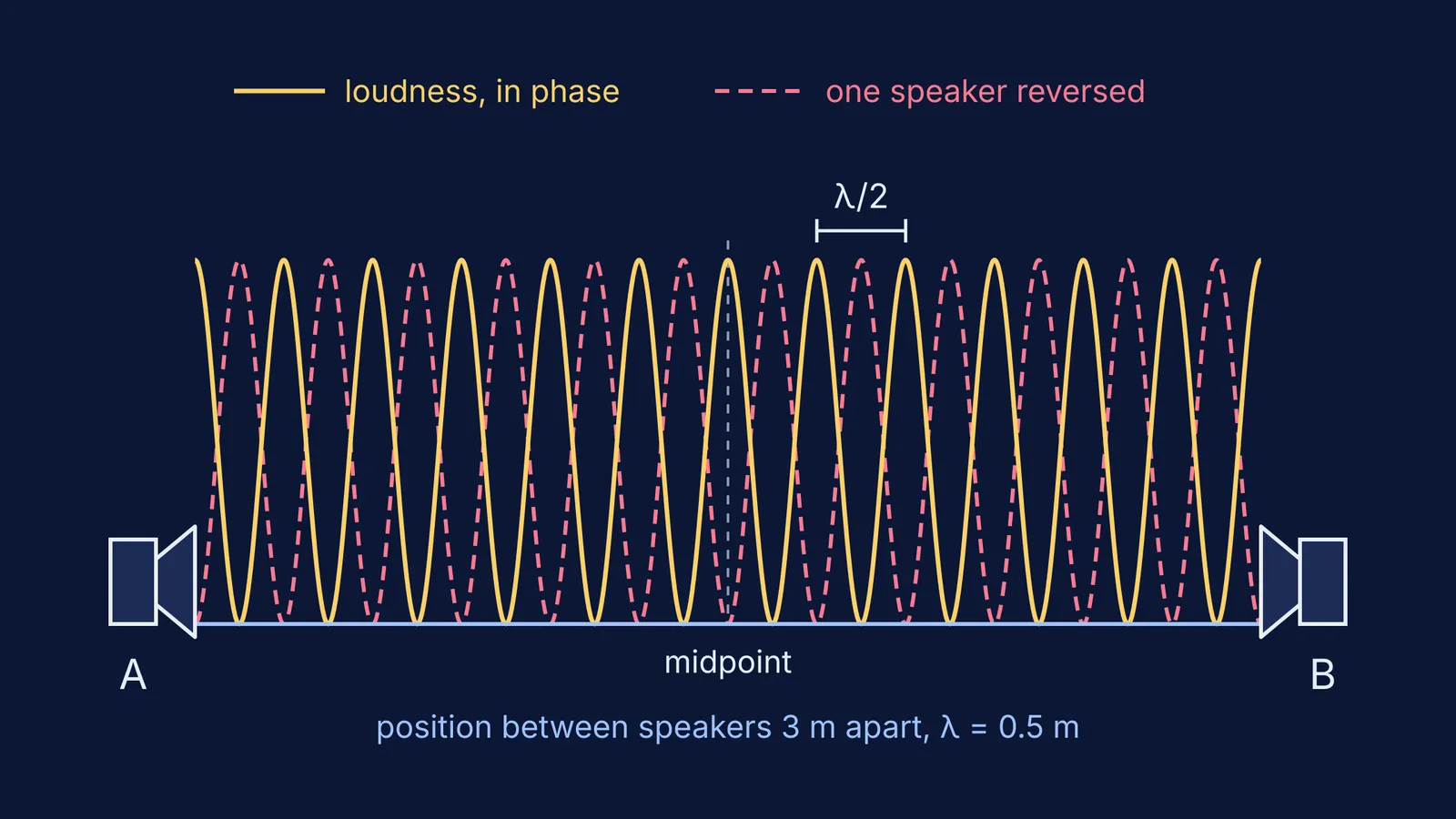
Loud spots are λ/2 apart, not λ apart.
Each quiet spot sits halfway between two loud ones, λ/4 from each.
With in-phase speakers the midpoint is always loud, because there Δ = 0.
Along this line the loud and quiet spots are the antinodes and nodes of a standing wave; see how two travelling waves make a standing wave.
Where are the loud spots for a 688 Hz tone?
The speed of sound in air at 20 °C is about 344 m/s (HyperPhysics, Georgia State University).
Choose a tone of 688 Hz. Then λ = v/f = 344 / 688 = 0.50 m.
Place the speakers 3.0 m apart. At the midpoint, 1.5 m from each, Δ = 0: loud.
Next loud spots: Δ = ±0.5 m, so 2x = 3 ∓ 0.5, giving x = 1.25 m and 1.75 m. They repeat every 25 cm.
Quiet spots: Δ = ±0.25 m, giving x = 1.375 m and 1.625 m, each 12.5 cm from the midpoint.
Across the whole gap Δ runs from −3 m to +3 m, which is 12 wavelengths, so you walk through 12 quiet spots.
In a real room the quiet spots are rarely silent: the nearer speaker's wave is stronger, so cancellation is incomplete, and walls add reflections.
What changes when one speaker is wired in reverse?
Swap the red and black wires on one speaker and its cone moves out while the other moves in. That is a 180° phase shift, the same as giving one wave an extra half wavelength of path. A University of Tennessee lecture-demo sheet notes that its phase switch simply swaps how the second speaker's wires are connected (UTK physics demo notes).
The same sheet reports that with the speakers side by side at 440 Hz, flipping the second speaker 180° out of phase makes the sound quieter than one speaker playing alone (UTK).
For reversed speakers the rules swap:
Loud where Δ = (n + ½)λ.
Quiet where Δ = nλ, including the midpoint.
In the worked example, the midpoint at 1.5 m goes quiet and the nearest loud spots move to 1.375 m and 1.625 m. The whole pattern slides by λ/4, 12.5 cm, while the spacing stays at 25 cm.
In the University of Oregon's demo, two out-of-phase speakers placed facing each other a few centimetres apart give substantial cancellation of sounds whose wavelengths are longer than that gap; put them back in phase and the bass becomes much more pronounced (University of Oregon physics demos). Noise-cancelling headphones do this on purpose, making a second sound 180° out of phase with the noise (OpenStax); here is how noise-cancelling headphones work.
How do you solve two-speaker questions without mixing up the rules?
Find λ = v/f, using the speed of sound the question gives.
Write the path difference at the point in terms of x.
Check how the sources are driven: in phase or reversed.
Apply the matching rule and solve for x.
Sanity-check: along the line, neighbouring loud spots should be λ/2 apart, and the midpoint should be loud for in-phase speakers and quiet for reversed ones.
If the pattern is still hard to picture, the Fermi Simulation Lab has interactive simulations for ideas that are easier to see than to read. When you want practice, the Fermi Problem Library has worked problems with a step-by-step solver that explains the reasoning, so you can see exactly where a path-difference setup went wrong.
Next time a note fades as you lean in, work out Δ.


