

On this page
When you are trying to study in a noisy house, active noise-cancelling (ANC) headphones can seem like magic. You flick a switch, and the drone of a ceiling fan or the rumble of traffic disappears completely. But it is not magic; it is a direct application of wave mechanics. The headphones use the principles of superposition and phase difference to actively erase incoming sound waves before they hit your eardrum.
If you are exploring wave mechanics, the Fermi Simulation Lab allows you to visualize how two overlapping waves interact in real-time.
What is a sound wave?
To understand how noise cancellation works, we must first look at how sound travels through a medium. Sound travels through the air as a longitudinal pressure wave. This wave consists of alternating regions of compressions, where the air pressure is high, and rarefactions, where the air pressure is low. You can think of these compressions and rarefactions as the peaks and troughs of the sound wave.
As the sound source vibrates, it pushes and pulls the air molecules, sending these pressure fluctuations out in all directions. Understanding these basic wave properties is crucial for any physics student; you can explore this further by reading about displacement and pressure waves in sound.
How does the principle of superposition work?
When two or more sound waves occupy the exact same space, their individual pressures add together algebraically. This fundamental mathematical rule is known as the principle of superposition. It governs how waves interact with one another when they meet.
The resulting sound you hear depends entirely on the relative alignment, or phase, of the two overlapping waves:
Constructive interference: If two identical waves meet "in phase" (meaning the peak of one wave perfectly meets the peak of the other), their pressures add up. This creates a resulting wave with a larger amplitude, which you perceive as a louder sound.
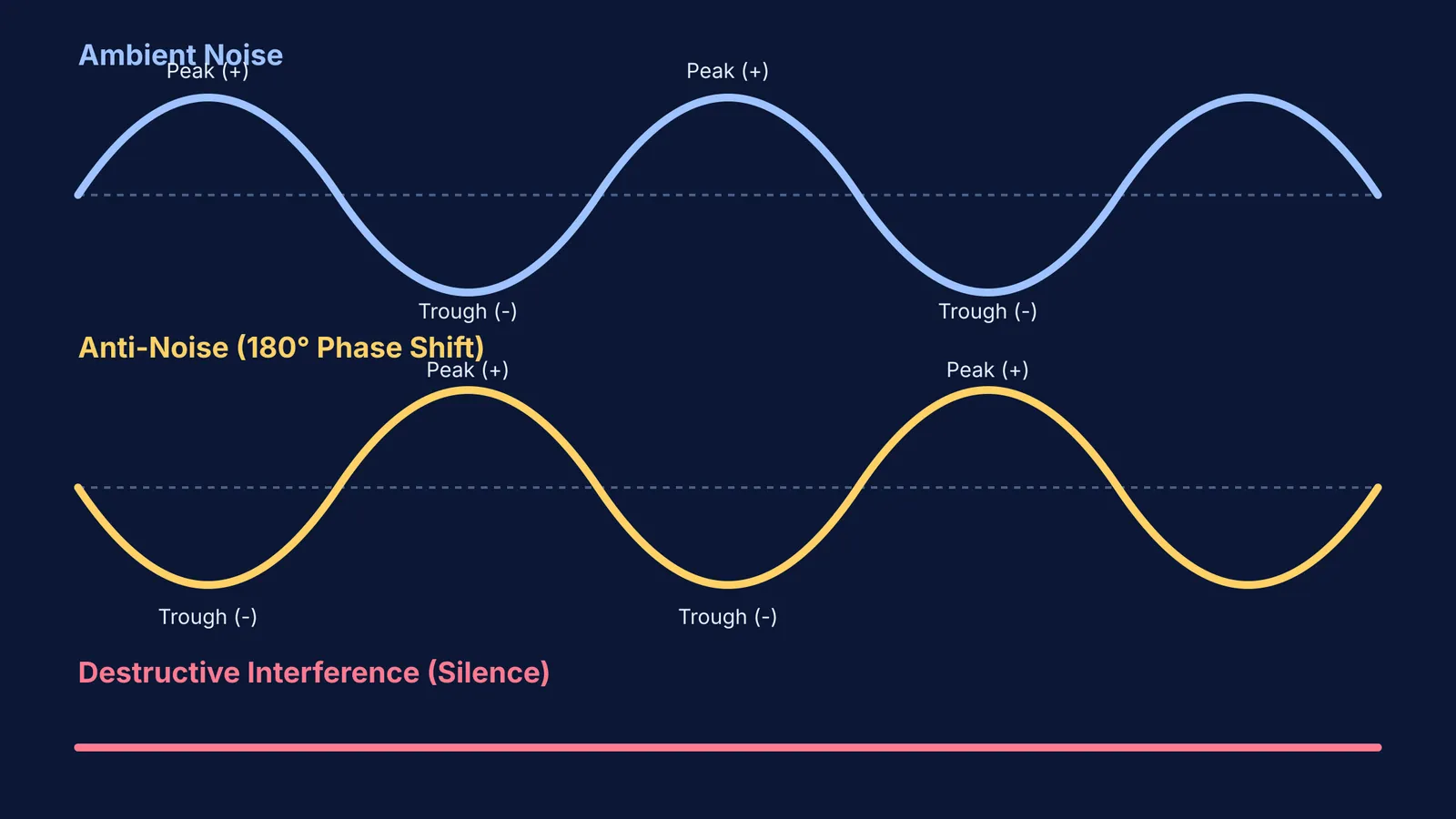
Destructive interference: If the waves meet exactly 180 degrees "out of phase" (meaning the peak of one wave meets the trough of the other), their pressures subtract from each other. The push of one wave is cancelled by the pull of the second wave.
Many students struggle with applying these addition rules in physics exams. Reviewing common electrostatics mistakes with superposition can help solidify your understanding of how vectors and waves add together algebraically.
How do active noise-cancelling headphones work?
Active Noise Cancellation (ANC) systems rely entirely on the concept of destructive interference to eliminate unwanted background noise. The entire process happens almost instantly:
Listen: Tiny reference microphones built into the outer earcups of the headphones continuously monitor the ambient background noise.
Invert: A Digital Signal Processor (DSP) inside the headphones rapidly analyzes the incoming sound wave and generates an exact mirror image of it. This new "anti-noise" wave is given a 180-degree phase shift, meaning its high-pressure peaks perfectly align with the incoming noise's low-pressure troughs.
Cancel: The headphone speakers play this anti-noise directly into your ear alongside whatever music you are listening to. Because the positive pressure of the ambient noise is perfectly countered by the negative pressure of the anti-noise, the two waves sum to zero before they ever reach your eardrum.
The relationship between a wave's alignment in time and its alignment in physical space is a key concept in physics; you can see how this works mathematically by converting phase difference to path difference.
Why do some noises still get through?
You might notice that while ANC blocks the steady hum of an airplane engine perfectly, you can still clearly hear a sudden handclap, a siren, or a dog barking. Destructive interference is highly dependent on frequency and predictability.
Low-frequency sounds, such as the drone of a bus engine, have very long, repetitive wavelengths. This gives the digital signal processor inside the headphones enough time to sample the noise, invert the wave, and play the anti-noise in perfect alignment.
Sudden or high-frequency sounds, on the other hand, change too rapidly and have much shorter wavelengths. If the anti-noise generation is even slightly delayed, the waves will not overlap perfectly. If the timing is completely off, the system could theoretically cause constructive interference and make the sharp noise even louder. To compensate for this physical limitation, modern headphones always combine active cancellation with passive isolation—using dense physical padding that tightly seals around your ears to physically block those sharper, higher frequencies.
How can you study in a noisy environment?
Even the best ANC headphones cannot block out every single distraction in a busy house. If you are preparing for a difficult exam in a noisy household, use this framework to protect your focus:
Combine active and passive blocking: Wear your ANC headphones and sit facing a blank wall, physically turning your back to visual distractions that might break your concentration.
Use a steady sound track: Play low-volume white noise or instrumental music through the headphones to mask the sudden high-frequency noises that the active cancellation system cannot catch.
Schedule deep work: Communicate your study blocks to your family in advance. Ask for a block of uninterrupted quiet time for your absolute hardest tasks, such as solving complex physics or mathematics problems.


