

On this page
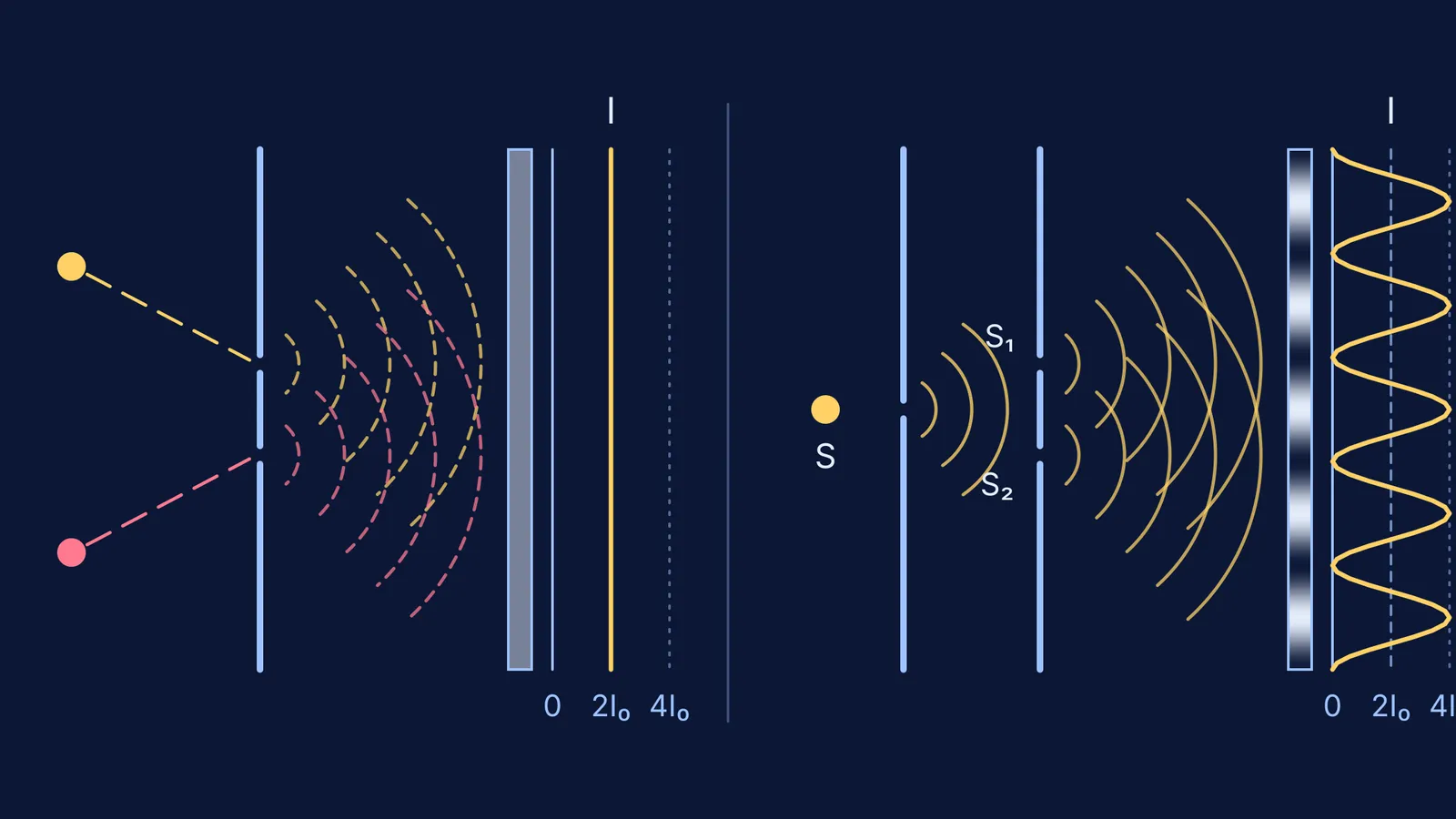
Shine two sodium lamps at two pinholes and the screen just gets evenly brighter. Send light from one lamp through a single pinhole that then lights the same two pinholes, and bright and dark bands appear. NCERT's Class 12 chapter uses exactly this comparison (NCERT Physics Part II, Chapter 10: Wave Optics), and it shows what "coherent" really means.
Why can't two independent light sources produce interference?
Light from an ordinary source such as a sodium lamp undergoes abrupt phase changes in times of the order of 10⁻¹⁰ seconds, according to NCERT's wave optics chapter. Two separate lamps make these jumps independently. So the phase difference φ between their waves, at any point on the screen, keeps changing at random.
At any instant the waves do interfere. If each alone gives intensity I₀, the resultant is I = 4I₀ cos²(φ/2), which NCERT derives as Equation 10.11. But every time φ jumps, each bright band and each dark band moves somewhere new.
Your eye cannot follow this. A fast camera shutter of 1/1000 s stays open 10⁷ times longer than 10⁻¹⁰ s, so it records something like ten million different patterns stacked on top of each other. The average of cos² over all phases is ½, so the screen shows a steady I = 2I₀ everywhere. That is NCERT's Equation 10.12. The intensities simply add, which is what you see when two bulbs light up a wall.
How do Young's slits create coherent sources?
Thomas Young's trick, in NCERT's words, was to "lock" the phases. Light from a bright source passes through one pinhole S, spreads out and falls on two pinholes S₁ and S₂ placed very close together. Both are fed by the same original source, so any abrupt phase change in S shows up in exactly the same way at S₁ and S₂ (NCERT, Section 10.5).
The random jumps still happen, but to both waves together, so they drop out of the phase difference. What is left depends only on the path difference S₂P − S₁P, which is fixed for each point P, so each band stays put. Read the history in Thomas Young and the experiment that showed light is a wave.
A worked example with NCERT's numbers
NCERT's computer-generated fringe pattern (Figure 10.13) uses d = 0.025 mm, D = 5 cm and λ = 5 × 10⁻⁵ cm (NCERT, Figure 10.13). Put them into the fringe width β = λD/d, working in metres:
λ = 5 × 10⁻⁷ m, D = 0.05 m, d = 2.5 × 10⁻⁵ m.
β = (5 × 10⁻⁷ × 0.05) ÷ (2.5 × 10⁻⁵) = 1 × 10⁻³ m.
So neighbouring bright bands sit 1 mm apart, matching the β ≈ 1 mm printed on the figure.
Replace the single source with two independent lamps and the screen shows a flat 2I₀. The total light is the same; Young's arrangement only moves energy from dark bands into bright ones, which NCERT notes is consistent with conservation of energy. For more practice, try our Young's double-slit fringe width problems and traps.
What does sustained interference need?
Use this checklist for "conditions for sustained interference" questions.
One parent source. Both waves must share every phase jump. Two independent lamps fail here.
The same frequency. If the frequencies differed, φ would grow steadily with time and the fringes would sweep across the screen.
A constant phase difference. This is what coherent means, and it follows from the first two points.
Nearly equal amplitudes. With amplitudes a₁ and a₂, the dark bands have intensity proportional to (a₁ − a₂)², so they are fully dark only when a₁ = a₂. Our explainer on intensity in interference and the resultant of two coherent waves works through the general case.
A narrow source and close slits. Since β = λD/d, a large slit gap squeezes the fringes until they are too fine to see. NCERT notes that direct sunlight gives no fringes because the Sun subtends about half a degree, and that it can damage your eyes (NCERT, Section 10.6.2).
How should you explain it in an exam answer?
A short written answer can follow this three-sentence script:
Two independent sources are not coherent: light from an ordinary source undergoes abrupt, random phase changes in times of about 10⁻¹⁰ s, so their phase difference keeps changing.
The interference pattern therefore shifts too fast to observe, and the screen shows only the average intensity, I = I₁ + I₂.
In Young's experiment, S₁ and S₂ receive light from the same source S, so any phase change reaches both together and the phase difference stays constant.
If time-averaging is still hard to picture, the Fermi Simulation Lab has interactive simulations for ideas easier to see than to read. For connected ideas, from path difference to single-slit diffraction, the Fermi Concept Library gives each concept its own lesson and its place in the map.


