

On this page
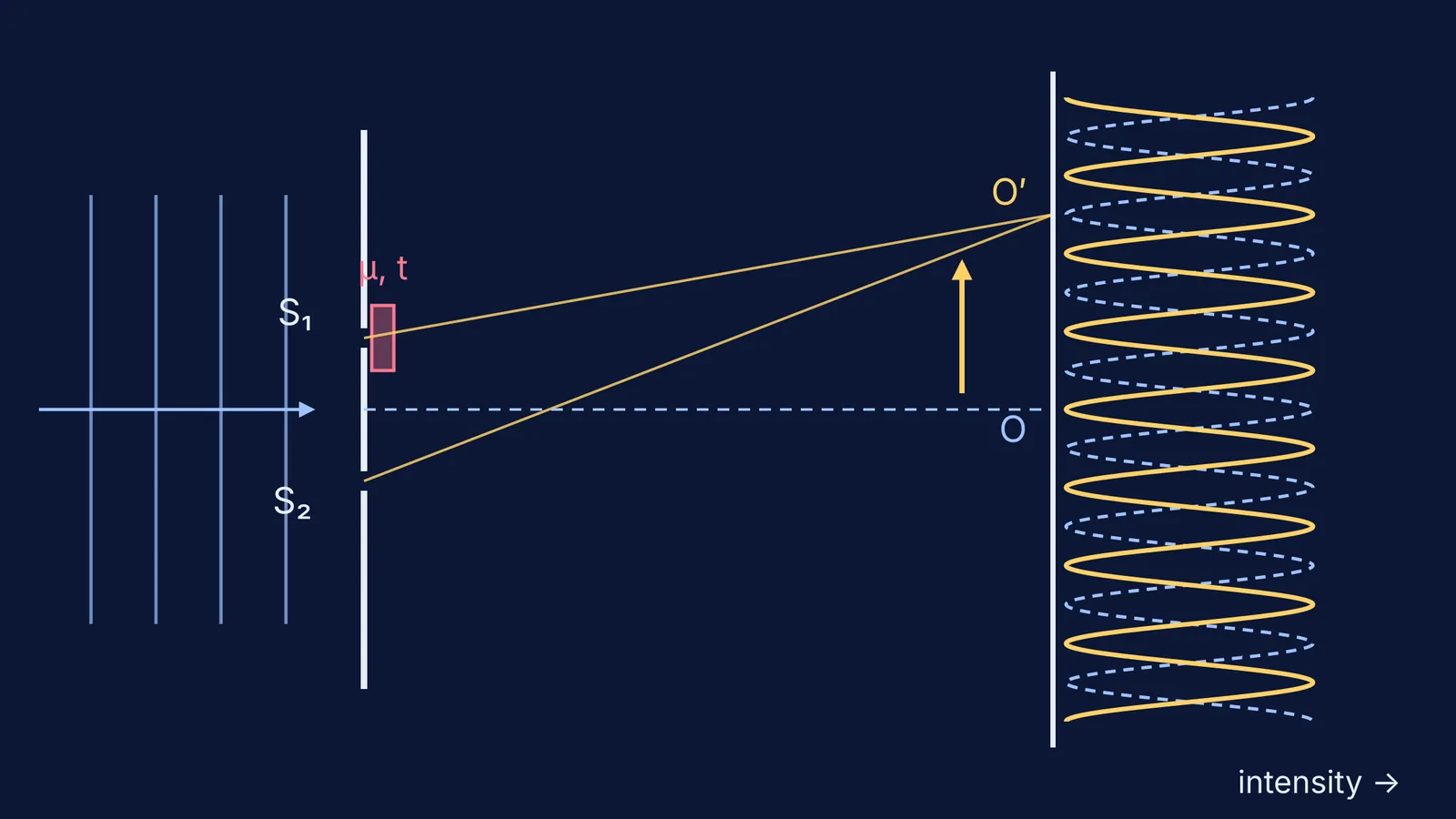
Put a thin sheet of glass or mica over one slit in Young's double-slit experiment and the whole fringe pattern slides sideways. The fringes keep their spacing; only their position changes. JEE Main questions run both ways: find the shift from the sheet, or the sheet from the shift.
Which way does the fringe pattern shift?
Towards the covered slit. Here is why.
Light crossing a sheet of thickness t and refractive index μ covers an optical path of μt instead of t, so the covered ray carries an extra (μ − 1)t. Our explainer on what optical path length means covers why.
The central bright fringe sits wherever the two optical paths are equal.
At the old centre O the covered ray is now effectively longer, so the paths balance at a point closer to the covered slit, where that ray's geometric path is shorter.
A way to remember it: the sheet slows that ray down, so the pattern leans towards the slow side to give it a shorter route. Compare this with moving the source slit, where the central fringe moves the opposite way.
How far does the pattern shift?
The NCERT Class 12 Physics chapter on wave optics shows that a point at distance x from the centre has a path difference of xd/D, which puts bright fringes at x = nλD/d (equation 10.13), where d is the slit separation and D the slit-to-screen distance. Set that geometric difference equal to the sheet's extra path:
xd/D = (μ − 1)t, so the shift is Δx = (μ − 1)tD/d.
The fringe width β = λD/d contains neither μ nor t, so it does not change; the whole pattern simply moves. Dividing the shift by β gives the number of fringes that pass a fixed point: N = (μ − 1)t/λ.
Worked example: where does the centre go?
Take illustrative values λ = 600 nm, d = 0.30 mm, D = 1.0 m and a sheet with μ = 1.5 and t = 3.0 μm.
Fringe width: β = λD/d = (600 × 10⁻⁹ × 1.0)/(0.30 × 10⁻³) = 2.0 mm.
Extra path: (μ − 1)t = 0.5 × 3.0 μm = 1.5 μm.
In wavelengths: N = 1.5 μm ÷ 0.6 μm = 2.5.
Shift: Δx = 2.5 × 2.0 mm = 5.0 mm towards the covered slit.
Now the trap. At the old centre O the path difference is 2.5λ, an odd number of half-wavelengths, so O is now a dark fringe. What appears at O comes from N, not Δx. The diagram at the top draws exactly this case: the dashed curve is the original pattern, the solid curve is the shifted one, and bright and dark have swapped everywhere.
How do you find thickness or refractive index from the shift?
Run the same equation backwards: (μ − 1)t = Nλ, where N counts how many fringe widths the central maximum moved.
A JEE Main question from 12 April 2019, Shift 1 said the central maximum shifts by one fringe width. With N = 1, the answer is t = λ/(μ − 1).
A JEE Main 2026 question from the 4 April evening shift used a mica sheet of μ = 1.56 that moved the central fringe to the old 7th bright fringe, with λ = 450 nm. Then 0.56t = 7 × 450 nm, so t = 5625 nm, about 5.6 μm.
Watch the word "dark". The NCERT chapter places dark fringes at x = (n + ½)λD/d (equation 10.14), with n = 0 for the first one, so the 10th dark fringe sits at 9.5λ, not 10λ. If a 633 nm laser shows the central fringe moving to the old 10th dark fringe through a sheet of μ = 1.5, then t = 9.5 × 633 nm ÷ 0.5 ≈ 12.0 μm. Using 10λ gives a wrong 12.7 μm. A Physics Forums thread on a glass-covered slit uses the same 9.5-wavelength step, run the other way: given 12.0 μm of glass, find μ.
To solve for μ instead, rearrange to μ = 1 + Nλ/t. If both slits carry sheets of equal thickness, the extra paths subtract: the shift becomes (μ₁ − μ₂)tD/d, towards the slit with the higher μ.
The Fermi Problem Library has worked problems with a step-by-step solver that explains the reasoning, so you can see which step of a reverse problem went wrong. If optical path itself feels shaky, the Fermi Concept Library gives each physics concept its own lesson.
What should you check before marking the answer?
Direction: towards the covered slit, or towards the higher μ if both slits are covered.
Fringe width: unchanged. A sheet over one slit only slides the pattern.
Fringe order: the nth bright fringe is at nλ of path difference, the nth dark fringe at (n − ½)λ.
Units: t is usually in μm and λ in nm, so convert both to metres before dividing.
For more traps of this kind, read our list of three mistakes students make in YDSE problems.


