

On this page
When light leaves the vacuum of space and enters a material like water or glass, it slows down. This drop in speed creates a mismatch: light traveling through a glass slab takes longer to cross it than it would to cross the same distance in empty space.
To solve problems involving phase shifts and time delays, physicists use a concept that converts a trip through a medium into an equivalent trip through a vacuum. By standardizing the distance, it becomes much easier to compare two beams of light traveling through completely different materials.
What is optical path length?
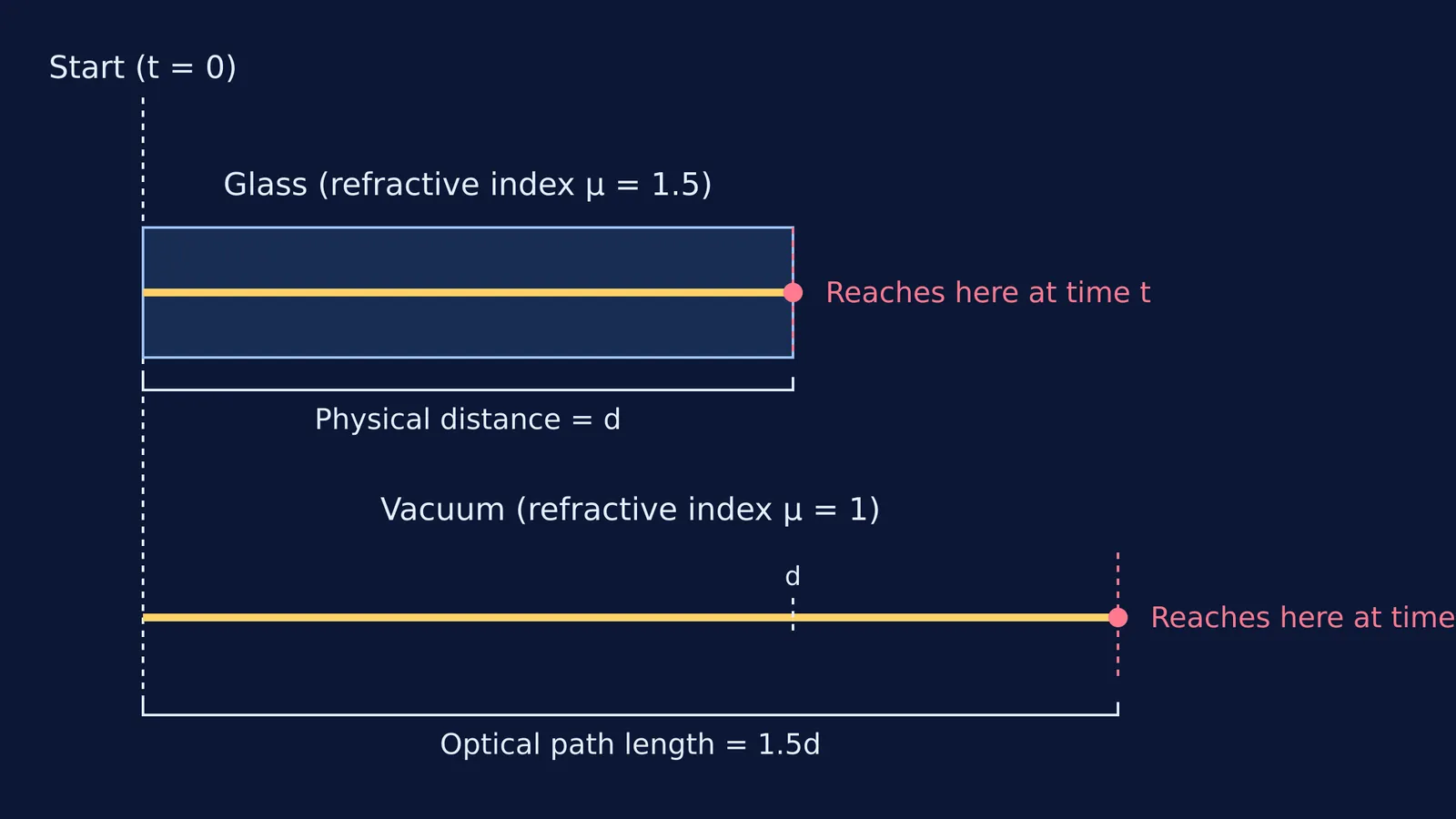
Optical path length is defined as the distance light would travel in a vacuum in the same amount of time it takes to traverse a given geometric distance through a medium (Wikipedia).
Because light travels slower in materials like glass than it does in a vacuum, the optical path length is always longer than the physical thickness of the object. For a uniform material, the formula is:
Optical path length (OPL) = μ × d
Here, μ is the refractive index of the medium, and d is the geometric (physical) distance the light travels. The refractive index represents how much the material slows the light down compared to its speed in a vacuum (c).
For example, if light passes through a 10 cm glass slab with a refractive index of 1.5, the optical path length is 15 cm. The light takes exactly the same amount of time to cross those 10 cm of glass as it would to cross 15 cm of empty space. Instead of juggling different speeds in different materials, you can simply convert everything to its vacuum equivalent.
How do you calculate the time delay of a glass slab?
Because a glass slab slows light down, a ray passing through it will emerge later than a ray travelling the same physical distance through air or vacuum. You can use the optical path length to find this exact time delay, which is a frequent requirement in competitive exams.
Consider a glass slab of thickness d and refractive index μ.
The light covers an optical path length of μ × d.
In a vacuum, the light would have only had to cover a distance of d.
The extra "vacuum distance" the light had to cover because of the glass is the path difference: Δx = μd − d = (μ − 1)d.
To find the time delay, divide this extra distance by the speed of light in a vacuum (c).
Time delay = (μ − 1)d / c
For a 15 cm thick glass slab with a refractive index of 1.5, the path difference is (1.5 − 1) × 0.15 m = 0.075 m. The time delay is 0.075 m / (3 × 10⁸ m/s) = 0.25 nanoseconds. This might seem tiny, but for a wave of light oscillating rapidly, a fraction of a nanosecond is enough to completely change its phase.
If you want to practice problems like this step by step, the Fermi Problem Library will walk you through the reasoning for optics and time delay calculations.
How does optical path length create a phase difference?
In wave optics, interference patterns depend entirely on whether two light waves meet in step (in phase) or out of step. This alignment is determined by the optical path difference between the two waves.
If you perform Young's Double Slit Experiment and place a thin sheet of glass in front of one of the slits, you are increasing the optical path length for that slit's light ray. The physical distance to the screen hasn't changed, but the wave has been delayed by the glass. Because the two waves no longer cover the same optical distance, they arrive at the center of the screen out of phase.
The extra optical path added by a sheet of thickness t is (μ − 1)t. This path difference shifts the entire interference pattern on the screen toward the slit that has the glass sheet. The number of fringes the pattern shifts is equal to the path difference divided by the wavelength of the light.
Why use optical path length instead of time?
You might wonder why physicists don't just calculate the time delay directly and use that to find the phase difference. While time is perfectly valid, tracking distances is much more practical in optical setups.
When you look at an interference pattern on a screen or trace rays through a lens, you are dealing with geometric shapes and distances. Optical path length allows you to stay in the realm of geometry. By stretching the physical path into a vacuum-equivalent path, you can map out exactly where the waves will peak and trough without ever needing to calculate a time in nanoseconds.
To understand the core ideas behind wave interference and refraction, explore the Fermi Concept Library, which breaks down the physics of path differences. You can also see how refraction works in practice by tracing a ray through a glass slab: the Class 10 practical.


