

On this page
Young's Double Slit Experiment (YDSE) is a staple of wave optics, but it is also a minefield of numerical traps. Even if you understand the physics behind interference, it is remarkably easy to drop marks because of simple mathematical and counting errors.
Here is a breakdown of the three most common mistakes students make in YDSE problems, why they happen, and exactly how to fix them.
Why do degrees fail in small-angle formulas?
Most YDSE problems rely on the small-angle approximation, where we assume sin θ ≈ θ ≈ tan θ. This allows us to simplify the path difference equation and easily find the fringe width. The problem? Students often plug degrees directly into this formula.
The small-angle approximation is derived by taking the first term of the Taylor series (specifically, the Maclaurin series) for sine or tangent. This mathematical shortcut is strictly only valid if the angle θ is measured in radians. Radians are dimensionless ratios, whereas degrees are arbitrary units of a circle.
For example, if a problem asks you to calculate the path difference for a fringe at an angle of 1° and you use 1 instead of converting it to 0.01745 radians (which is 1 × π / 180), your final answer will be off by a factor of nearly 60. Using 5° as 5 instead of 0.0872 radians will map your theoretical bright fringe meters off the actual screen.
Always check your calculator setting and physically write down the conversion (multiplying by π/180) before applying sin θ ≈ θ.
What happens when the medium changes?
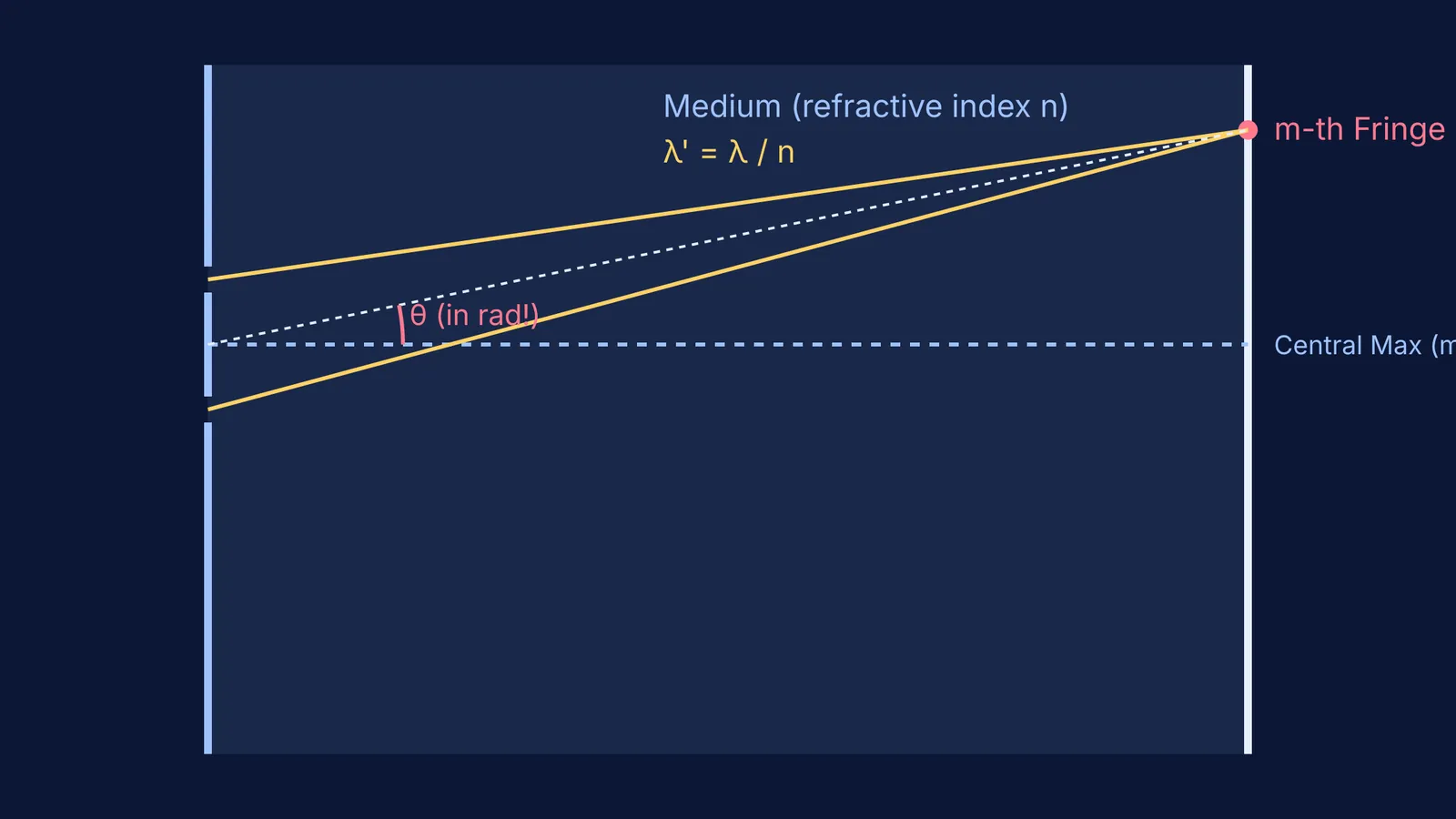
Another classic mistake happens when the entire double slit apparatus is immersed in a liquid, such as water or oil, instead of air. In the rush of an exam, students often apply the standard vacuum wavelength (λ) given in the prompt to their calculations.
When light enters a medium with a refractive index n, its speed drops but its frequency remains the same. As a result, the wavelength of the light inside the medium physically decreases according to the formula λ_med = λ / n.
Because the fringe width β is directly proportional to the wavelength (β = λD / d), the entire interference pattern will compress. Failing to divide your wavelength by n means your calculated fringe width will be too large by a factor of n. If you are calculating the setup in water (n = 1.33), your calculated fringes will be 33% too wide if you skip this step.
This relates closely to the core wave concepts discussed in Light entering glass: what happens to speed, wavelength, frequency.
How should you count fringes and gaps?
The third major trap is miscounting the fringes, often called the "off-by-one" error.
In YDSE, the central bright fringe is the exact center of the pattern where the path difference is zero, making it the n = 0 order. The first bright fringe on either side is n = 1, the second is n = 2, and so on.
When a question gives you the physical distance between two fringes (for example, "the distance from the 1st bright fringe to the 5th bright fringe is 12 mm"), many students divide 12 by 5 to find the gap between them. However, between fringe 1 and fringe 5, there are only 4 gaps (5 − 1 = 4). You must divide the total distance by the number of *gaps*, not the fringe number.
This error also frequently appears when dealing with dark fringes. Depending on the formula used, the "first dark fringe" corresponds to a path difference of λ/2. You must carefully track whether your specific formula uses n=0 or n=1 for this first minimum. If you are calculating how to convert these gaps using Phase difference vs path difference: converting with 2π/λ, remember that the central maximum must be included if you are asked for the *total* number of fringes visible on a screen.
To practice identifying these traps in real questions without the penalty of losing exam marks, explore the Fermi Problem Library.
The YDSE Troubleshooting Checklist
Before submitting your final answer to a wave optics problem, run this quick check:
Angles: Are my angles converted to radians?
Medium: Did the problem specify a surrounding medium, and did I divide λ by n?
Counting: Am I dividing distances by the number of gaps between fringes, rather than the fringe order itself?


