

On this page
Work, energy and power look like the friendly chapter: one theorem, a few formulas. The equations are short, so a missing term does not look wrong on the page.
Tara O'Brien Pride, Stamatis Vokos and Lillian McDermott reported in the American Journal of Physics (1998) that difficulties with the work-energy and impulse-momentum theorems extend from the introductory to the graduate level, and that multiple-choice answers often hid them; questions asking students to explain their reasoning were needed. A later study by Lindsey, Heron and Shaffer (2009) found that introductory students struggled to calculate the work done on a system, and that failing to link work with a change in the system's energy was widespread.
What are the most common mistakes in work-energy problems?
Three are worth checking for in every numerical:
Leaving out the work done by friction (or any other non-conservative force).
Taking kinetic energy from one reference frame and work or another energy from a different frame.
Using U = mgh for heights that are not small compared with Earth's radius.
Power questions add a fourth trap: average power is work divided by time, but instantaneous power is P = F·v at that moment, as OpenStax University Physics defines them.
How do you include the work done by friction?
The change in mechanical energy equals the work done by non-conservative forces, as OpenStax University Physics states. Friction's work is negative, so mechanical energy goes down.
Worked example. A 2 kg block starts from rest and slides 5 m down a 30° incline. Take g = 9.8 m/s².
Without friction: the drop in height is 5 × sin 30° = 2.5 m, so gravity does 2 × 9.8 × 2.5 = 49 J of work, and the speed at the bottom is 7 m/s.
With μ = 0.2: friction is μmg cos 30° ≈ 3.39 N, and over 5 m it does about −17.0 J of work. Kinetic energy at the bottom is 49 − 17.0 = 32.0 J, so the speed is about 5.66 m/s.
The frictionless answer is almost a quarter too high.
Why does the answer change when you switch reference frames?
Because velocity is relative, kinetic energy depends on the frame of reference, as OpenStax University Physics explains. In its example, a 75 kg person walking at 1.50 m/s inside a train moving at 15.0 m/s has 84.4 J of kinetic energy relative to the car, but 6.83 kJ relative to the tracks if walking towards the back of the train.
Both numbers are correct. The mistake is mixing them, such as an initial kinetic energy from the ground and a final one from the car. The work-energy theorem holds in any inertial frame, but only if every term uses that same frame.
The fix: write the frame at the top of your working ("ground frame") and check each velocity and displacement against it, especially with conveyor belts, lifts and trains.
When can you not use mgh for potential energy?
The formula mgh assumes g is constant over the height you move through. OpenStax University Physics says it works well only if g does not change significantly, and gives the general form U = −GMm/r for larger distances.
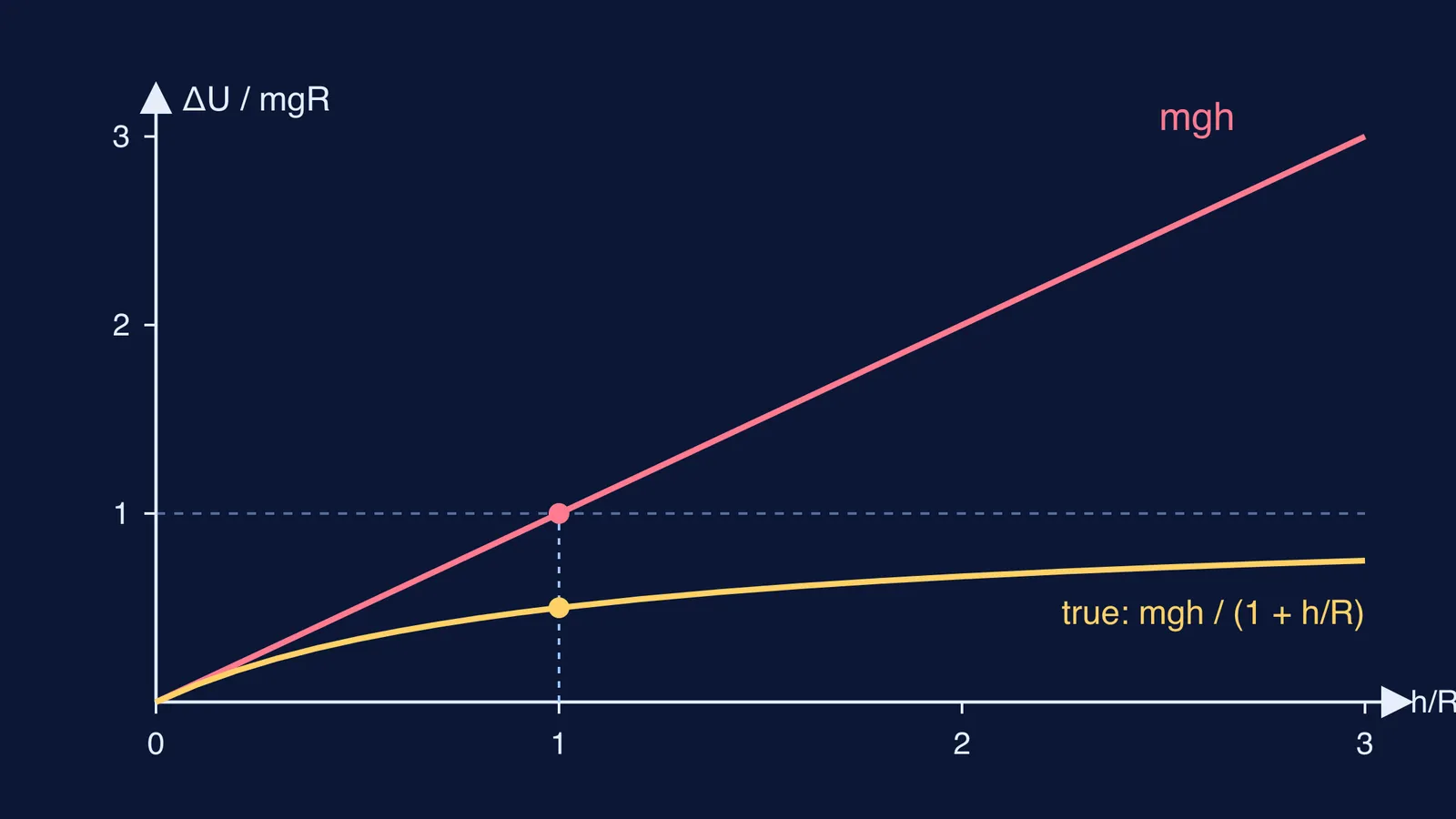
Using U = −GMm/r and GM = gR², the exact increase in potential energy when you lift a mass m from the surface to height h is mgh/(1 + h/R). So mgh overstates the true value by a factor of (1 + h/R).
With Earth's mean radius of 6371 km from the NASA Earth Fact Sheet:
At 400 km, mgh is about 6% too high.
At h = R (6371 km), mgh gives twice the true value. For a 1000 kg satellite, that is about 6.2 × 10¹⁰ J instead of 3.1 × 10¹⁰ J.
A quick rule: mgh is off by roughly h/R, so it stays within 1% only below about 64 km.
A 60-second check before you write the final answer
Have I named my reference frame, and does every velocity and displacement use it?
Have I listed every force and its work, including friction, air resistance and tension?
Is the sign of each work term right (negative when the force opposes the motion)?
Is the height small compared with Earth's radius? If not, use −GMm/r.
Does the question want average or instantaneous power?
If you keep getting the same kind of numerical wrong, try a few in the Fermi Problem Library, where the step-by-step solver explains the reasoning rather than printing an answer. If the gap is the idea itself, look up the work-energy theorem in the Fermi Concept Library, where each physics concept has its own lesson.
This week, run the five checks on every energy question in one past paper.


