On this page
Rolling questions look different every time: a ring on a ramp, a disc on a table, a ball in a bowl. Underneath, they all ask the same thing. How is the body's kinetic energy split between moving forward and spinning? Once you know the split for the three standard shapes, a whole family of JEE Main and board questions takes a few lines.
What fraction of kinetic energy is rotational in a rolling body?
A body rolls without slipping when the speed of its centre of mass equals Rω, as set out in OpenStax University Physics, section 11.1. The same section writes the total kinetic energy of a rolling body as ½Mv² + ½Iω², translational plus rotational.
Write the moment of inertia as I = kMR², where k is a pure number that depends only on the shape. Put ω = v/R into the rotational term and it becomes ½kMv². So:
Translational KE = ½Mv²
Rotational KE = ½kMv²
Total KE = ½(1 + k)Mv²
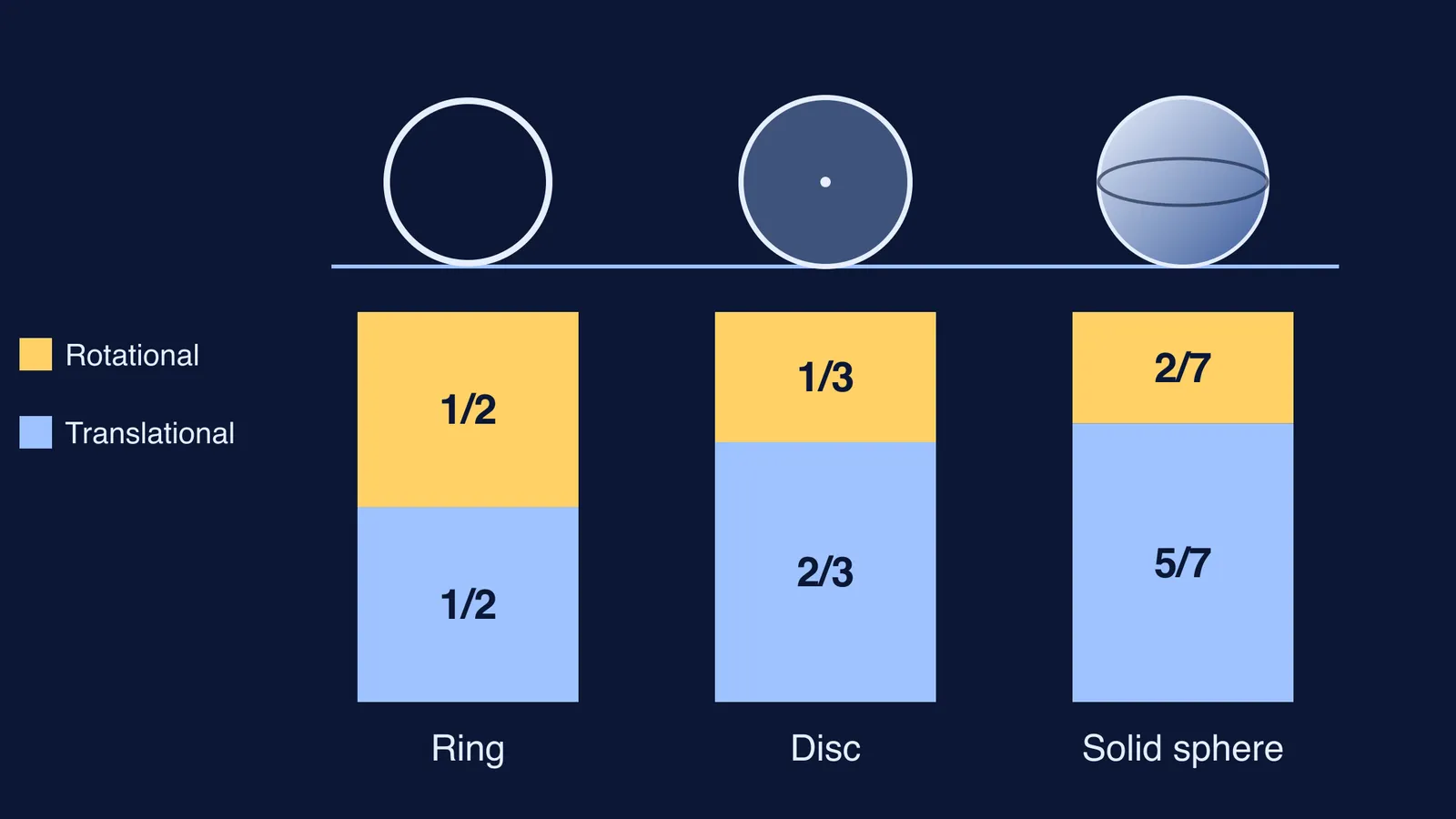
The rotational fraction of a rolling body's kinetic energy is k/(1 + k), and the translational fraction is 1/(1 + k). M, R and v cancel, so a heavy steel disc and a light plastic disc share their energy in exactly the same ratio.
What are the values for a ring, disc and sphere?
The moments of inertia for these shapes are listed in Figure 10.20 of OpenStax University Physics, section 10.4: MR² for a hoop, ½MR² for a solid disc or cylinder, (2/5)MR² for a solid sphere and (2/3)MR² for a thin spherical shell. Feeding each k into k/(1 + k):
Ring (k = 1): rotational 1/2, translational 1/2.
Hollow sphere (k = 2/3): rotational 2/5, translational 3/5.
Solid disc or cylinder (k = 1/2): rotational 1/3, translational 2/3.
Solid sphere (k = 2/5): rotational 2/7, translational 5/7.
The ratio of rotational to translational KE is simply k: 1 for the ring, 1/2 for the disc, 2/5 for the solid sphere. Examiners ask for this ratio and for the fraction of total, so read the question twice.
If the k values feel like magic numbers, our post on radius of gyration problems shows where they come from, since k is just (radius of gyration / R)².
Which reaches the bottom of an incline first?
Here is a worked example. A ring, a disc and a solid sphere are released from rest at the top of a ramp 1.8 m high and roll without slipping. Mechanical energy is conserved in rolling without slipping, as OpenStax University Physics, section 11.1 shows. Take g = 9.8 m/s².
Energy conservation: Mgh = ½(1 + k)Mv², so v = √(2gh / (1 + k)).
2gh = 2 × 9.8 × 1.8 = 35.28 m²/s².
Ring: v = √(35.28 / 2) = 4.2 m/s.
Disc: v = √(35.28 / 1.5) ≈ 4.85 m/s.
Solid sphere: v = √(35.28 / 1.4) ≈ 5.02 m/s.
The sphere wins, then the disc, then the ring, whatever their masses or sizes. The disc's speed is about 15% higher than the ring's, which matches the hoop-and-cylinder comparison on HyperPhysics (Georgia State University). That page also notes that mass and radius cancel out of the final speeds.
Quick check with the fractions: the ring turns only half of mgh into forward motion, the sphere turns 5/7 of it. More translational share means more speed at the bottom.
What mistakes cost marks on rolling-energy questions?
Dropping the spin term. Writing mgh = ½Mv² treats the body as sliding. That is only right on a frictionless slope, where the body would not start rolling at all.
Fraction versus ratio. "Rotational to total" for a disc is 1/3. "Rotational to translational" is 1/2.
Wrong axis. k must be about the axis through the centre of mass when you use the ½Mv² + ½Iω² split. Using I about the contact point already includes the translational part.
Hollow and solid mixed up. A hollow sphere has k = 2/3, not 2/5.
Assuming friction does work. In pure rolling the contact point is momentarily at rest, so static friction does no work and mechanical energy is conserved.
For the condition itself, see our explainer on rolling without slipping, and for why KE splits into a centre-of-mass part plus a relative part, read kinetic energy as centre-of-mass plus relative motion.
To practise, pick five rolling problems from the Fermi Problem Library, where the step-by-step solver explains the reasoning rather than printing an answer, and before you read each step, write down k and the energy split yourself. If moment of inertia is still shaky, the lesson on it in the Fermi Concept Library shows where it sits among the other rotation ideas.