

On this page
Many Class 11 and JEE Main collision problems hide one question: how much kinetic energy can disappear? The usual approach is to solve for both final velocities and subtract. The faster route is to split the kinetic energy into a centre-of-mass part and a relative part. Only the relative part is ever up for grabs.
What is the kinetic energy of a system about its centre of mass?
For any system, the total kinetic energy equals the kinetic energy of the whole mass moving with the centre of mass, plus the kinetic energy of the parts measured in the centre-of-mass frame. Written out:
K = ½Mv²cm + K_rel
Here M is the total mass and v_cm is the velocity of the centre of mass. K_rel is the kinetic energy about the centre of mass: what you would measure riding along with it.
For two bodies, K_rel has a compact form: K_rel = ½μv²rel, where μ = m₁m₂/(m₁+m₂) is the reduced mass and v_rel is the speed of one body relative to the other, as set out in Gea-Banacloche's University Physics I, section 4.2/04%3A_Kinetic_Energy/4.02%3A_Convertible_and_Translational_Kinetic_Energy). That textbook calls K_rel the "convertible" kinetic energy, and notes it has the same value for every observer, whatever frame they use.
Why can't a collision change the centre-of-mass part?
The total momentum of a system is M times v_cm, and with no external force the velocity of the centre of mass never changes, as OpenStax University Physics, section 9.6 shows. In a collision the forces between the bodies are internal, so v_cm is the same before and after.
If v_cm and M are fixed, ½Mv²cm is fixed. Heat, sound and a dented bumper must all come out of K_rel.
That also sets the most that can be lost. In the centre-of-mass frame the total momentum is zero, so both bodies may end up at rest in that frame. That is a perfectly inelastic collision: the bodies stick, v_rel becomes zero and all of K_rel is gone, while K_cm stays.
With a coefficient of restitution e, the relative speed after the collision is e times the relative speed before, so the convertible energy after is e² times its value before (Gea-Banacloche, section 4.2/04%3A_Kinetic_Energy/4.02%3A_Convertible_and_Translational_Kinetic_Energy)). The energy lost is therefore (1 − e²)K_rel. Elastic means e = 1 and nothing is lost; sticking means e = 0 and all of K_rel is lost.
How much kinetic energy is lost in a collision? A worked example
A 2 kg block moving at 6 m/s hits a 1 kg block at rest on a smooth floor.
Total kinetic energy: ½(2)(6²) = 36 J.
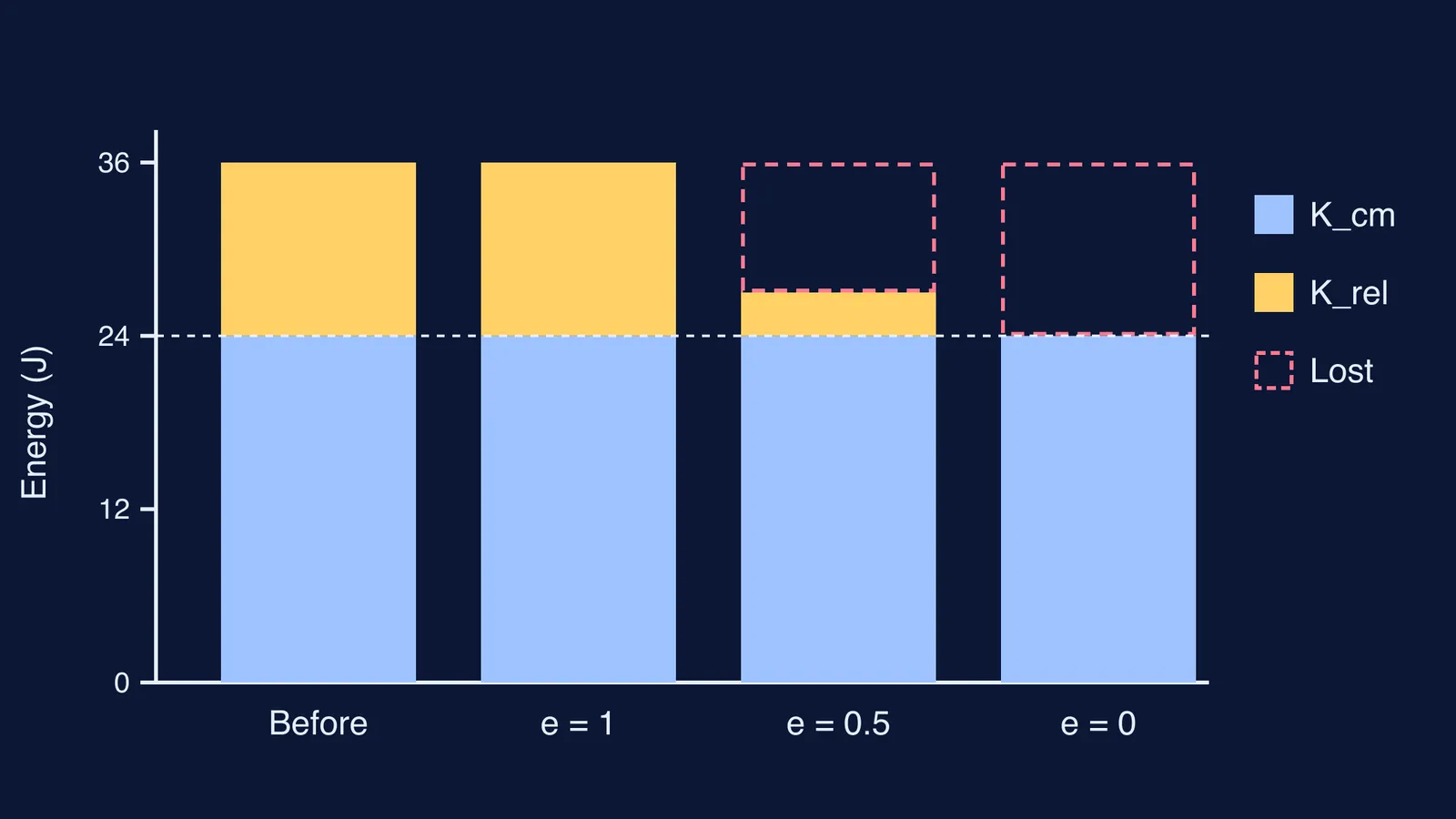
Centre-of-mass velocity: v_cm = (2 × 6 + 1 × 0)/3 = 4 m/s, so K_cm = ½(3)(4²) = 24 J.
Reduced mass: μ = (2 × 1)/3 = 2/3 kg. Relative speed: 6 m/s. So K_rel = ½(2/3)(6²) = 12 J.
Check: 24 + 12 = 36 J. The split adds up.
Now read off every possible outcome without solving for a single final velocity:
e = 1 (elastic): K_rel stays 12 J. Final total 36 J, nothing lost.
e = 0.5: K_rel becomes 0.25 × 12 = 3 J. Final total 27 J, so 9 J lost.
e = 0 (blocks stick): K_rel becomes 0. Final total 24 J, so 12 J lost, one third of the start.
Check e = 0.5 the long way: final velocities of 3 m/s and 6 m/s keep momentum at 12 kg m/s and give 9 + 18 = 27 J.
The sticking case gives a neat general result when the target starts at rest: the fraction lost is K_rel/K = μ/m₁ = m₂/(m₁+m₂). Here that is 1/3. We work through more sticking cases in how to find the fraction of kinetic energy lost in a perfectly inelastic collision.
How do you use this split in JEE problems?
Run this short checklist before you start solving for velocities:
Is there an external force along the line of motion during the collision? If not, write down v_cm and K_cm; they will not change.
Find μ and v_rel, then K_rel = ½μv²rel.
Use e to get the energy left in relative motion: e²K_rel. Loss = (1 − e²)K_rel.
If the question asks for heat produced, deformation energy or maximum spring compression, the answer is a share of K_rel, never of K_cm.
Step 4 covers a common trap. For two blocks joined by a spring on a smooth floor, maximum compression comes when both share one velocity, so ½kx² = ½μv²rel. The same logic sits behind the ballistic pendulum, where the bullet's speed comes from the height the block rises.
It works in reverse too: in an explosion, internal energy becomes K_rel while K_cm stays put. For the elastic case seen from the centre-of-mass frame, read why velocities simply reverse in an elastic collision in the CM frame.
To practise, the Fermi Problem Library has worked problems with a step-by-step solver that explains the reasoning rather than printing an answer. If reduced mass still feels shaky, the Fermi Concept Library gives each concept its own lesson.


