

On this page
Most students meet elastic collisions as two long formulas to memorise, and one sign slip ruins the answer. There is a shorter route: step into the frame that moves with the centre of mass, where the collision is almost trivial, then step back.
What happens to velocities in an elastic collision in the CM frame?
In the centre-of-mass frame, an elastic collision makes the equal and opposite momenta of the two particles reverse direction but keep the same magnitude, so each velocity simply flips sign, according to University of Texas mechanics notes on one-dimensional collisions. Timon Idema's open textbook agrees, and returns to the lab frame by adding the centre-of-mass velocity (Idema, Mechanics and Relativity, LibreTexts).
Here is why. In the CM frame the total momentum is zero, so the bodies carry equal and opposite momenta, p and −p. Kinetic energy there is p²/2m1 + p²/2m2, and an elastic collision keeps it fixed, so the size of p cannot change. In one dimension, a momentum of fixed size can only stay as it was (no collision) or flip. So it flips.
How do you find final velocities using the centre of mass frame?
Use the centre-of-mass velocity V = (m1u1 + m2u2)/(m1 + m2), the formula given in the University of Texas notes. Then:
Find V from the initial velocities, with signs (right is positive).
Subtract V from each initial velocity: u1' = u1 − V and u2' = u2 − V.
Reverse both: after the collision the CM-frame velocities are −u1' and −u2'.
Add V back to each to get the lab-frame answers.
Steps 2 to 4 collapse into one line: v = −(u − V) + V = 2V − u, for each body. Substituting V gives v1 = [(m1 − m2)u1 + 2m2u2]/(m1 + m2), exactly the lab-frame result in the same notes.
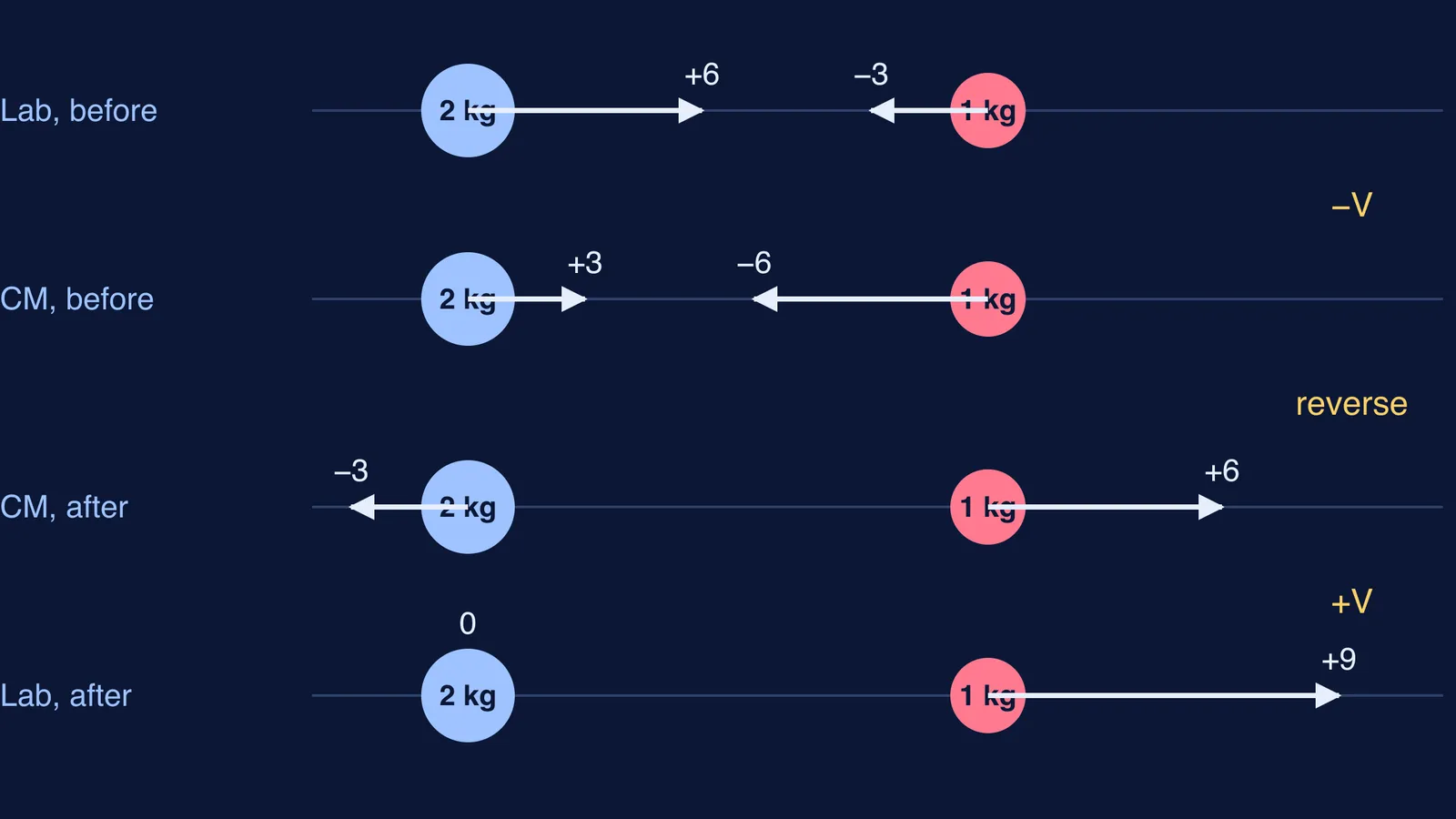
Worked example: a 2 kg ball meets a 1 kg ball head-on
A 2 kg ball moves right at 6 m/s. A 1 kg ball moves left at 3 m/s, so u2 = −3 m/s. The collision is elastic and head-on.
V = (2 × 6 + 1 × (−3)) / 3 = 9/3 = 3 m/s.
CM frame, before: u1' = 6 − 3 = +3 m/s and u2' = −3 − 3 = −6 m/s. Check: 2 × 3 + 1 × (−6) = 0.
CM frame, after: −3 m/s and +6 m/s.
Lab frame, after: v1 = −3 + 3 = 0 and v2 = 6 + 3 = 9 m/s.
Check the answer the slow way. Momentum is 12 − 3 = 9 kg m/s before and 0 + 9 = 9 kg m/s after. Kinetic energy is 36 + 4.5 = 40.5 J before and ½ × 1 × 81 = 40.5 J after. The heavy ball stops dead, which is easy to see in the CM picture: its CM-frame velocity, −3 m/s after the flip, exactly cancels V.
A quicker one: a 1 kg ball at 8 m/s hits a 3 kg ball at rest. V = 8/4 = 2 m/s, so v1 = 2 × 2 − 8 = −4 m/s (it bounces back) and v2 = 4 − 0 = 4 m/s.
Why does the CM frame method save time in exams?
One symmetric formula replaces two lopsided ones, so there are fewer places for a sign to go wrong.
Equal masses fall out at once: V = (u1 + u2)/2, so v1 = u2 and v2 = u1, and the balls swap velocities.
Relative velocity reverses, which Idema writes (for CM-frame velocities) as v_rel,f = −v_rel,i (LibreTexts). That is the same as saying the coefficient of restitution is 1.
A ball bouncing off a very heavy wall is the limit where V is the wall's velocity. Our post on the speed of a ball after an elastic collision with a moving wall works through that case.
To practise, the Fermi Problem Library has worked problems with a step-by-step solver that explains the reasoning rather than printing an answer, so you can check your V and signs.
When does the reversal rule not apply?
Inelastic collisions. Kinetic energy is not conserved, so the CM-frame momenta still flip but shrink. When bodies stick together, both end up at rest in the CM frame and move off together at V.
Glancing collisions in two dimensions. The same energy argument keeps each speed unchanged in the CM frame, but the direction can turn through an angle instead of simply reversing, so you need the scattering angle from the question. For equal masses, see why an oblique elastic collision sends the balls off at 90°.
Forgetting what V means. The collision does not change V, as long as no external force acts. Our exploding projectile simulation post shows the centre of mass carrying on regardless.
If reference frames feel shaky, the Fermi Concept Library gives each physics concept its own lesson, so you can revisit relative velocity first. Next time you see an elastic collision, find V first and write v = 2V − u twice.


