

On this page
When you solve mechanics problems for JEE or NEET, rigid formulas can sometimes hide what is really happening. A classic example is a ball hitting a massive, moving wall. If you try to apply the standard two-body momentum equations, the infinite mass of the wall breaks the algebra.
Instead, the trick is to shift your perspective. By working in the wall's frame of reference, a difficult algebra problem becomes a three-step mental calculation. If you are struggling with an oblique elastic collision of equal masses or deciding if two projectiles collide midair, the relative velocity method used here is exactly the tool you need.
What is the speed of a ball after an elastic collision with a moving wall?
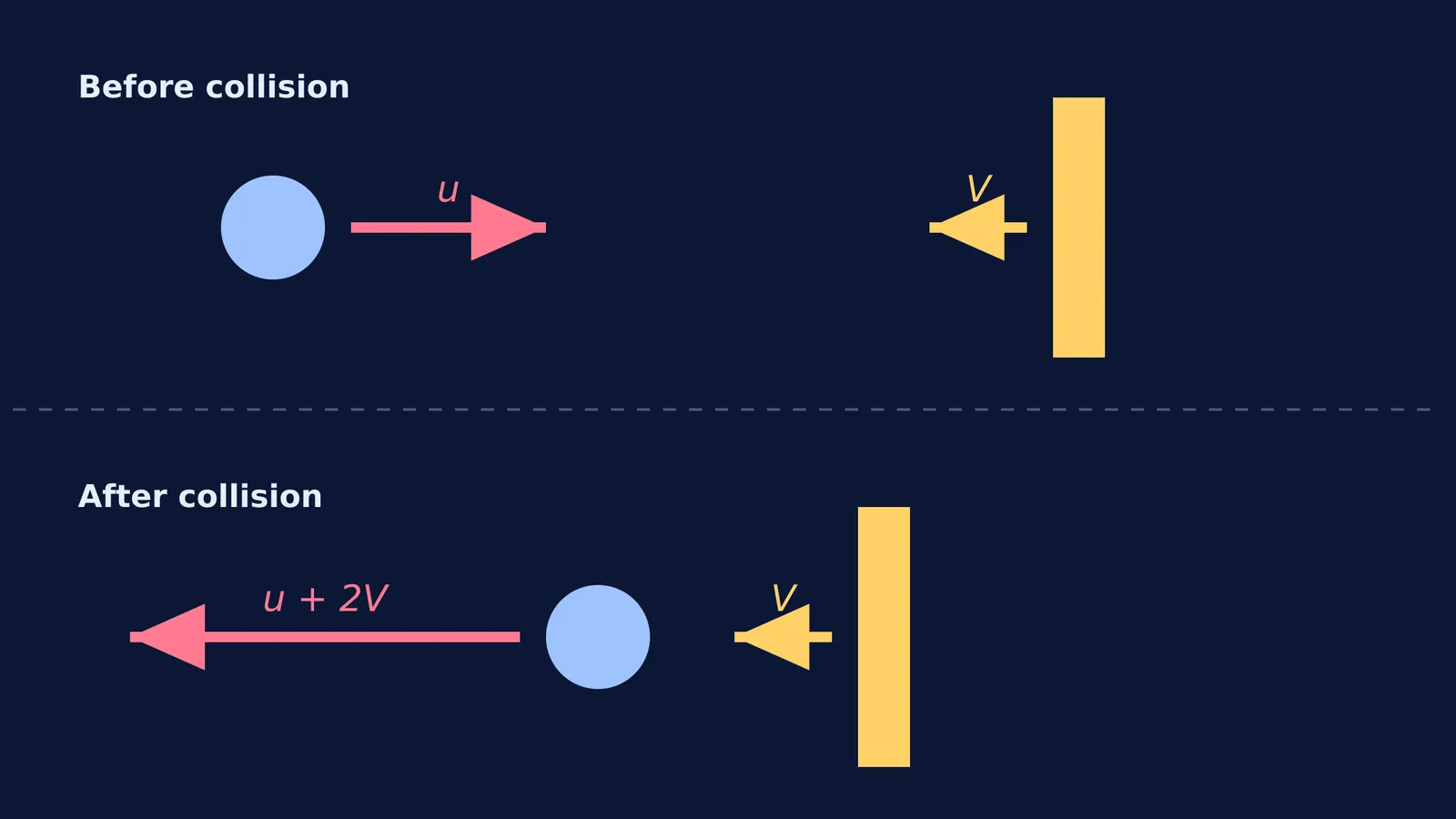
Imagine a ball travelling to the right at speed u. It is about to strike a heavy wall that is moving to the left, toward the ball, at speed V.
Because the collision is perfectly elastic, no kinetic energy is lost. According to University Physics, the defining rule of a perfectly elastic collision is that objects move away from each other at the same relative speed at which they approached each other (OpenStax).
When the ball hits the wall, its final speed in the opposite direction becomes u + 2V. The ball does not just reverse its speed; it steals momentum from the wall, springing back substantially faster than it arrived.
How does the wall's frame of reference make the calculation easier?
To see why the final speed is u + 2V, we stop watching from the ground and imagine we are moving alongside the wall at speed V. This is called shifting to the wall's frame of reference.
Find the approach speed in the wall's frame: If you are sitting on the wall moving to the left at V, and the ball is coming at you from the left at u, the ball appears to be moving faster. The relative speed of approach is u + V.
Apply the elastic reflection rule: In your frame of reference, you are stationary. An elastic collision with a stationary wall simply reverses the ball's direction without changing its speed. The ball therefore bounces away from you at a relative speed of u + V.
Shift back to the ground frame: The ball is now travelling away from the wall at u + V. But the wall itself is still moving to the left at V over the ground. To an observer on the ground, the ball's total speed to the left is the speed of the bounce plus the speed of the wall. That makes the final ground speed (u + V) + V, which simplifies to u + 2V.
If you struggle to piece together these steps during an exam, the Fermi Problem Library has worked problems with a step-by-step solver that explains the reasoning rather than printing an answer.
What happens when the wall moves away from the ball?
The same logic applies if the wall is retreating. Suppose the ball is thrown at speed u to the right, chasing a wall moving at speed V to the right (where u is greater than V, so the ball can catch up).
In the wall's frame, the ball approaches at a slower relative speed: u − V. When it strikes, it bounces back elastically, travelling away from the wall at u − V. However, because the wall is moving to the right at V, we must subtract the wall's forward motion from the ball's backward bounce to find the ground speed.
The ball's final speed to the left is (u − V) − V, leaving it at u − 2V. The ball loses speed because the receding wall absorbs some of its kinetic energy. This is the exact mechanism spacecraft use to speed up or slow down when performing gravitational slingshots around moving planets.
Why does the infinite mass of the wall matter?
In a standard collision between two objects, both masses change their velocities to conserve the total momentum of the system. However, when one object is a massive wall (or a heavy truck), its mass is effectively infinite compared to the ball.
Because the wall's mass is so large, the impact with the tiny ball does not noticeably change the wall's speed. The wall keeps ploughing forward at speed V. All the changes happen to the lighter object, which must absorb the full momentum shift. This assumption—that V remains constant before and after the bounce—is the secret that allows the relative velocity shortcut to work perfectly. Without this assumption, you would need to calculate a tiny fractional change in the wall's speed, pulling you right back into the heavy algebra you wanted to avoid.
A worked example: checking your intuition
Let us put arbitrary numbers to the idea to check the algebra using the relative velocity principles established by standard texts (OpenStax). A tennis ball is served at 30 m/s toward a concrete barrier mounted on a truck moving toward the player at 10 m/s.
Initial ball speed (u) = 30 m/s
Wall speed (V) = 10 m/s
Final speed = u + 2V = 30 + 2(10) = 50 m/s
The ball returns at 50 m/s. Notice how much kinetic energy the ball gained from the moving wall.
When you study from the Fermi Concept Library, you will find every concept in physics, chemistry, biology, mathematics and computing, each with its own lesson and its place in the map, showing how relative velocity connects elastic collisions to broader momentum principles like a shell exploding midair. Mastering the shift in reference frames is one of the most powerful habits you can build for competitive physics.


