

On this page
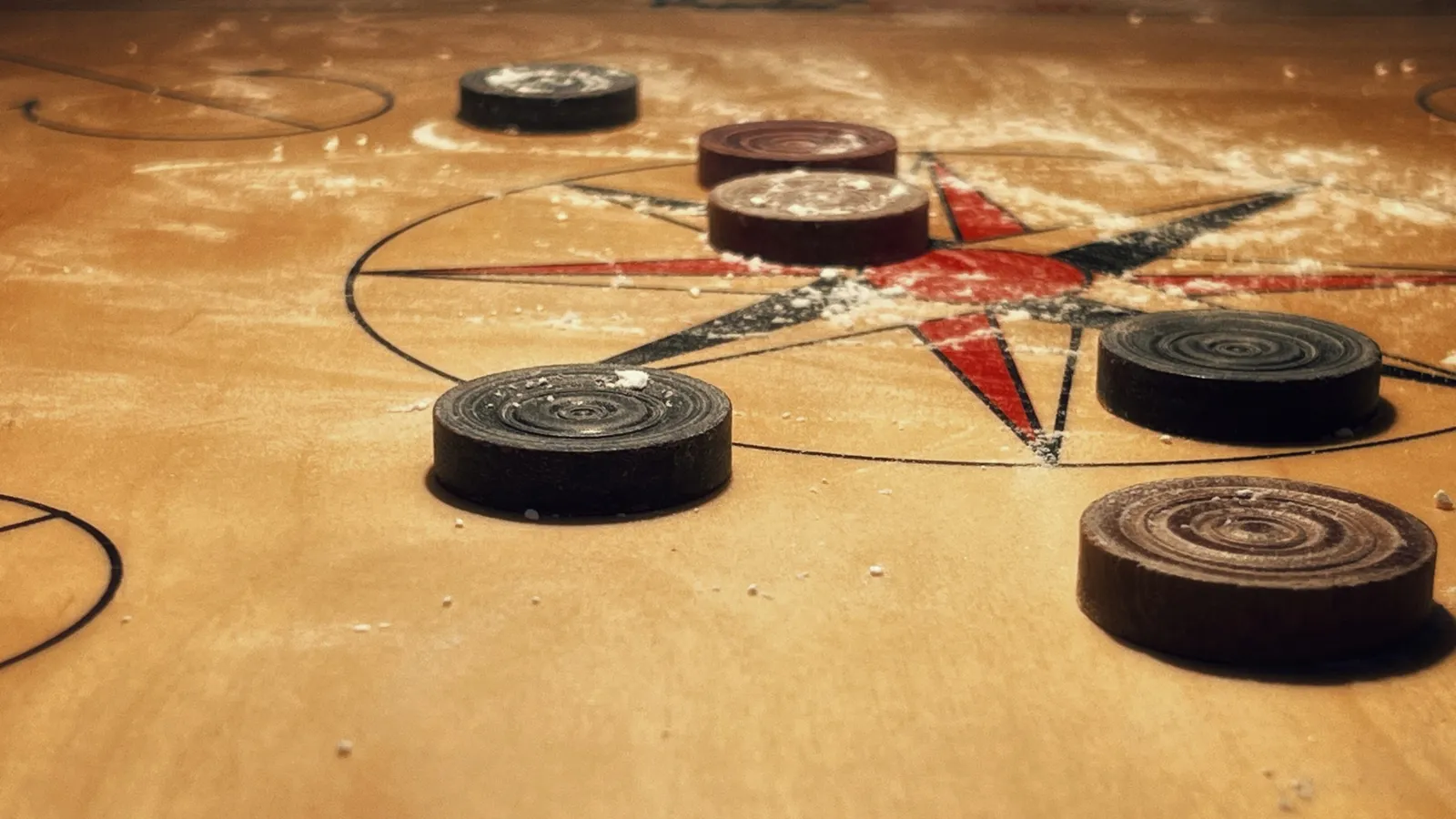
In carrom or billiards, a thin cut sends the striker and the target off at close to a right angle. Physics exams ask you to prove it, then twist the question by making the collision inelastic or the masses unequal. This post gives the proof, two worked examples and what changes when the conditions break.
Where is this in the syllabus?
The NTA Syllabus for JEE (Main) 2026 lists "elastic and inelastic collisions in one and two dimensions" in Unit 4, and the NEET (UG) 2026 syllabus uses the same words. The NCERT Class 11 chapter Work, Energy and Power (Reprint 2026-27) works it as Example 5.12: a cue ball sends a target ball off at 37°, and the cue ball goes off at 53°. NCERT concludes that "when two equal masses undergo a glancing elastic collision with one of them at rest, after the collision, they will move at right angles to each other." It assumes friction and rotation can be ignored.
Why are the paths at 90°?
Let the moving ball have velocity u, and the final velocities be v₁ (cue) and v₂ (target). Momentum is a vector, as OpenStax University Physics, section 9.5 stresses, so conserve it as a vector. The masses are equal, so they cancel:
Momentum: u = v₁ + v₂
Kinetic energy: u² = v₁² + v₂²
Square the first equation: u² = v₁² + v₂² + 2 v₁·v₂
Compare 2 and 3: v₁·v₂ = 0. Either one ball stops (a head-on hit) or the two velocities are perpendicular. In picture form, u, v₁ and v₂ make a right-angled triangle, and energy conservation is Pythagoras' theorem.
Worked example 1: an elastic glancing hit
A ball moving at 3.0 m/s strikes an identical ball at rest. The target moves off at 40° to the original direction. Find both speeds.
For smooth spheres the impulse acts along the line joining the centres, so the target moves along that line. The cue ball goes off at 90° − 40° = 50° on the other side.
Target: v₂ = u cos 40° = 3.0 × 0.766 = 2.30 m/s
Cue: v₁ = u sin 40° = 3.0 × 0.643 = 1.93 m/s
Check energy per kilogram: ½(3.0)² = 4.5 J; ½(1.93² + 2.30²) = 4.5 J.
What if the collision is not perfectly elastic?
Keep the same geometry but take a coefficient of restitution e = 0.8. Work along the line of centres, where the approach speed is u cos 40° = 2.30 m/s.
Target, along the line: (1 + e)/2 × 2.30 = 0.9 × 2.30 = 2.07 m/s
Cue, along the line: (1 − e)/2 × 2.30 = 0.1 × 2.30 = 0.23 m/s
Cue, across the line: unchanged at 1.93 m/s
The cue ball now moves at tan⁻¹(1.93/0.23) ≈ 83° from the line of centres, so the two paths are about 83° apart, not 90°. Any loss of kinetic energy closes the angle.
What if the masses are different?
Redo the proof keeping the masses. Multiplying the energy equation by m₁ and subtracting it from the squared momentum equation gives
2m₁ v₁·v₂ = (m₁ − m₂) v₂².
So the sign of the dot product follows m₁ − m₂:
Heavier ball hits a lighter one: angle less than 90°. With m₁ = 2m₂ and the same 40° line, it is about 68°.
Lighter ball hits a heavier one: angle more than 90°. With m₁ = m₂/2, it is about 112°.
Equal masses: exactly 90°.
Which mistakes cost marks?
Using the rule outside its conditions. It needs equal masses, a target at rest and an elastic collision.
Applying restitution to whole speeds. Use e only for the components along the line of centres. Our post on collisions and the coefficient of restitution covers this.
Adding speeds as numbers. 3.0 ≠ 1.93 + 2.30; momentum adds as vectors.
Measuring both angles from different lines. Measure both from the original direction, then add them.
A practice routine
Write the three-line proof from memory.
Redo example 1 with the target at 25°. (Check: 2.72 m/s and 1.27 m/s.)
Redo the inelastic case with e = 0.5 and find the angle between the paths.
Derive the unequal-mass result and test it on m₁ = 3m₂.
When you can follow the proof but freeze on setting up a new collision, the Fermi Problem Library has worked problems with a step-by-step solver that explains the reasoning at each step.
Next time you play carrom, watch the striker and the coin after a thin cut, then write down the three-line proof.


