
On this page
A shell flies up, splits in two at the top, and the pieces go their separate ways. So where does "the projectile" go now? Until the first piece hits the ground, the centre of mass carries on along the parabola it was already on, as if nothing had happened. Here is how to predict that, and where each piece lands.
Why does the centre of mass keep the original parabola?
The centre of mass is the mass-weighted average of the positions of all the parts of a system, as defined in OpenStax University Physics, section 9.6. The same section explains that internal forces cannot change the momentum of the system as a whole; only external forces can.
An explosion is made of internal forces: piece A pushes on piece B, and B pushes back just as hard. Gravity is the only external force before and after the split, so the centre of mass still accelerates at g downwards. OpenStax says it directly about a firework shell: after it bursts, "the center of mass of the shell is now a projectile (the only force on it is gravity), so its trajectory does become parabolic."
So make two predictions before you press play:
Until the first piece lands, the centre of mass follows exactly the same curve the unbroken projectile would have followed.
Each fragment traces a new parabola of its own, but their mass-weighted average stays on the old one.
Our step-by-step piece on a shell exploding midair, its momentum and its fragments works through the momentum and energy side.
Where do the fragments land after the explosion?
We use the shortcut from MIT OpenCourseWare's classical mechanics notes (Example 10.5): find where the centre of mass lands, then use the definition of the centre of mass to place the pieces.
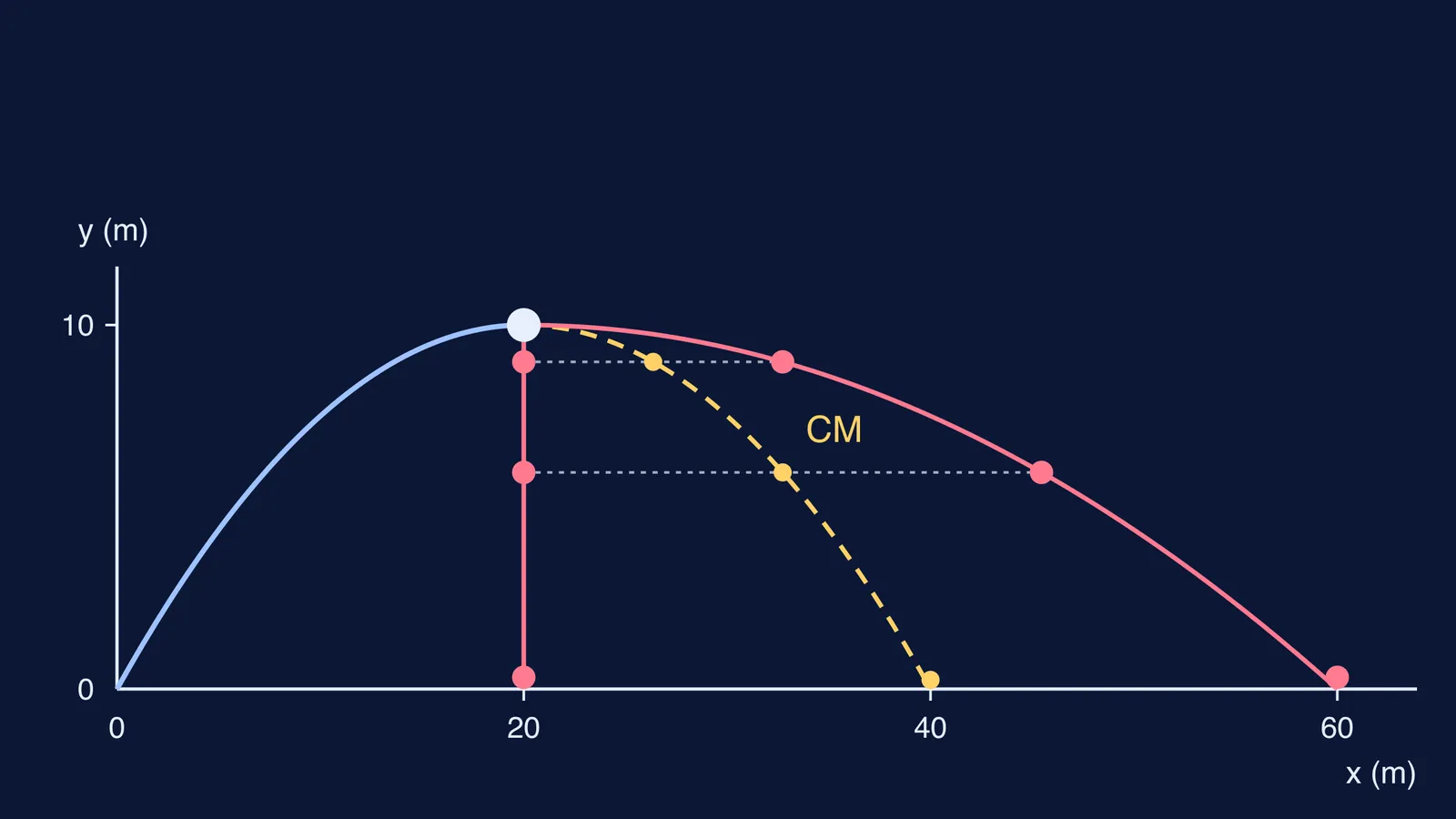
Take a 2 kg ball launched at 20 m/s at 45°, with g = 10 m/s² and no air resistance. Its range is u² sin 2θ / g = 40 m, and its maximum height is u² sin² θ / 2g = 10 m, reached at x = 20 m.
Case 1: equal halves. At the top, the ball splits into two 1 kg pieces. One piece is left momentarily at rest and drops straight down, landing at x = 20 m. Horizontal momentum is conserved during the split, so the other piece leaves with twice the original horizontal speed. Both start from 10 m with no vertical velocity, so they land at the same moment, and the centre of mass lands at 40 m:
(1 × 20 + 1 × x) / 2 = 40, so x = 60 m.
Case 2: unequal pieces. In the MIT example, the projectile explodes at the top of its path into two pieces that fly apart horizontally: a quarter-mass piece and a three-quarter-mass piece. The small piece lands back at the launch point. The centre of mass lands at twice the explosion's distance from launch, so the large piece lands at 8/3 of that distance. In our numbers, the 0.5 kg piece lands at 0 m and the 1.5 kg piece at about 53.3 m, which puts the centre of mass at 40 m. The MIT notes point out that neither the height nor g enters the answer.
When does the landing-point rule fail?
The parabola rule lasts only as long as gravity is the only external force. Watch for two cases:
Pieces land at different times. If the explosion gives one piece an upward or downward kick, one piece hits the ground first. From then on the ground pushes on it, so the centre of mass of the pair leaves the parabola and the balance rule for landing points no longer holds.
Air resistance is switched on. Drag is an external force, so the centre of mass no longer follows the vacuum parabola.
For more practice, see centre of mass problems: finding it and using it.
How do you test this in a simulation?
Crouch, Fagen, Callan and Mazur (2004) found that students who passively watched a classroom demonstration understood the underlying concept no better than students who did not see it at all, while students who predicted the outcome first showed significantly greater understanding. So write your prediction down before you run anything.
A ten-minute plan:
Sketch the original parabola and mark where you think the centre of mass will land.
Choose the masses and the kick. Use the balance rule to predict where each piece lands.
Run the simulation with a centre-of-mass trace on, and compare.
Change one thing: give one piece a vertical kick. Predict which rule breaks, then check.
Write one sentence explaining any mismatch.
The Fermi Simulation Lab has interactive simulations for ideas that are easier to see than to read, and the same predict-first loop works there. Our post on learning projectile motion with a simulation through six predictions uses this method on unbroken projectiles. If the algebra in a numerical trips you up, the Fermi Problem Library has worked problems with a step-by-step solver that explains the reasoning.