On this page
Most students can say "fixed end inverts, free end doesn't". Fewer can say why, or what happens when a light string is tied to a heavy one. Guess first, then send a pulse down a virtual string and watch it come back. Below: the reason behind each result, a test plan and a worked example for two joined strings.
What happens to a wave pulse at a fixed end?
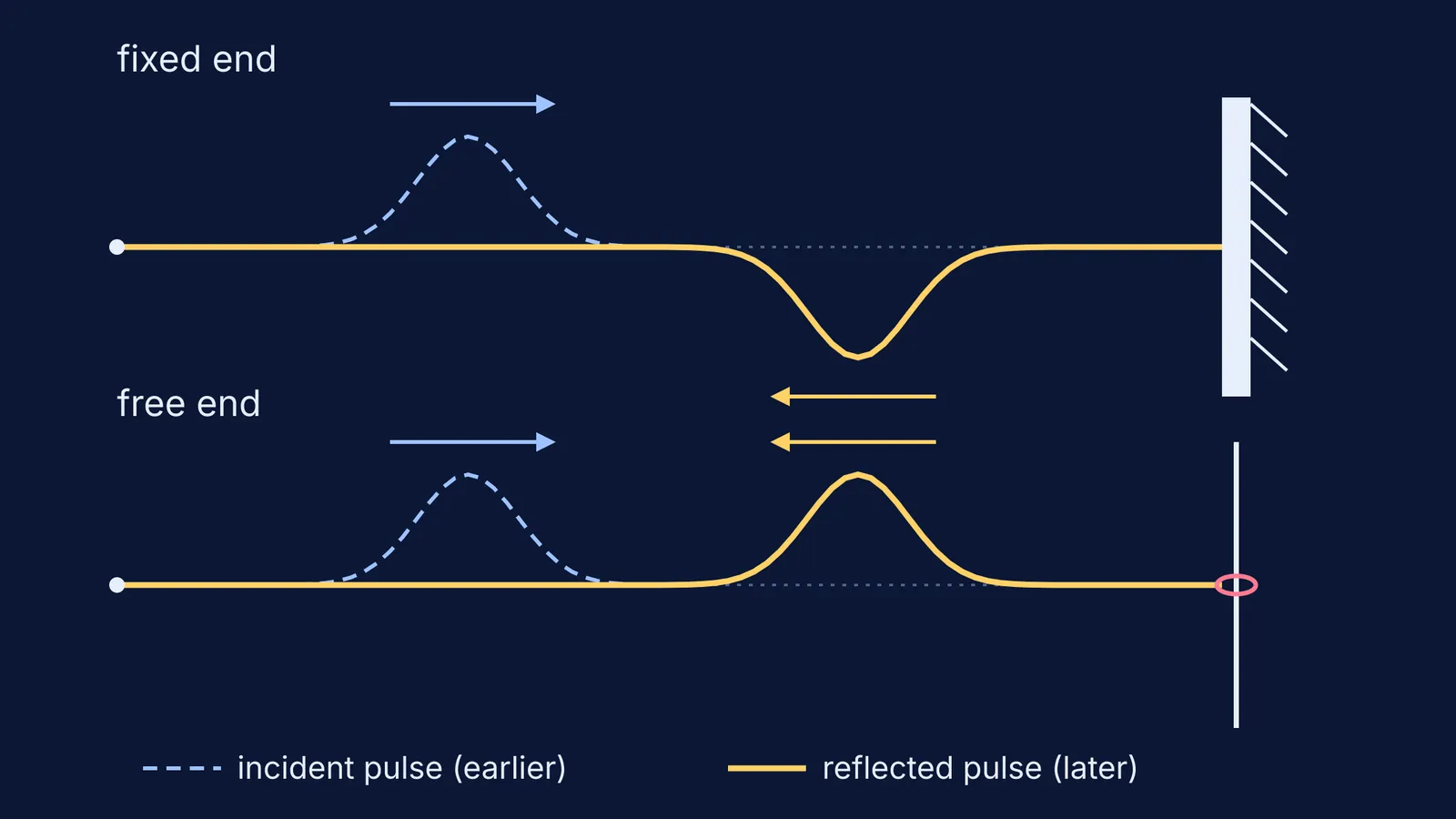
It comes back upside down. The OpenStax University Physics text puts it this way: at a fixed boundary, "the reflected wave is reflected 180° (π rad) out of phase with respect to the incident wave", so a crest returns as a trough (OpenStax, University Physics Vol. 1, section 16.5).
The fixed point can never move, so the displacement there must stay zero at every moment. An incoming upward pulse and the returning pulse can only cancel at the wall if the returning pulse points down. In the standard junction formulas, a fixed end is the limit where the reflected amplitude equals minus the incident amplitude, nothing is transmitted and a node forms at the boundary (Fitzpatrick, University of Texas at Austin).
What happens at a free end?
The pulse comes back upright. A "free" end usually means the string is tied to a light ring sliding on a smooth vertical rod. The ring moves freely but feels no sideways force, so the string must meet the rod flat. OpenStax states that for a free boundary "the reflected wave is in phase with respect to the incident wave" (OpenStax, section 16.5).
The same formulas give a reflected amplitude equal to the incident amplitude, with an antinode at the boundary (Fitzpatrick). As the pulse arrives, the ring briefly rises to twice the pulse height before the pulse heads back. Watch for that overshoot in the simulation.
How do you test wave reflection in a simulation?
The free PhET Wave on a String simulation lets you set the end to fixed, loose or open (no end) and adjust tension and damping (PhET description on ComPADRE). Set damping to zero so the returning pulse is easy to see.
Write your prediction for each end first: upright or inverted, and roughly how tall.
Fixed end: send one pulse. Pause just after it reflects and check which side of the line it is on.
Loose end: send the same pulse. Watch the ring at the moment of reflection and note how high it goes.
No end: send it again. Nothing should come back; this is your control.
For any failed prediction, write which boundary condition you forgot: zero displacement or zero sideways force.
Our Fermi Simulation Lab has interactive simulations for ideas that are easier to see than to read. Next, try finding harmonics in a standing-wave simulation: standing waves are reflections from both ends adding up.
What happens when a pulse reaches a join of two strings?
Part of the pulse reflects and part goes through. OpenStax states that going from a low-density to a high-density string, the reflected wave is out of phase and the transmitted wave in phase; from high to low density, both are in phase (OpenStax, section 16.5).
To get the sizes, use each string's impedance, Z = √(μT), where μ is mass per unit length and T is tension. The reflected amplitude is (Z₁ − Z₂)/(Z₁ + Z₂) times the incident amplitude. The transmitted amplitude is 2Z₁/(Z₁ + Z₂) times it (Fitzpatrick).
Worked example. Take two strings under the same tension, the second with four times the mass per unit length, so Z₂ = √4 × Z₁ = 2Z₁.
Light into heavy: reflected = (1 − 2)/3 = −1/3, so the reflection is inverted and one third as tall. Transmitted = 2/3, upright.
Heavy into light: reflected = (2 − 1)/3 = +1/3, upright. Transmitted = 4/3, upright and taller than the pulse that arrived.
Energy check (light into heavy): the reflected power fraction is (1/3)² = 1/9 and the transmitted fraction is (Z₂/Z₁) × (2/3)² = 2 × 4/9 = 8/9. They add to 1, as the source says they must (Fitzpatrick).
The 4/3 surprises people, but it is not free energy: a lighter string carries less energy at the same height. Push the limits and you recover the two ends: infinite impedance acts like a wall, zero like a free ring. Practise with reflected and transmitted amplitudes on a string, and see how wave speed on a string changes with tension.
What should you remember for exams?
Fixed end: inverted, node at the end, nothing transmitted.
Free end: upright, antinode at the end, the end briefly reaches twice the height.
Into a heavier string: the reflection inverts. Into a lighter one: it stays upright. The transmitted pulse is always upright.
Reflected and transmitted power fractions always add to 1.
If a junction problem still trips you up, the Fermi Problem Library has worked problems with a step-by-step solver that explains the reasoning rather than printing an answer. Then test your answer in the simulation.