

On this page
Ask a student a seemingly simple physics question: "If I tighten a guitar string so the tension is four times as great, how much faster will a wave pulse travel along it?"
Most students will answer without hesitating: "Four times as fast."
They are wrong, but they are wrong in a completely predictable way. They have fallen for a cognitive trap that trips up learners across the sciences. Here is why the intuition fails, what the physics actually says, and how to test it.
What is the illusion of linearity?
When students see that one thing causes another, they naturally assume the relationship is a straight line. If you double the input, you double the output. If you multiply the pull by four, the speed must multiply by four.
Educational researchers call this the "illusion of linearity". In their 2007 book *The Illusion of Linearity*, Dirk De Bock and colleagues documented how deeply ingrained this proportional bias is. Because early maths education relies heavily on linear ratios—like calculating the cost of four apples if two cost a certain amount—students turn to proportional reasoning even when the physical laws are quadratic, inverse, or governed by square roots.
This bias trips up students constantly in high school physics. They assume that driving a car twice as fast will require twice the braking distance, ignoring that kinetic energy scales with the square of the speed. They assume that doubling the distance between two magnets will halve the magnetic force, missing the inverse-square law. When intuition says the universe is built on simple ratios, non-linear relationships feel wrong until they are proven.
What is the formula for wave speed on a string?
The speed of a transverse wave pulse on a string depends on just two physical properties of the string itself: how tightly it is pulled, and how heavy it is. You cannot change the speed of the wave by flicking your wrist harder or shaking the string faster.
According to standard wave mechanics, the speed (v) is determined by the tension (F_T) and the linear mass density (μ, the mass per unit length):
v = √(F_T / μ)
This formula/Book%3A_University_Physics_I_-_Mechanics_Sound_Oscillations_and_Waves_(OpenStax)/16%3A_Waves/16.04%3A_Wave_Speed_on_a_Stretched_String) shows that the speed is proportional to the square root of the tension. The tension acts as the restoring force: a tighter string snaps back to its resting position more violently, pulling the neighbouring sections of the string along with it. The mass density acts as the inertia: a thicker, heavier string resists being moved, slowing the wave down.
If you keep the string the exact same thickness (so μ does not change) but increase the tension from F_T to 4 × F_T, you can substitute the new tension into the formula:
New speed = √(4F_T / μ)
New speed = 2 × √(F_T / μ)
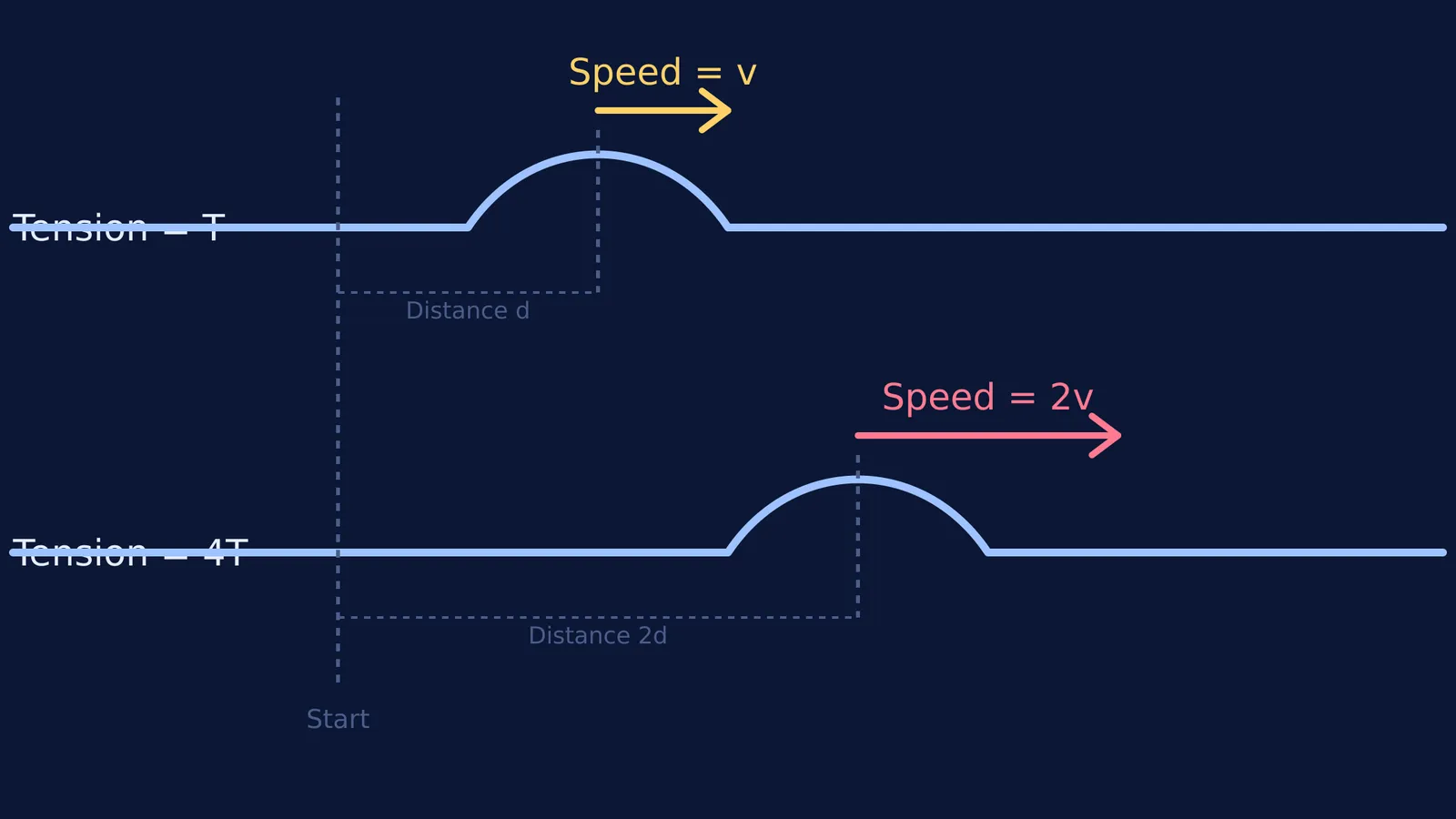
Because the square root of 4 is 2, the speed of the wave pulse doubles. A massive four-fold increase in effort only buys you a two-fold increase in speed.
How can you test the prediction in a simulation?
Physics is not just about memorising the square root rule; it is about seeing it in action. When an idea contradicts intuition, running an experiment is the fastest way to rewrite that intuition.
You can test this relationship directly in the Fermi Simulation Lab. Set up two identical strings on the screen. Set the tension of the first string to 1 N, and the second string to 4 N. When you launch a wave pulse down both strings at the exact same moment, you can watch the race. The pulse on the high-tension string pulls ahead, but when it reaches the end, the slow pulse is exactly halfway there.
If a student gets stuck trying to remember the formula or picture the outcome, Fermi's AI tutor can run the simulation alongside them, pausing to ask what they notice about the two speeds before moving on to the maths.
How to test your child's physical intuition?
You can use this exact question as a diagnostic tool to check how your child approaches non-linear physics problems at home.
Ask the question: "If I tighten a string four times as much, what happens to the speed of a wave on it?"
Wait for the answer: If they say "it goes four times as fast", do not just tell them they are wrong. Their linear logic is perfectly normal; it is just being applied to the wrong situation.
Prompt the formula: Ask them to write down the formula for wave speed on a stretched string.
Run the numbers: Have them plug in the number 4 for the tension, and ask them what the square root symbol does to that 4.
Expand the lesson: Ask them where else in their physics syllabus they have seen square roots or squared terms, such as the equations for how a stretched wire changes resistance or the elastic potential energy in a stretched wire.
It is a small check, but breaking the illusion of linearity early makes a huge difference when they face harder topics. Once a student learns to look out for the square root, they stop guessing blindly and start trusting the calculation.


