

On this page
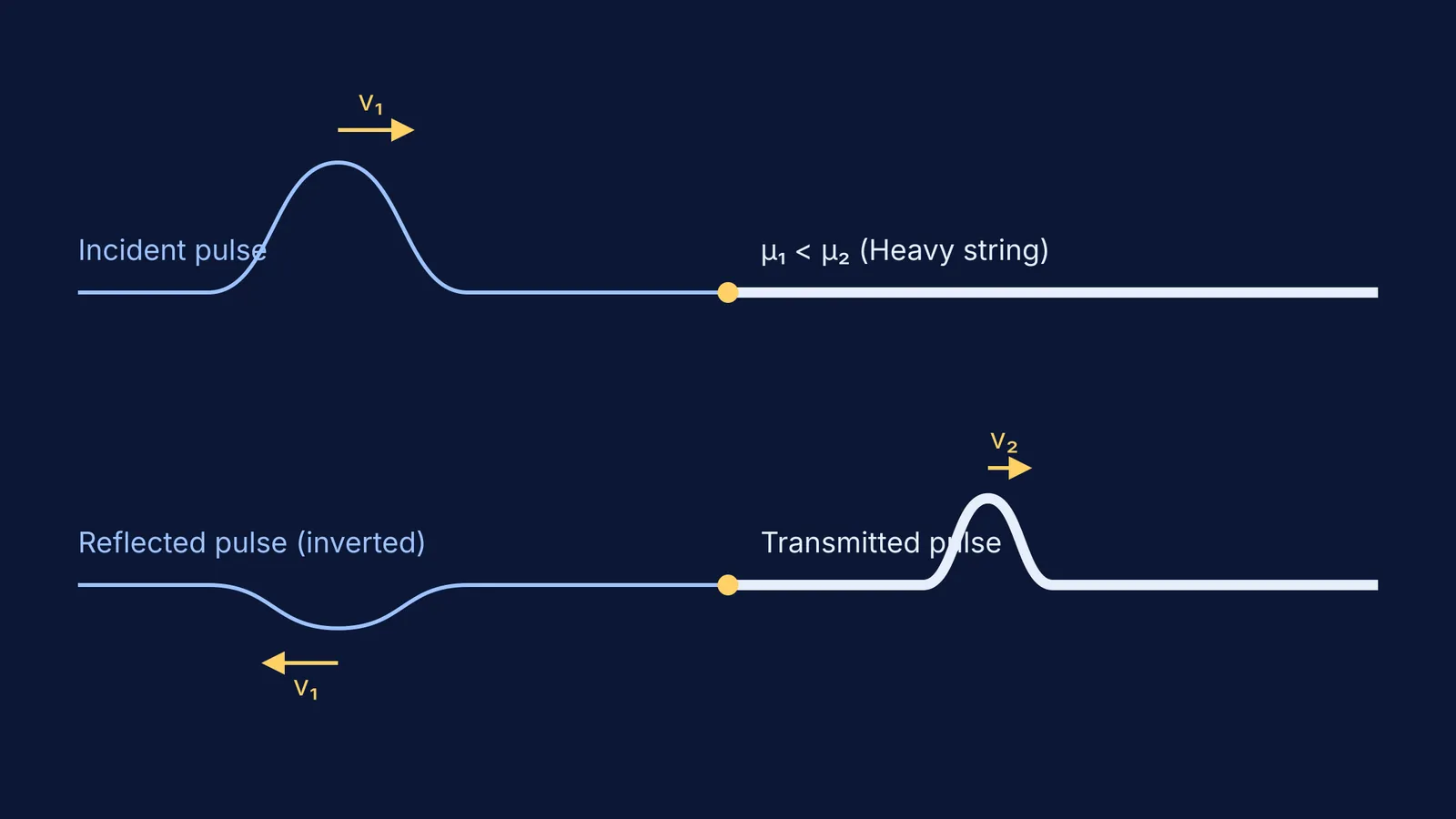
When a wave travelling on a string encounters a knot tying it to a second string of a different thickness, the wave splits. One part continues forward into the new string, and another part bounces back.
Just like translating phase difference to path difference requires matching the geometry of a wave, calculating these split waves requires matching the physical limits at the boundary. The knot joining the two strings must not break, which means the displacement of the string on the left must exactly match the displacement on the right at all times. Furthermore, assuming the knot is massless, the transverse forces pulling on it must balance out, meaning the slope of the string must be continuous across the junction.
Reflected and transmitted amplitude at junction of two strings?
By solving those two boundary conditions—displacement and slope—physicists arrive at two fundamental formulas for the amplitude ratios. These ratios depend entirely on the wave speed in the first string (v₁) and the wave speed in the second string (v₂). Derived from the general transmission principles detailed on Wikipedia, the formulas for a string are:
Reflection coefficient (r): The ratio of the reflected amplitude to the incident amplitude is (v₂ − v₁) / (v₁ + v₂).
Transmission coefficient (t): The ratio of the transmitted amplitude to the incident amplitude is 2v₂ / (v₁ + v₂).
Because the speed of a wave on a stretched string is determined by its linear mass density (μ) and tension (v = √(T/μ)), as explained by Lumen Learning, a heavier, thicker string carries a slower wave. This speed difference dictates exactly how the wave's energy divides at the knot.
Why does the reflected wave sometimes invert?
If you look closely at the reflection formula, r = (v₂ − v₁) / (v₁ + v₂), the sign of the result changes depending on which string is faster.
Light to heavy (v₁ > v₂): When the wave enters a heavier, slower string, the term (v₂ − v₁) becomes negative. A negative reflection coefficient means the pulse undergoes a 180° phase shift. In practical terms, a crest bounces back as a trough. The heavy string struggles to move as quickly as the light string expects, acting a bit like a fixed wall.
Heavy to light (v₁ < v₂): When the wave moves into a lighter, faster string, the numerator is positive. The reflected wave stays upright, and a crest reflects as a crest. The boundary yields easily, acting more like a free end.
The transmission coefficient, 2v₂ / (v₁ + v₂), is always positive because wave speeds cannot be negative. Therefore, the wave that makes it through the junction never flips upside down, regardless of the strings' densities. This mathematical continuity is a staple of wave mechanics, similar to the phase relationships seen between displacement and pressure waves in sound.
How do you calculate the exact amplitudes?
Let us say you have an incident pulse with an amplitude of 10 cm travelling on a light string at 100 m/s. It hits a heavier string where the wave speed drops to 50 m/s.
To find the new amplitudes, we plug the values into the transmission formulas from Wikipedia. Here, v₁ = 100 and v₂ = 50.
First, find the reflection coefficient:
r = (50 − 100) / (100 + 50) = −50 / 150 = −1/3. The reflected amplitude is −1/3 × 10 cm = −3.33 cm. The negative sign confirms the pulse is inverted.
Next, find the transmission coefficient:
t = (2 × 50) / (100 + 50) = 100 / 150 = 2/3. The transmitted amplitude is 2/3 × 10 cm = 6.67 cm.
Notice that the transmitted amplitude (6.67 cm) and the reflected amplitude (−3.33 cm) perfectly obey the displacement boundary condition at the knot: the sum of the incident and reflected amplitudes (10 + (−3.33)) equals the transmitted amplitude (6.67).
Mastering wave boundaries
Wave boundary conditions can be hard to picture. When you rely solely on memorising formulas, it is easy to get the algebra wrong or forget whether the heavy string causes the inversion.
If you are stuck on a textbook problem about wave transmission ratios, put it into the Fermi Problem Library. Instead of simply printing the final amplitude, the step-by-step solver walks you through matching the boundary conditions yourself. If you are struggling to picture why the wave flips when it hits a dense boundary, you can open the Fermi Simulation Lab to send pulses across different knots and watch the crests and troughs in motion. And if you are completely lost in the algebra, Fermi's AI tutor can build a plan for the session so you can review wave speeds and impedance before you try another problem.


