

On this page
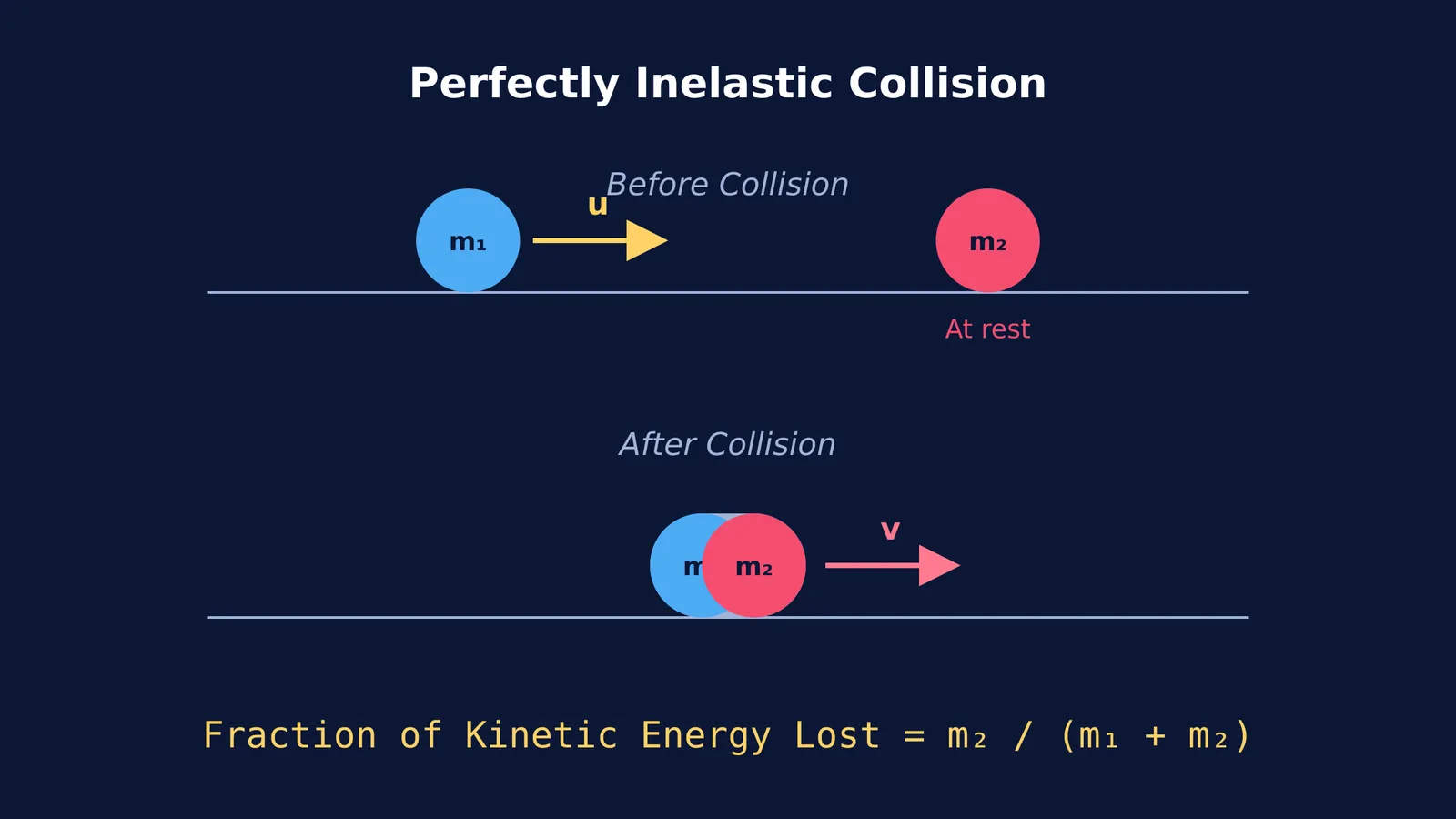
When two objects collide and stick together, they form a single mass moving at a common velocity. This is called a perfectly inelastic collision. While the total momentum of the system is conserved, the kinetic energy is not.
If a body of mass m₁ moving at velocity u strikes a stationary body of mass m₂, a significant portion of its kinetic energy is lost. The fraction of kinetic energy lost perfectly inelastic collision problems ask you to find depends entirely on the ratio of the two masses.
What happens in a perfectly inelastic collision?
In any isolated collision, the total momentum remains constant. For a perfectly inelastic collision where the second object is initially at rest, the law of conservation of momentum states that the initial momentum of the moving body equals the final momentum of the combined mass.
According to standard physics principles, we write this as: m₁u = (m₁ + m₂)v
Here, v is the final velocity of the stuck-together objects. Rearranging for v gives: v = [m₁ / (m₁ + m₂)] u
This shows that the final velocity is always less than the initial velocity, because the initial momentum must now carry a larger combined mass (OpenStax).
How do you derive the kinetic energy lost?
To find the energy lost, we calculate the difference between the initial kinetic energy (K_i) and the final kinetic energy (K_f).
The initial kinetic energy belongs entirely to the first mass:
K_i = ½ m₁u²
The final kinetic energy is shared by the combined mass moving at velocity v:
K_f = ½ (m₁ + m₂)v²
Substitute the expression for v into the final kinetic energy equation: K_f = ½ (m₁ + m₂) [m₁u / (m₁ + m₂)]² K_f = ½ [m₁² u² / (m₁ + m₂)]
Now, subtract the final kinetic energy from the initial kinetic energy to find the absolute loss (ΔK): ΔK = K_i − K_f ΔK = ½ m₁u² − ½ [m₁² u² / (m₁ + m₂)] ΔK = ½ m₁u² [1 − m₁ / (m₁ + m₂)] ΔK = m₁m₂u² / 2(m₁ + m₂)
This is the standard formula for the kinetic energy lost when a moving body sticks to a stationary one.
Where does the lost energy go?
Energy cannot be destroyed. When a physics problem asks for the "lost" kinetic energy, it means the energy is no longer measurable as macroscopic movement. Instead, it is transformed into other forms.
In real-world inelastic collisions, this energy goes into:
Deformation: Bending metal in a car crash or squashing a ball of clay.
Heat: Increasing the internal thermal energy of the colliding objects.
Sound: Generating the acoustic waves of the impact.
If you are confused by how energy transforms across different types of collisions, the Fermi Concept Library covers every concept in physics, chemistry, biology, mathematics and computing, each with its own lesson and its place in the map. If you are stuck on a conservation of momentum problem and do not know where to start, Fermi's AI tutor can work out what you already know and build a plan for the session, writing on a board, drawing the figure, running the simulation, and checking understanding as it goes. For checking your method, the Fermi Problem Library has worked problems with a step-by-step solver that explains the reasoning rather than printing an answer.
What happens at extreme mass ratios?
The fraction formula m₂ / (m₁ + m₂) provides immediate insight into extreme scenarios without requiring any calculations.
If a very light object strikes a very heavy stationary object (m₁ ≪ m₂), the fraction m₂ / (m₁ + m₂) approaches 1. This means nearly 100% of the initial kinetic energy is lost (OpenStax). An example is a fly hitting a stationary train. The fly stops moving, the train barely moves, and almost all the fly's initial energy goes into deformation.
Conversely, if a very heavy object strikes a very light stationary object (m₁ ≫ m₂), the fraction m₂ / (m₁ + m₂) approaches 0. Almost 0% of the kinetic energy is lost. Think of a moving train hitting a stationary fly. The train's velocity is practically unchanged, so it keeps nearly all its kinetic energy.
How does a worked example look?
Imagine a 2 kg block of clay sliding at 6 m/s across a frictionless surface. It hits a stationary 4 kg block, and they stick together.
Using the fraction formula, the fraction of kinetic energy lost is m₂ / (m₁ + m₂) = 4 / (2 + 4) = 4/6, or two-thirds (66.7%). Because this is a theoretical example applying the standard physics model, we can verify this with absolute numbers rather than experimental data (OpenStax).
Let us verify this with the absolute numbers.
The initial kinetic energy is ½ × 2 kg × (6 m/s)² = 36 J.
Using the formula for absolute loss, ΔK = (2 × 4 × 6²) / (2 × (2 + 4)) = (8 × 36) / 12 = 288 / 12 = 24 J.
Losing 24 J out of an initial 36 J is exactly two-thirds of the energy.
This simple relation means you can often skip the velocity calculations entirely if a multiple-choice question only asks for the fractional loss.


