On this page
Heat a magnet far enough and it stops being a magnet. The more interesting question is what happens when it cools. Predict first, then check the physics below.
What is the Curie point of a magnet?
The Curie temperature is the temperature above which a ferromagnetic material cannot be magnetised, as explained in LibreTexts' introductory physics text on ferromagnets/04%3A_Unit_3-_Classical_Physics_-_Thermodynamics_Electricity_and_Magnetism_and_Light/4.11%3A_Magnetism/4.11.03%3A_Ferromagnets_and_Electromagnets). The same text gives the Curie temperature of iron as 1043 K (770 °C).
Nickel's Curie temperature is 627 K and cobalt's is 1400 K, according to the table in Wikipedia's Curie temperature article. Above this point the material is paramagnetic, because its atoms lose their ordered magnetic moments.
The strong magnets on your desk give out much sooner. A standard N-grade neodymium magnet has a Curie temperature of 310 °C and a maximum working temperature of 80 °C, according to the temperature table from magnet supplier supermagnete. The same table lists 450 °C for a Y35 ferrite magnet.
If domains are new to you, start with how Pierre Weiss explained ferromagnetism with magnetic domains.
Predict first: four magnets, four heatings
Take four identical N-grade neodymium disc magnets, with the limits from the supermagnete table in mind. Before reading on, write down what each one will be like back at room temperature.
Magnet A is warmed to 60 °C, then cooled on a wooden table.
Magnet B is heated to 200 °C, then cooled on a wooden table.
Magnet C is heated to 350 °C, then cooled on a wooden table.
Magnet D is heated to 350 °C, then cooled inside a strong, steady magnetic field.
For each, choose: same as before, a bit weaker, almost no magnetism, or magnetised again. Bonus: will Magnet C still be pulled towards another magnet?
Does heating a magnet destroy its magnetism?
Only past certain temperatures. Check your four predictions.
Magnet A: back to normal. Below the maximum operating temperature, a magnet is weaker while hot but returns to its original strength when it cools, and these reversible losses are typically within 5 to 10 percent, according to K&J Magnetics' guide to temperature and neodymium magnets. 60 °C is under the 80 °C limit that supermagnete lists for N grade.
Magnet B: permanently weaker. Above the maximum operating temperature, some of the magnetisation is lost for good, and a magnet brought back to room temperature is weaker than before, the same K&J guide says.
Magnet C: almost no magnetism. At the Curie temperature "the whole tendency to align into domains collapses, and the material ceases to be a ferromagnet at all," Mike W. wrote in an answer for the University of Illinois Physics Van Q&A. Domains form again on cooling, "but unless an external field is applied as the material cools, the domains will point all different directions, so you won't have a net magnetized permanent magnet."
So the bonus answer is yes. Magnet C is a ferromagnet again, just an unmagnetised one, like a plain iron nail. Its domains are small and randomly oriented but line up in an external field, the LibreTexts chapter/04%3A_Unit_3-_Classical_Physics_-_Thermodynamics_Electricity_and_Magnetism_and_Light/4.11%3A_Magnetism/4.11.03%3A_Ferromagnets_and_Electromagnets) explains, so a strong magnet will still pull on it.
Magnet D: magnetised again. The Illinois answer names the exception: a field applied during cooling. Nature runs this experiment in lava. When an igneous rock cools, it acquires a thermoremanent magnetisation from Earth's field that can last for millions of years, as summarised in Wikipedia's article on thermoremanent magnetization. Paleomagnetists read that frozen record to work out Earth's ancient field.
Why do domains scramble on heating and come back random?
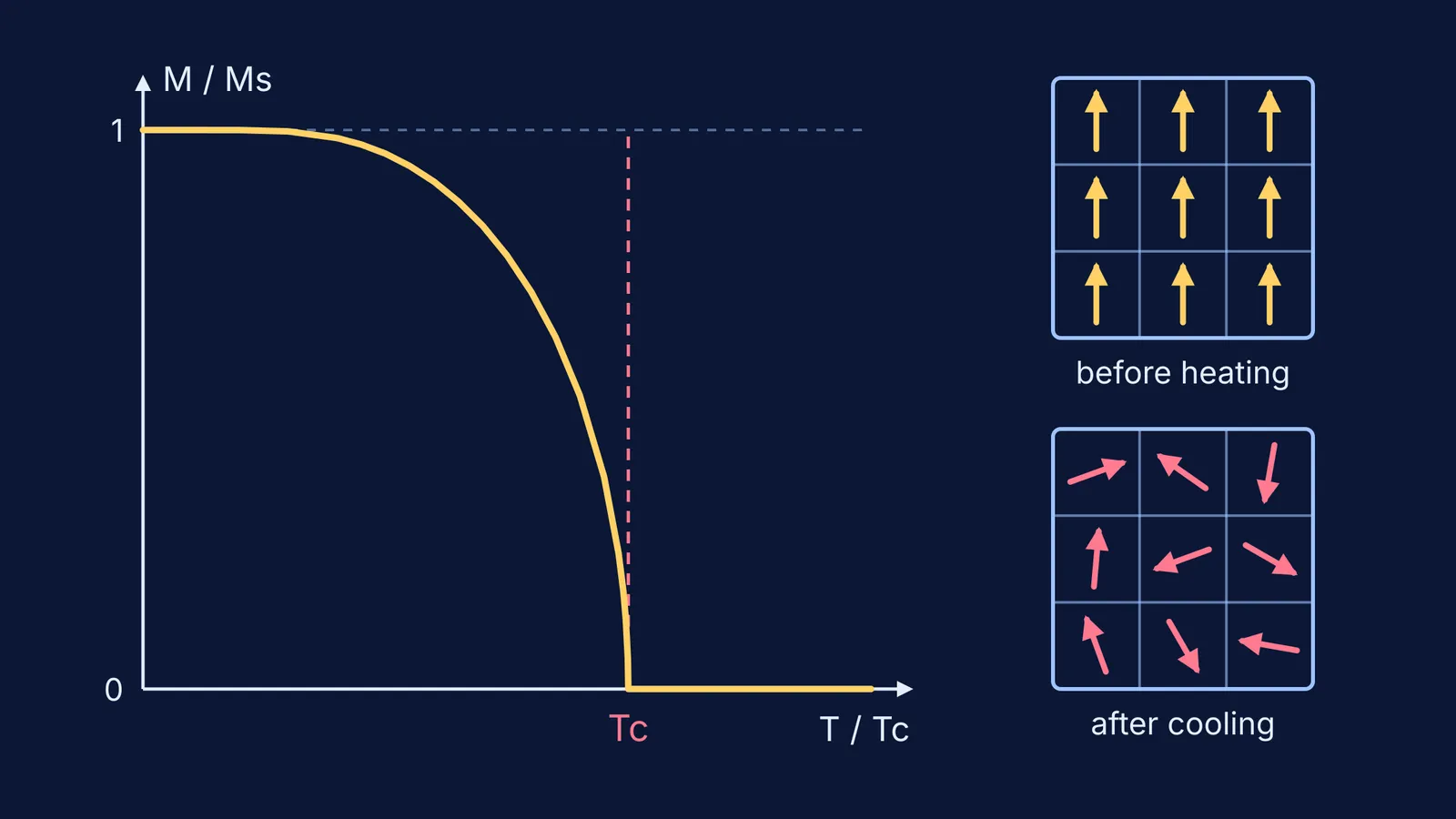
Two things compete inside a ferromagnet: neighbouring atoms pulling each other into line, and the random jiggling of heat. Thermal motion can disrupt and randomise the orientation and size of domains, the LibreTexts chapter/04%3A_Unit_3-_Classical_Physics_-_Thermodynamics_Electricity_and_Magnetism_and_Light/4.11%3A_Magnetism/4.11.03%3A_Ferromagnets_and_Electromagnets) explains. As the temperature rises, the spontaneous magnetisation approaches zero near the Curie temperature, as the Wikipedia Curie temperature article describes. Past that point, jiggling wins everywhere and there are no domains.
On cooling, lining up wins again, but each region chooses its own direction. With no outside field to break the tie, the regions point every which way and their fields mostly cancel. The diagram at the top shows both halves.
How can you watch it happen in a simulation?
In any spin or domain simulation, run this sequence:
Start cold with every spin aligned and note the net magnetisation.
Raise the temperature in steps and mark where the net value falls fastest.
Go past the Curie point and watch the pattern turn to noise.
Cool with the field at zero and count the separate regions that form.
Repeat with a small field switched on, and compare the final net magnetisation.
The Fermi Simulation Lab has interactive simulations for ideas that are easier to see than to read, so you can test each prediction instead of memorising the answer. If the word domain still feels shaky, the Fermi Concept Library gives every physics concept its own lesson.
For revision, see magnetic and non-magnetic materials, and why your spoon sticks. For younger siblings, try our magnet experiments for kids at home, which all stay at room temperature.