

On this page
If you take a fridge magnet and walk around your house, you will quickly find that it sticks to the refrigerator door, some of your spoons, and everyday paper clips. But it will slide right off a gold ring, an aluminium foil roll, and most of your older, heavier coins. This difference often confuses people who assume that all heavy, shiny metals should behave the same way. The real reason comes down to the microscopic atomic structure of the metals.
What are magnetic and non-magnetic materials?
Materials that are strongly attracted to a magnet are known as ferromagnetic materials (Wikipedia). Inside these materials, the magnetic moments of atoms line up in the same direction, creating "domains" that act like tiny magnets. When brought near an external magnet, these domains align with the field, causing a strong attraction. If you want to understand electromagnetism from the ground up, the Fermi Concept Library has a lesson for every concept in physics and chemistry, each with its place in the map. It helps you see how these microscopic domains create the forces we feel in our hands.
Materials that do not stick to a magnet are non-magnetic. Most elements fall into this category. They are either paramagnetic (very weakly attracted) or diamagnetic (very weakly repelled), but in everyday life, this force is too weak to notice. To understand how these forces are mapped, you can read about why magnetic field lines form closed loops.
What is the magnetic and non magnetic materials list?
It is a common misconception among students that all metals are magnetic, simply because they are hard and shiny. In reality, only a select few elements exhibit this property naturally at room temperature.
Magnetic materials (Ferromagnetic):
Iron (used in nails, tools, and the core of Earth)
Nickel (a shiny metal often used in alloys)
Cobalt (used in strong permanent magnets)
Gadolinium (magnetic at low temperatures)
Ferritic and martensitic stainless steel (found in some cutlery and appliances)
Non-magnetic materials:
Copper (used in electrical wires)
Aluminium (used in foil and cans)
Gold and silver (used in jewellery)
Zinc, lead, and brass
Austenitic stainless steel
Wood, plastic, glass, and rubber
Why does a steel spoon stick but a coin does not?
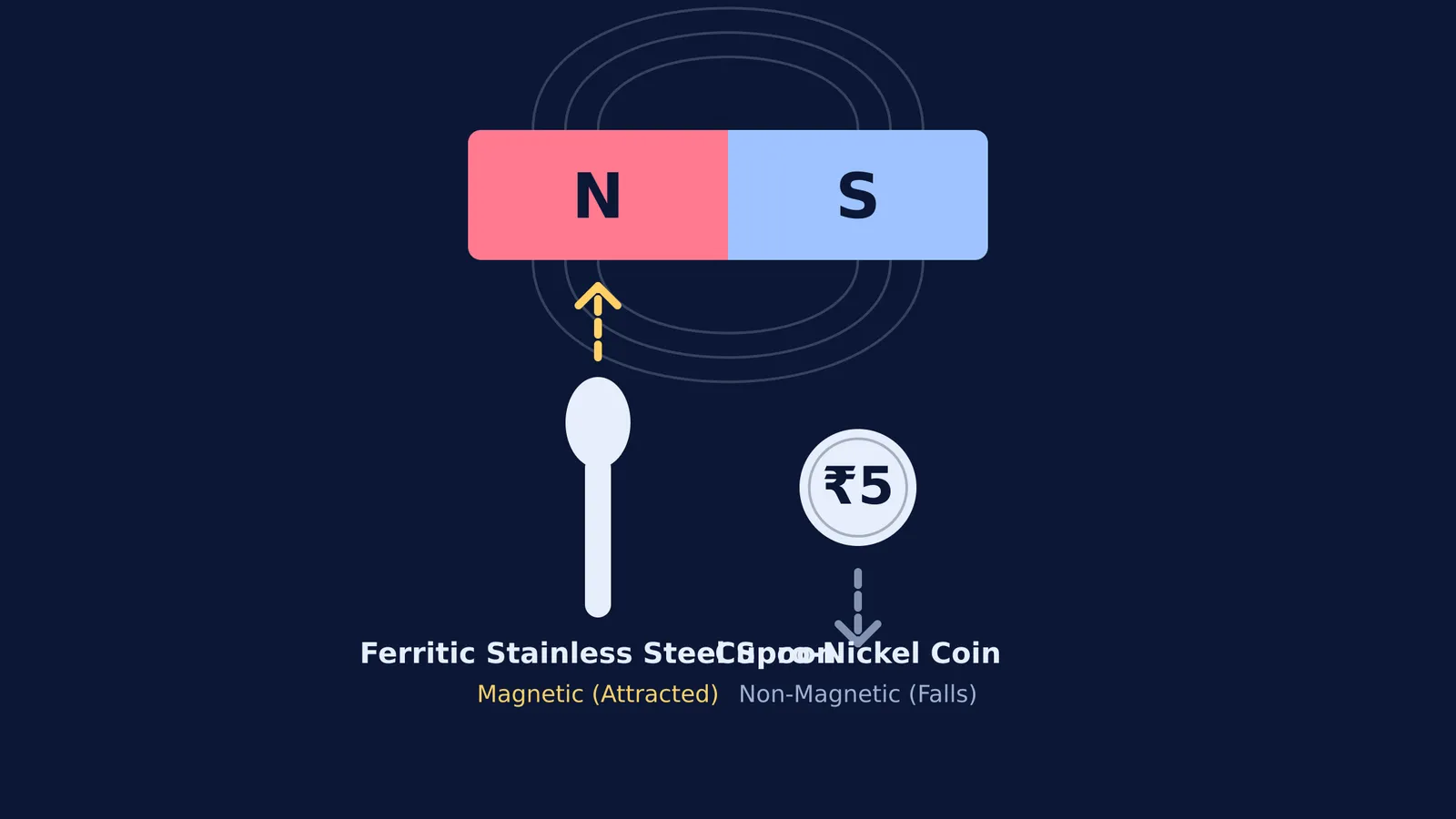
If you test the spoons in your kitchen drawer, some might stick strongly while others barely hold on or do not stick at all. This is because cutlery is made from different grades of stainless steel (Wikipedia).
Austenitic stainless steel: The highest quality cutlery (often stamped "18/10" or "18/8", meaning 18% chromium and 10% or 8% nickel) is austenitic stainless steel (Wikipedia). This face-centred cubic structure is essentially non-magnetic, so these spoons will not stick to your magnet. You can learn more about how chromium protects this metal in our guide on why stainless steel does not rust.
Ferritic stainless steel: More affordable spoons (stamped "18/0", meaning zero nickel) are made of ferritic stainless steel (Wikipedia). The lack of nickel gives it a body-centred cubic crystal structure, which means it is magnetic and will stick firmly.
Are Indian coins magnetic?
You might naturally expect any heavy metal coin to be magnetic, but older Indian ₹1, ₹2, and ₹5 coins typically slide right off a magnet. This is because they were historically minted from cupro-nickel, an alloy of roughly 3 parts copper to 1 part nickel (Wikipedia). Nickel itself is ferromagnetic, but the high copper content in the alloy completely prevents the cupro-nickel mixture from becoming ferromagnetic.
However, modern Indian coins are very different. Since the 1990s and 2000s, the rapidly rising cost of copper on the global market led mints to switch to alternative materials to save money. Today, many modern ₹1, ₹2, and ₹5 coins are made from ferritic stainless steel instead (Wikipedia). This means if you find a newer, lighter ₹5 coin in your wallet, it will likely snap right onto your magnet without hesitation!
How can you test the metals in your house?
The best way to commit this list to memory for your next exam is to test it yourself. Grab a strong fridge magnet and try this quick, hands-on activity in your own home:
The coin test: Find an old, thick ₹5 coin and a newer, shiny ₹5 coin. Test both. The old cupro-nickel coin will drop, while the new ferritic steel one will stick.
The cutlery test: Check your forks and spoons. Do some stick while others do not? The ones that drop are likely austenitic 18/10 steel.
The aluminium test: Try sticking the magnet to a soda can or kitchen foil. It will not work, proving that not all shiny metals are magnetic.
Understanding these materials is a great starting point for physics. If you want to see how fields flow around these metals in real time, try our guide on how to visualise the magnetic field of a wire, loop and solenoid.


