

On this page
If you leave a normal iron nail outside in the rain, it will rapidly turn into a flaky, orange-brown mess. Yet the stainless steel sink in your kitchen handles water every day without degrading.
The secret is not a coating applied at the factory, but a chemical trick built straight into the metal itself. Here is the chemistry of how stainless steel defends against corrosion.
Why does stainless steel not rust?
Rust is iron oxide, a compound formed when iron is exposed to water and oxygen. In ordinary steel, rust flakes away as it forms. Because the rust is porous and physically larger than the iron it replaces, it cracks off, exposing fresh iron beneath to continue the cycle until the entire piece of metal is destroyed.
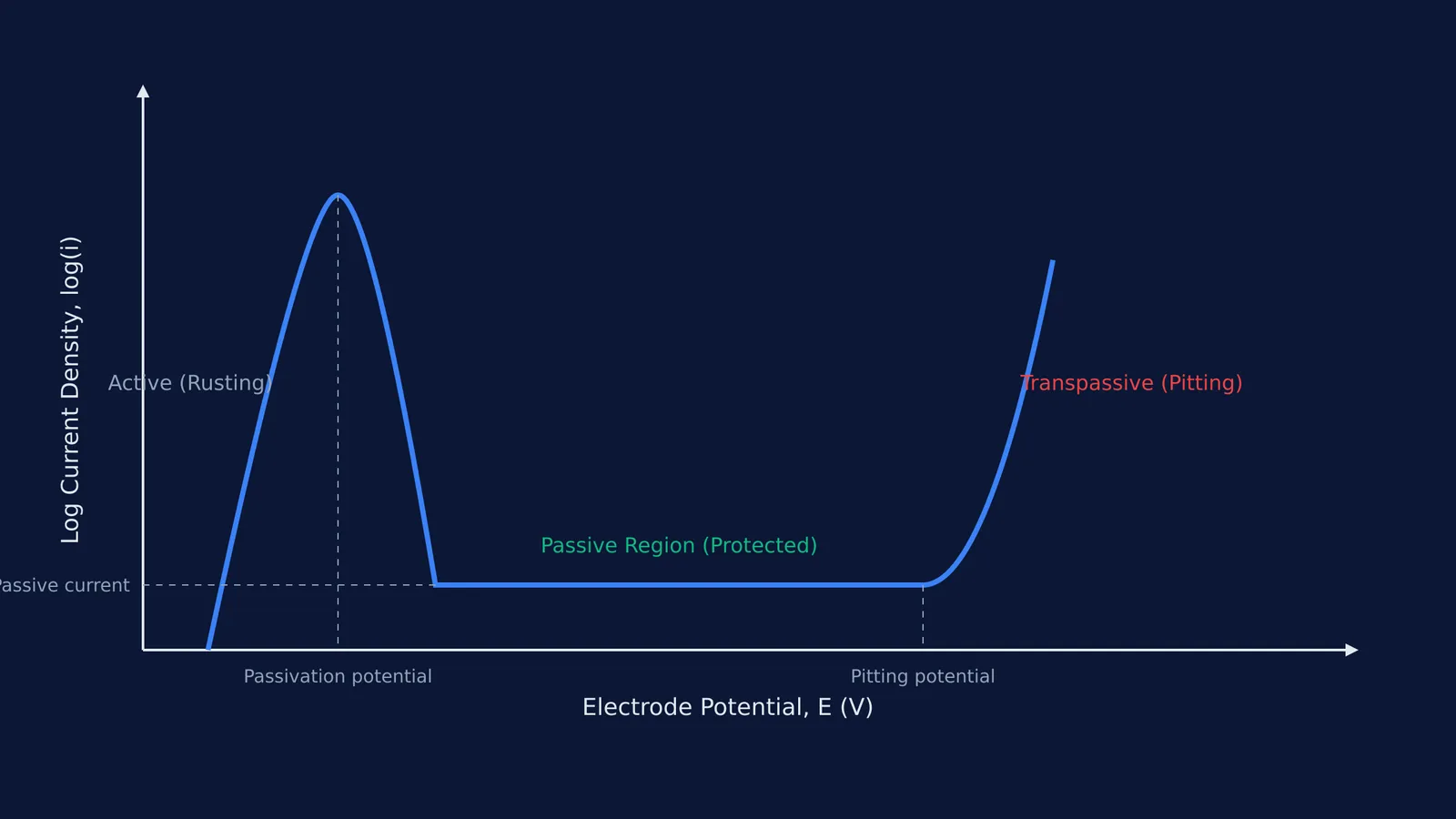
Stainless steel behaves differently because it contains a minimum of 10.5% chromium. When the steel is manufactured, the chromium atoms are distributed evenly throughout the iron matrix. As soon as the surface of the metal is exposed to oxygen, the chromium reacts to form a very thin, continuous layer of chromium(III) oxide (Cr₂O₃).
This barrier—called a passive film—is entirely invisible. It seals the iron beneath away from the reactive environment. It is the exact same principle seen when everyday oxidation in Class 10 science describes aluminium forming a protective alumina layer to prevent further decay.
How does the chromium oxide layer protect the steel?
The passive film works as a highly effective physical and electrical barrier. Because chromium oxide molecules pack tightly together in a stable lattice, they do not allow water or oxygen molecules to slip through to the iron underneath.
Corrosion is essentially an electrical circuit. The E° values of 3d metals dictate how eagerly different metals give up their electrons. Iron readily gives up electrons to oxygen in the presence of water to form rust. However, the chromium oxide layer acts as an electrical insulator. By stopping the transfer of electrons between the underlying iron and the environment, it halts the electrochemical corrosion process in its tracks.
Can the passive film heal itself?
Yes. One of the most remarkable properties of stainless steel is that its protection is entirely self-healing.
If you accidentally scratch a stainless steel surface with a sharp knife, you break the microscopic chromium oxide layer and expose the raw alloy beneath. However, before the iron can even begin to rust, the newly exposed chromium atoms at the surface instantly react with oxygen in the air or water to form a fresh layer of chromium oxide. The shield is rebuilt almost instantly.
When can stainless steel still corrode?
While stainless steel is highly resistant to general rusting, it is not completely invincible. Certain extreme environments can break down the passive film faster than it can heal:
Chlorides: Saltwater or household bleach can attack the passive layer locally. Chlorides penetrate the film and create deep, narrow holes known as pitting corrosion.
Extreme acids: High concentrations of non-oxidising acids, such as hydrochloric acid, can dissolve the protective layer and attack the bare metal.
High temperatures: Extreme heat (often during welding) can cause the chromium and carbon in the steel to bind together into chromium carbides. This ties up the chromium, leaving the surrounding steel vulnerable to corrosion.
To combat these specific threats, metallurgists create different grades of stainless steel by adding other elements. For example, adding molybdenum to the alloy creates marine-grade stainless steel (often labelled as Type 316), which resists chloride pitting far better than standard kitchen-grade steel (Type 304).
See it in action
Understanding how atoms arrange themselves at a surface boundary is crucial for mastering chemistry and materials science. If you find it hard to picture the microscopic battle between metal ions and oxygen, the Fermi Simulation Lab lets you interact with these atomic structures. You can change the environmental conditions, scratch the surface, and watch the passive film form and heal in real time.
Checklist: How to care for stainless steel
To keep the passive film intact on your stainless steel tools, bottles, or appliances, follow these simple rules:
Keep it clean: Wash away salts, bleach, and acidic food residues promptly before they can pit the surface.
Allow it to breathe: Do not seal wet stainless steel in airtight containers for long periods; the surface needs access to oxygen to maintain its protective layer.
Avoid abrasive steel wool: Scrubbing with plain iron wool can embed tiny iron particles into the stainless surface. These iron particles will rust and compromise the passive film.
Dry thoroughly: While the metal resists water, standing water can eventually cause stubborn mineral deposits that trap moisture and weaken the film.


