

On this page
Electric field lines begin on positive charges and end on negative ones. But if you map out the magnetic field around a bar magnet, you will notice something different: the lines never terminate. They form continuous, unbroken paths.
This fundamental difference is a frequent topic in high school and university physics, and it comes down to one of the universe's strict rules: the absence of magnetic monopoles.
Why do magnetic field lines form closed loops?
In electrostatics, an isolated positive charge acts as a source, and an isolated negative charge acts as a sink. However, in magnetism, isolated poles do not exist. If you cut a bar magnet in half, you do not isolate the north pole from the south pole; you simply create two smaller magnets, each with its own north and south pole.
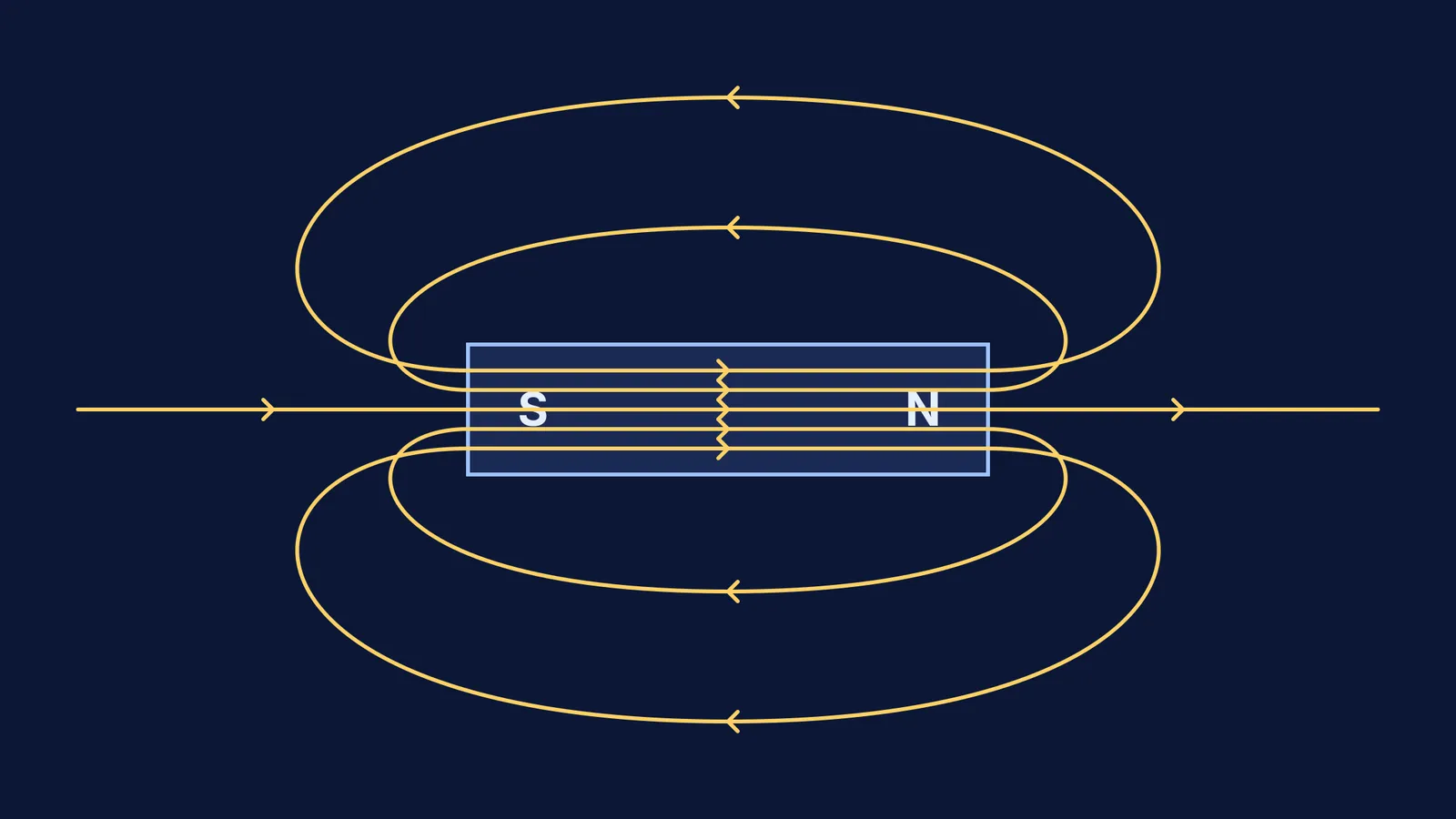
Because there are no isolated magnetic charges to act as starting or ending points, a magnetic field line cannot simply stop. According to OpenStax *University Physics*, magnetic field lines must emerge from the north pole, enter the south pole, and continue through the magnet back to the north pole, forming continuous loops (Source).
This rule is formalised in Gauss's law for magnetism, which is one of Maxwell's four equations of electromagnetism (Source). It states that the net magnetic flux through any closed surface is exactly zero. Mathematically, for every magnetic field line that enters a given volume, another must exit it. Since lines can neither originate nor terminate inside a region, they must loop back on themselves.
Do field lines really go through the magnet?
Yes, they do. A common misconception is that magnetic field lines "start" at the north pole and "end" at the south pole. This is only half the picture.
While the field lines travel from north to south outside the magnet, they complete their circuit by traveling from south to north inside the magnet. The field inside the material is just as real as the field outside. This continuous path is what makes it a closed loop.
If you struggle to visualise these continuous paths, the Fermi Simulation Lab provides interactive simulations for the ideas that are easier to see than to read, allowing you to trace field lines through and around different magnetic sources. For a broader look at how these rules fit into the rest of electromagnetism, you can explore the Fermi Concept Library.
Current loops as the source of magnetism
At a fundamental level, all magnetic fields are generated by the motion of electric charges, which means they are created by electrical currents. Whether the field comes from a straight wire carrying a current or the orbital motion of an electron within an atom, the resulting magnetic field circles around the path of that current.
Because the current itself must flow in a continuous circuit or loop to maintain a steady flow of charge, the magnetic field lines it generates naturally wrap around that current path in continuous, closed loops. Even in a permanent bar magnet, the field is the macroscopic sum of countless aligned microscopic current loops created by the electrons in the magnetic material. Since every individual building block creates a closed-loop field, the overall magnetic field of the bar magnet must also consist of closed loops.
How to use this rule in exams
Examiners test this concept by asking you to compare magnetic and electric fields, or by presenting you with diagrams of field lines. Here is how to apply the rule:
Spotting fake diagrams: If a multiple-choice question asks you to identify a valid magnetic field, eliminate any option where lines cross each other or end abruptly at a point.
Calculating flux: If asked for the total magnetic flux through a closed surface (like a sphere or a cube), the answer is always zero. This is a direct consequence of lines forming closed loops. Note that this is completely different from electric flux, as seen when applying Gauss's law for a sphere with non-uniform charge density.
Connecting to Faraday's law: The idea of closed-loop fields appears again in electromagnetic induction. A changing magnetic field creates a circulating electric field inside a solenoid. Unlike static electric fields, these induced electric fields also form closed loops without starting or ending on charges.
When you are reviewing these properties and find yourself stuck on the underlying mathematics, Fermi's AI tutor can help. Instead of just giving you the answer, the tutor works out what you already know and builds a plan for the session, checking your understanding as it goes.


