

On this page
If every iron atom is a miniature magnet with its own dipole moment, why does an ordinary iron nail not stick to your refrigerator door? This puzzle baffled nineteenth-century physicists. If atomic dipoles naturally align, all iron should be permanently magnetic; if thermal agitation scrambles them, iron should behave merely as a paramagnet. In 1907, French physicist Pierre Weiss published a landmark paper in the *Journal de Physique Théorique et Appliquée* that resolved the paradox and founded our modern understanding of ferromagnetism.
Why is unmagnetised iron not a permanent magnet?
Each iron atom has unpaired electrons whose spins generate an intrinsic magnetic dipole moment of approximately 2.2 Bohr magnetons (about 2.06 × 10⁻²³ J/T), as detailed in NCERT Class 12 Physics. Yet an ordinary iron rod does not deflect a nearby compass needle.
Weiss realized classical dipole-dipole forces were far too weak to explain this. Classical magnetostatics predicts internal fields under 1 Tesla, which thermal energy at room temperature would immediately disrupt. Under classical dipole forces alone, iron would lose magnetic order below 1 K. Instead, iron stays ferromagnetic up to 1043 K (770 °C).
To explain this stability, Weiss proposed in his 1907 molecular field paper that an internal "molecular field" of roughly 1000 Tesla forces neighbouring atomic dipoles into parallel alignment across microscopic regions.
How did Pierre Weiss uncover magnetic domains?
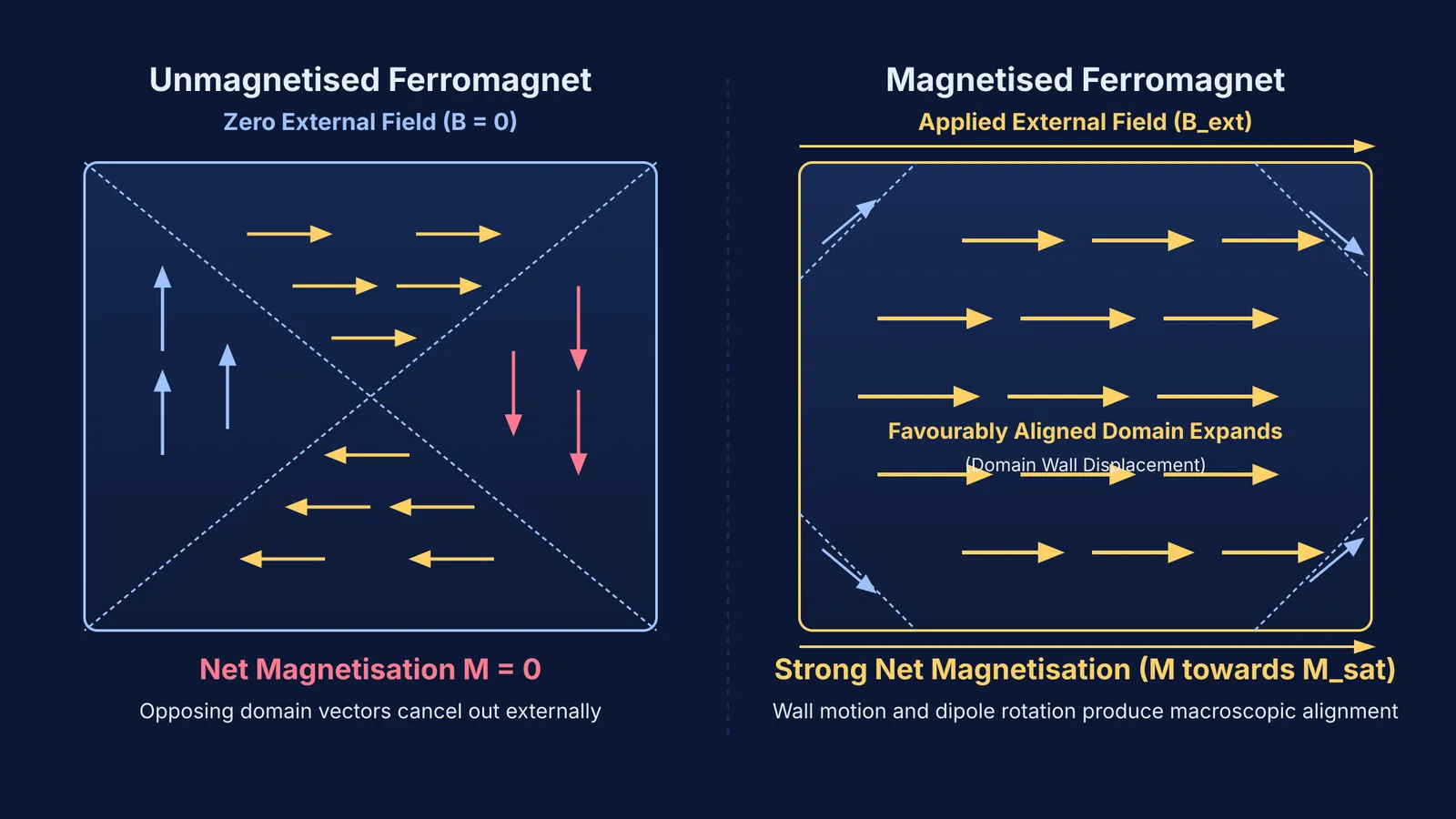
If a 1000 Tesla internal field locks atomic dipoles together, why is the net magnetic field of an iron bar zero? Weiss resolved this in his 1907 treatise by introducing magnetic domains.
The material divides into microscopic regions. Within each domain, the molecular field aligns all atomic dipoles in the same direction. However, neighbouring domains point in different directions across the bulk metal, forming closed flux loops whose vector sum cancels to zero externally. This microscopic structure also explains how cutting a bar magnet alters its magnetic moment.
In 1928, Werner Heisenberg showed in *Zeitschrift für Physik* that this molecular field is quantum exchange energy arising from Coulomb repulsion and the Pauli exclusion principle. In 1931, Francis Bitter observed these domain walls in *Physical Review* using colloidal iron oxide, while how the Barkhausen effect proved magnetic domains demonstrated domain wall jumps audibly through an amplifier.
What happens to magnetic domains in an external field?
According to the NCERT Class 12 Physics syllabus, a typical ferromagnetic domain spans roughly 1 mm and contains about 10¹¹ atoms. In an external magnetic field, iron magnetises through two distinct steps:
Domain wall displacement: In weak fields, domain walls shift so favourably oriented domains expand at the expense of opposing domains.
Domain rotation: In stronger fields, dipoles within remaining domains rotate directly into the direction of the applied field until reaching saturation.
The Fermi Simulation Lab provides interactive simulations for the ideas that are easier to see than to read, similar to visualising magnetic fields of coils and solenoids.
Why does heating iron destroy its ferromagnetism?
Thermal agitation shakes the crystal lattice, opposing the exchange forces that hold atomic dipoles aligned.
At the Curie temperature (Tc), thermal energy overcomes the exchange interaction. According to NCERT's thermal magnetism data, domain structure collapses and ferromagnets become paramagnetic. For iron, this transition occurs at 1043 K; NCERT Table 5.4 lists cobalt at 1394 K and nickel at 631 K.
Above Tc, magnetic susceptibility obeys the Curie-Weiss law:
χ = C / (T - Tc)
Here C is the Curie constant and T is absolute temperature. As temperature cools toward Tc, susceptibility approaches infinity, triggering spontaneous domain formation.
How do you solve magnetic domain problems in Class 12 exams?
Board and entrance exams frequently test domain arithmetic from NCERT Physics Chapter 5. Consider an iron cubic domain of edge length 1 μm (10⁻⁶ m), density 7870 kg/m³, molar mass 55.85 g/mol, and atomic dipole moment 2.22 Bohr magnetons (2.06 × 10⁻²³ J/T):
Domain volume: V = (10⁻⁶ m)³ = 10⁻¹⁸ m³.
Domain mass: m = 7870 kg/m³ × 10⁻¹⁸ m³ = 7.87 × 10⁻¹² g.
Number of atoms: N = (7.87 × 10⁻¹² / 55.85) × 6.022 × 10²³ ≈ 8.49 × 10¹⁰ atoms, confirming the 10¹¹ order-of-magnitude figure in NCERT.
Net magnetic dipole moment: M_domain = (8.49 × 10¹⁰) × (2.06 × 10⁻²³ J/T) ≈ 1.75 × 10⁻¹² J/T.
Saturation magnetisation: M = 1.75 × 10⁻¹² / 10⁻¹⁸ = 1.75 × 10⁶ A/m, matching experimental values for pure iron.
The Fermi Problem Library provides worked problems with a step-by-step solver that explains the reasoning rather than printing an answer. For a broader view of how magnetism connects across thermodynamics and atomic physics, the Fermi Concept Library covers every concept in physics, chemistry, biology, mathematics and computing, each with its own lesson and its place in the map.


