

On this page
What is the magnetic moment of a bar magnet?
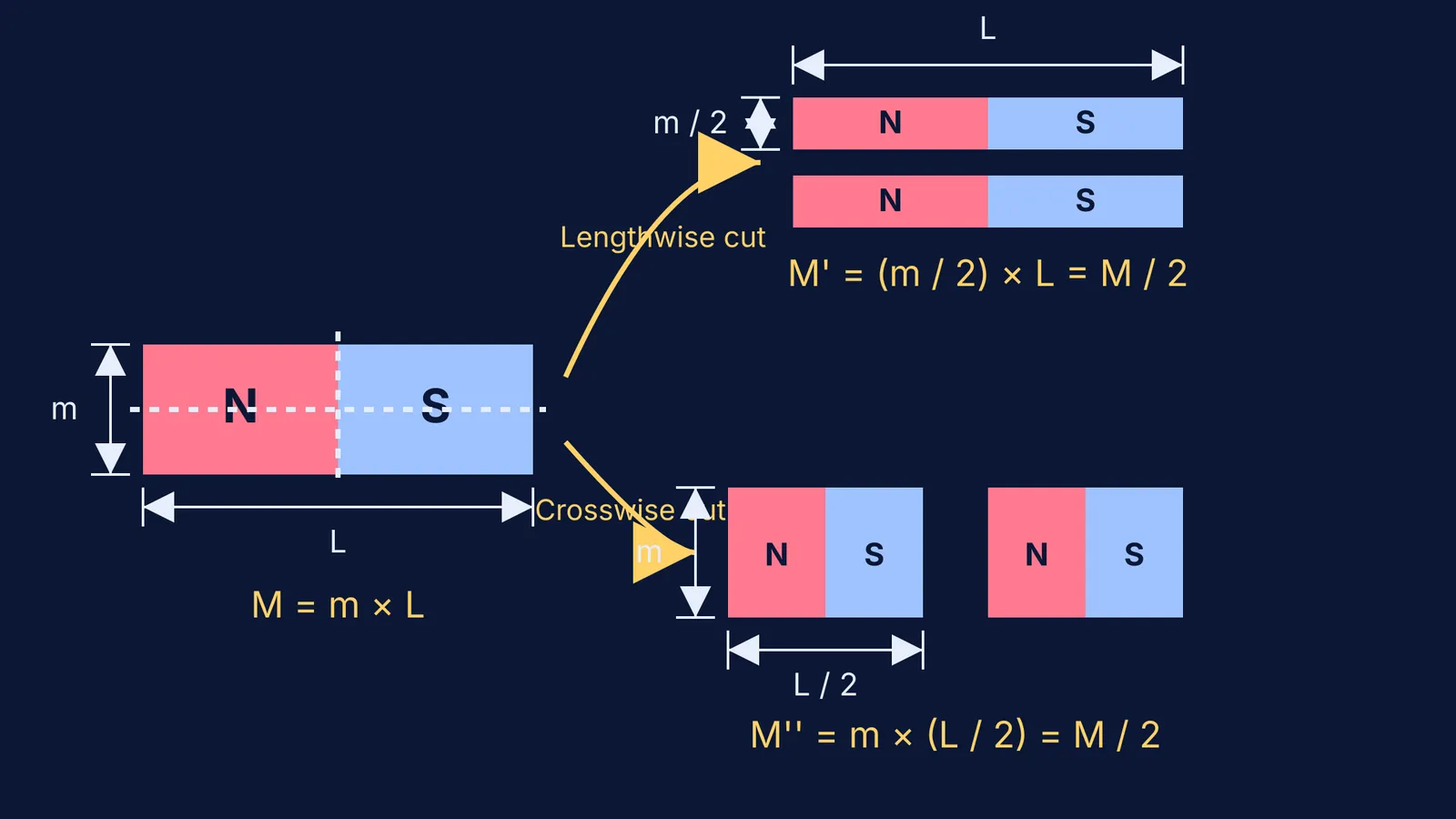
To understand how cutting changes a magnet, we first have to look at what creates its strength. The magnetic moment (M) of a bar magnet is the product of its pole strength (m) and its total magnetic length (L), giving the formula M = m × L, according to Vedantu.
Pole strength represents how much magnetic pull exists at the North or South end of the material. The magnetic length is the straight-line distance between these two poles. Because the poles sit slightly inside the physical edges of the bar, the magnetic length is always slightly shorter than the geometric length of the metal itself.
If you are revising magnetism for an exam and struggling to picture these invisible fields, the Concept Library contains every concept in physics, chemistry, biology, mathematics and computing, each with its own lesson and its place in the map.
What happens when a bar magnet is cut lengthwise?
A lengthwise, or longitudinal, cut runs parallel to the axis connecting the North and South poles, slicing the magnet down its longest side.
When you make this cut exactly down the middle:
The total distance between the North and South ends of each new piece remains unchanged. The magnetic length is still L.
The cross-sectional area of the pole faces is cut exactly in half.
Because pole strength depends directly on the surface area exposed at the ends, the new pole strength becomes m / 2.
Using the original formula, the new magnetic moment is the new pole strength multiplied by the new length: (m / 2) × L. This simplifies to M / 2. The magnetic moment of each half is exactly half of the original magnet.
Why does the pole strength drop when cut lengthwise?
To understand why the pole strength halves, you have to look at the microscopic structure of the magnet. A permanent magnet gets its strength from millions of atomic dipoles aligned in the same direction. The overall pole strength is determined by how many of these aligned atoms sit at the cross-sectional area of the pole.
When you slice the magnet lengthwise, you are splitting that surface area into two smaller rectangles. You now have half as many aligned atoms exposed at the end of each piece. Fewer atoms mean a weaker pole.
What happens when a bar magnet is cut crosswise?
A crosswise, or transverse, cut slices the magnet perpendicular to its axis, like chopping a carrot into two pieces.
When you cut the magnet perfectly in half this way:
The cross-sectional area of the cut pieces matches the original bar. Because the area is unchanged, the pole strength remains m.
The physical length of each piece is halved. The new magnetic length becomes L / 2.
Calculating the new magnetic moment gives m × (L / 2), which again simplifies to M / 2. Just like the lengthwise cut, a crosswise cut halves the total magnetic moment, but it does so by halving the distance between the poles rather than diluting their strength.
If you are curious about how these dipoles behave when exposed to external forces, you can read more about calculating the net force on a dipole in a non-uniform field.
How to calculate the magnetic moment for multiple cuts?
Entrance exams frequently test this concept by combining both types of cuts in the same question. Here is a reliable framework for solving these proportional reasoning problems.
Imagine a standard bar magnet with magnetic moment M. You are asked to calculate the moment of a single piece if the original magnet is cut into 3 equal pieces lengthwise, and then cut into 4 equal pieces crosswise.
Calculate the new pole strength. The magnet is cut into 3 pieces lengthwise. This divides the cross-sectional area by 3, so the new pole strength is m / 3.
Calculate the new length. The magnet is cut into 4 pieces crosswise. This divides the total length by 4, making the new length L / 4.
Multiply to find the new moment. The magnetic moment of one small piece is (m / 3) × (L / 4).
Simplify the expression. Multiplying the fractions gives (m × L) / 12. Since m × L is the original moment M, the final answer is M / 12.
You can verify this logically: you turned one magnet into 12 identical smaller magnets. Each one must possess 1/12th of the original magnetic moment. This additive property differs significantly from other magnetic properties, such as the magnetic moment of a spinning charged ring, where the math relies heavily on the charge-to-mass ratio.
If you find yourself plateauing on physics problems that combine multiple proportional changes, the Fermi Problem Library has worked problems with a step-by-step solver that explains the reasoning rather than printing an answer.


