

On this page
In short
The Barkhausen effect is the crackling noise produced in a ferromagnetic material when its magnetization changes in microscopic, discrete jumps. Discovered by Heinrich Barkhausen in 1919, it provided the first direct experimental evidence that magnetic domains exist.
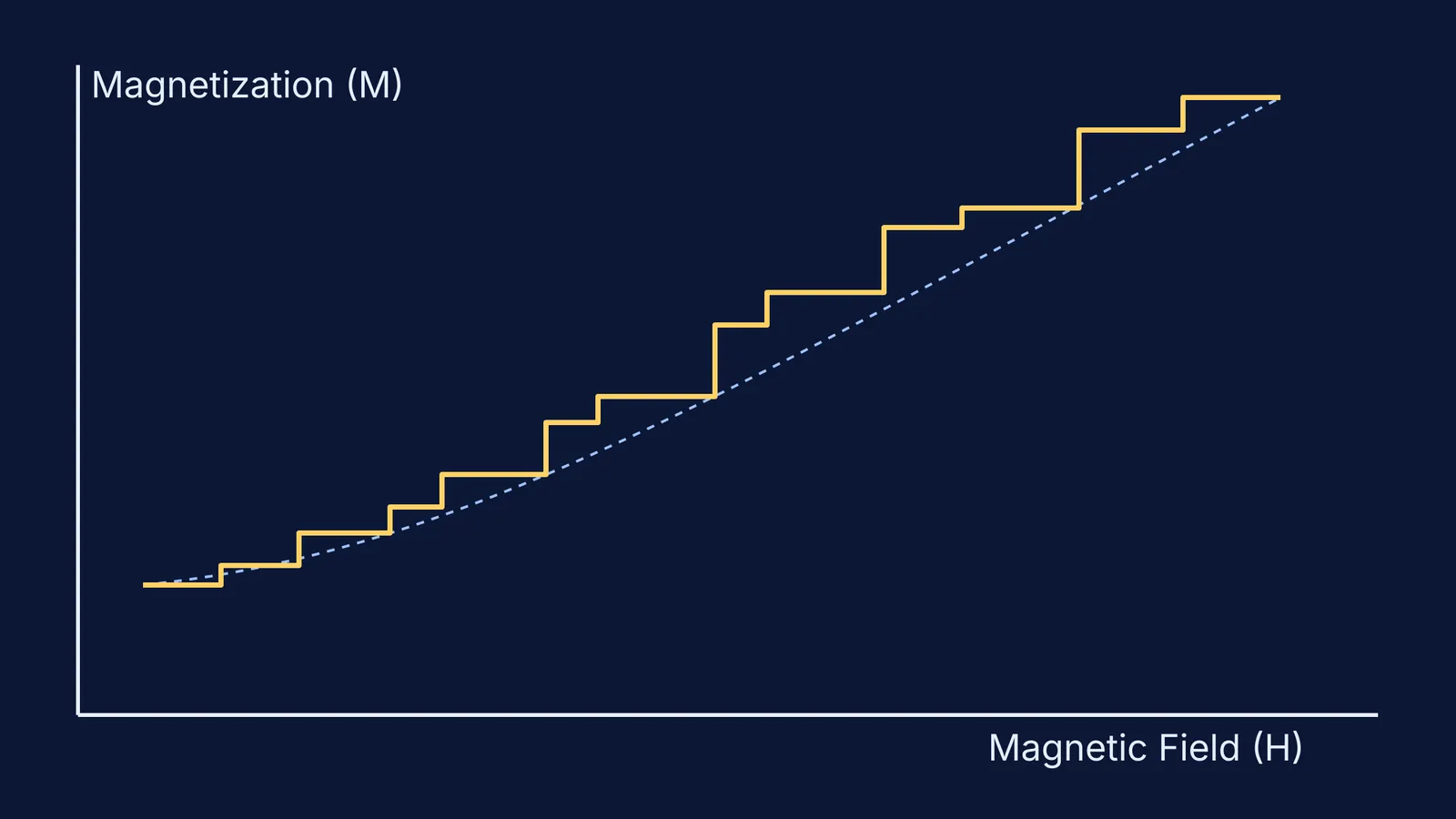
If you change the magnetic field applied to a piece of iron, its magnetization does not increase smoothly. Instead, it rises in a series of tiny, sudden jumps. This phenomenon is known as the Barkhausen effect, and it settled one of the biggest debates in early 20th-century physics.
What is the Barkhausen effect?
Before 1919, physicists knew that certain metals could be magnetized, but the microscopic mechanism was theoretical. In 1907, the French physicist Pierre-Ernest Weiss proposed that ferromagnetic materials are divided into tiny regions called magnetic domains (Wikipedia). Inside each domain, the atomic magnets all point in the same direction.
However, no one had been able to observe these domains. The Barkhausen effect provided the first experimental proof. The effect is the crackling noise produced in a ferromagnet when its magnetization changes in discrete jumps (Britannica). These jumps are the audible evidence of magnetic domains snapping into alignment with an external magnetic field.
How did Heinrich Barkhausen discover the effect?
Heinrich Barkhausen, a German physicist, devised a simple but elegant experiment in 1919 to test the domain theory. He took an iron bar and wrapped it in a coil of copper wire. He then connected this coil to an electronic amplifier and a loudspeaker (Wikipedia).
When he slowly brought a strong permanent magnet closer to the iron bar, he heard a distinct noise. If the iron's magnetization had increased continuously, the speaker would have produced no sound or a smooth hum. Instead, Barkhausen heard a series of sharp clicks. The noise proved that the internal structure of the iron was reorganizing itself in sudden, discontinuous steps.
Visualising these microscopic changes from a textbook description can be difficult. If you are struggling with such concepts, the Fermi Simulation Lab provides interactive simulations for the ideas that are easier to see than to read.
Why do magnetic domains make noise?
Inside an unmagnetised iron bar, magnetic domains point in random directions, cancelling each other out. When you apply an external magnetic field, the domains that align with the field begin to grow at the expense of the others.
However, the boundaries between these domains—the domain walls—do not slide smoothly. They get pinned or stuck on microscopic crystal defects, impurities, and structural boundaries in the metal (Wikipedia). As the external magnetic force increases, the pressure on the pinned wall builds up until it suddenly snaps past the defect.
Each sudden snap causes a rapid, localized change in the magnetic flux. By Faraday's law of induction, this rapid flux change induces a tiny voltage pulse in the surrounding coil. When these microscopic pulses are amplified, they create the crackling noise Barkhausen heard.
If you are working through induction calculations and keep getting stuck on Faraday's law, the Fermi Problem Library explains the reasoning step-by-step rather than just printing the final answer.
How is the Barkhausen effect used today?
While it started as a fundamental physics discovery, the Barkhausen effect has become a powerful industrial tool. Because the noise is created when domain walls snap past crystal defects, the exact sound profile reveals the internal structure of the metal (Britannica).
Engineers use Barkhausen noise analysis as a form of non-destructive testing. By placing a sensor on a steel component—like a car engine part or an airplane landing gear—they can measure the Barkhausen noise to detect microscopic cracks, mechanical stress, or metal fatigue before the part fails. If a manufacturing process like grinding or heat treatment has damaged the surface of the steel, the domain walls will get pinned differently, altering the crackling sound. This allows safety inspectors to find invisible damage without having to cut the metal open or destroy the component.
How to explain the Barkhausen effect in a viva?
If your examiner asks you about ferromagnetism or the domain theory, you can use this simple script to demonstrate your understanding:
State the definition: "The Barkhausen effect is the series of discontinuous changes in magnetization that occur when the external magnetic field applied to a ferromagnet is changed."
Explain the cause: "It happens because domain walls get pinned on crystal defects and then suddenly snap past them as the magnetic field increases."
Connect it to induction: "Each sudden jump in magnetic flux induces a small electromotive force (EMF) in a surrounding coil, which can be amplified and heard as noise."
State the significance: "It provided the first direct experimental evidence for the existence of magnetic domains, which Weiss had predicted in 1907."
Mention modern uses: "Today, engineers analyse this noise to detect invisible stress and metal fatigue in steel components without destroying them."
This structure shows that you understand the macroscopic observation, the microscopic mechanism, and the historical significance of the discovery.


