On this page
Mendel's laws say how “factors” pass from parents to offspring, not where those factors are. Two researchers, one watching a grasshopper and one a sea urchin, gave the same answer: on the chromosomes. A white-eyed fruit fly later backed them up.
What is the chromosomal theory of inheritance?
The chromosomal theory of inheritance states that Mendel's factors, which we now call genes, are carried on chromosomes, so the patterns Mendel saw follow from how chromosomes pair and separate in meiosis (Embryo Project).
Walter Sutton, a graduate student under E. B. Wilson at Columbia University, chose the lubber grasshopper Brachystola magna because its testes were large enough to watch meiosis. In his December 1902 paper he reported 23 chromosomes in the grasshopper's spermatogonia: 11 pairs plus one unpaired “accessory” chromosome (Sutton 1902, The Biological Bulletin; full scan on archive.org).
Near its end, Sutton pointed to “the probability that the association of paternal and maternal chromosomes in pairs and their subsequent separation during the reducing division as indicated above may constitute the physical basis of the Mendelian law of heredity.”
How did Sutton and Boveri match Mendel's factors to chromosomes?
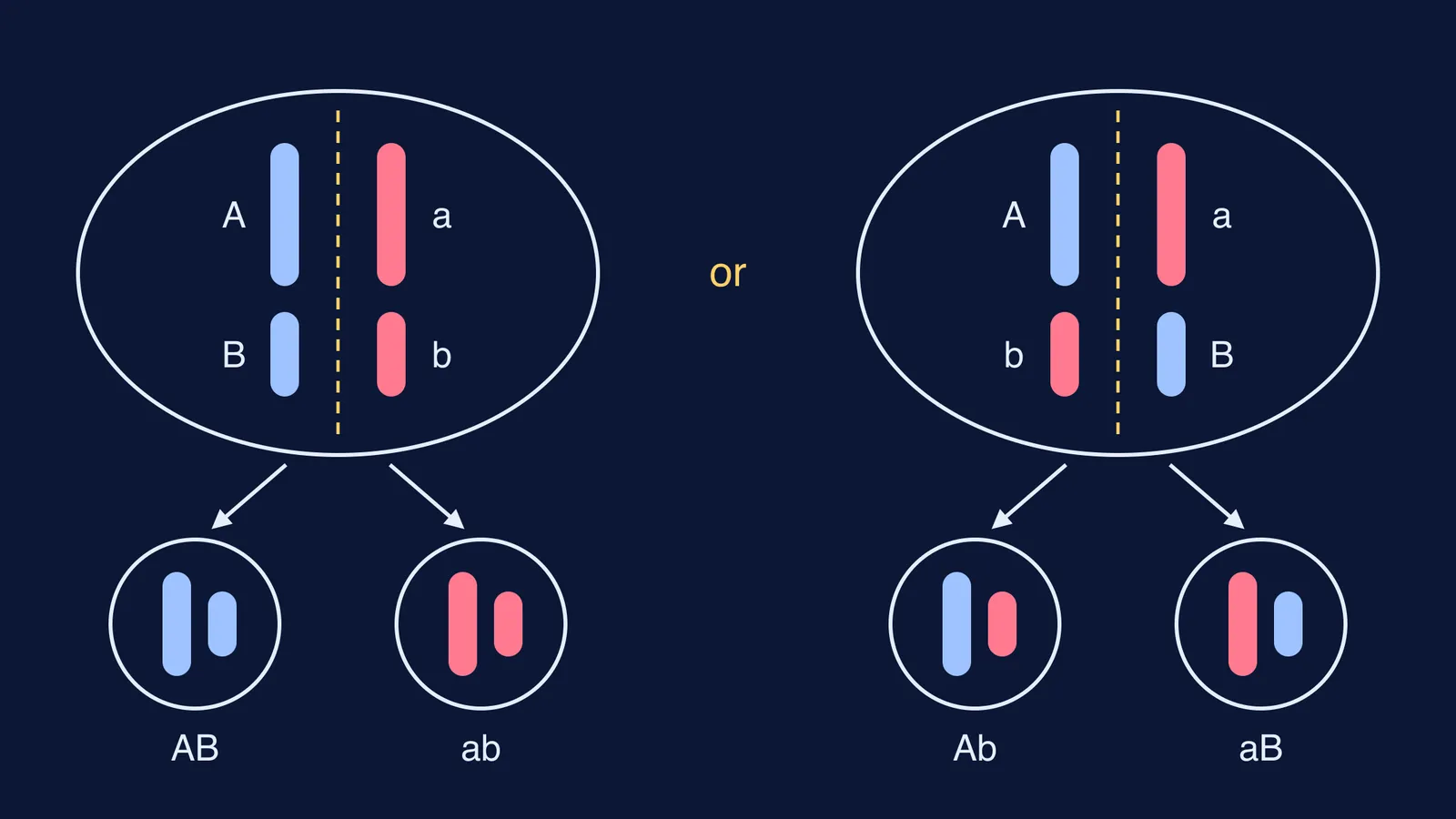
In “The Chromosomes in Heredity” (April 1903), Sutton made the match explicit (Sutton 1903; scan on archive.org). How each pair lies at the reducing division is “purely a matter of chance”, he wrote, so pairs sort independently, and one individual can make 2 to the power n kinds of germ cell, where n is the number of chromosome pairs. Humans have 23 pairs, 46 chromosomes in total (NHGRI).
Theodor Boveri, working in Munich, reached similar conclusions independently (Embryo Project). A sea urchin egg fertilised by two sperm splits into three or four cells at once, scattering its chromosomes unevenly. Of 1,500 four-way eggs, one became a healthy larva (0.07%); of 719 three-way eggs, 58 did (8%) (Developmental Biology, “Baltzer on Boveri”). Boveri read this as evidence that chromosomes differ in what they carry, so a cell given an incomplete set lacks some hereditary factors. The combined idea became known as the Sutton–Boveri theory.
Which of Mendel's laws match which stage of meiosis?
Factors come in pairs: chromosomes come in homologous pairs, one from each parent.
Law of segregation: the two homologues separate at anaphase I, so each gamete gets one.
Law of independent assortment: each pair's orientation at metaphase I is independent of every other pair.
One factor per trait in a gamete: one chromosome of each pair in a gamete.
If the pea crosses are hazy, start with how Mendel found the laws of inheritance, and keep sister chromatids and homologous chromosomes apart.
How did Morgan prove genes are on chromosomes?
Thomas Hunt Morgan's 1910 paper opens: “In a pedigree culture of Drosophila which had been running for nearly a year through a considerable number of generations, a male appeared with white eyes” (Morgan 1910, Science; scan on archive.org). Bred to his red-eyed sisters, it gave 1,237 red-eyed offspring and 3 white-eyed males. Inbreeding those hybrids gave 2,459 red-eyed females, 1,011 red-eyed males and 782 white-eyed males. No white-eyed females appeared.
Morgan placed the eye-colour factor on the X, which females carry twice and males once (Embryo Project). Write the cross that way:
Parents: X+X+ red female × XwY white male. The F1 are red.
F1 cross: X+Xw × X+Y.
Expected F2: half red females, a quarter red males, a quarter white males.
Of Morgan's 4,252 F2 flies, a quarter would be 1,063. He got 782 white-eyed males, about 18%: fewer than expected, but all male, which a gene on an ordinary chromosome pair would not produce.
Calvin Bridges, in Morgan's lab at Columbia University, then tested the idea directly. In crosses of white-eyed females with red-eyed males, about 1 in 1,600 flies broke the pattern. He blamed X chromosomes that failed to separate (nondisjunction), predicted XXY females and XO males, and found them under the microscope (Embryo Project). He published it in the first issue of Genetics in 1916 (Bridges 1916).
Morgan received the 1933 Nobel Prize in Physiology or Medicine “for his discoveries concerning the role played by the chromosome in heredity” (Nobel Prize). More in our profile of Thomas Hunt Morgan and his fruit flies.
How do you write the chromosomal theory in an exam?
A board or NEET-UG answer needs four moves:
Define it: genes are on chromosomes.
Credit Sutton (grasshopper) and Boveri (sea urchin), working independently.
Give the parallels: segregation is homologues parting at anaphase I; independent assortment is each pair's chance orientation at metaphase I.
Give the proof: Morgan's X-linked white eye, then Bridges's nondisjunction.
If homologue or bivalent is the snag, the Fermi Concept Library gives every biology concept its own lesson and its place in the map. For X-linked crosses like Morgan's, the Fermi Problem Library has worked problems with a step-by-step solver that explains the reasoning rather than printing an answer.