On this page
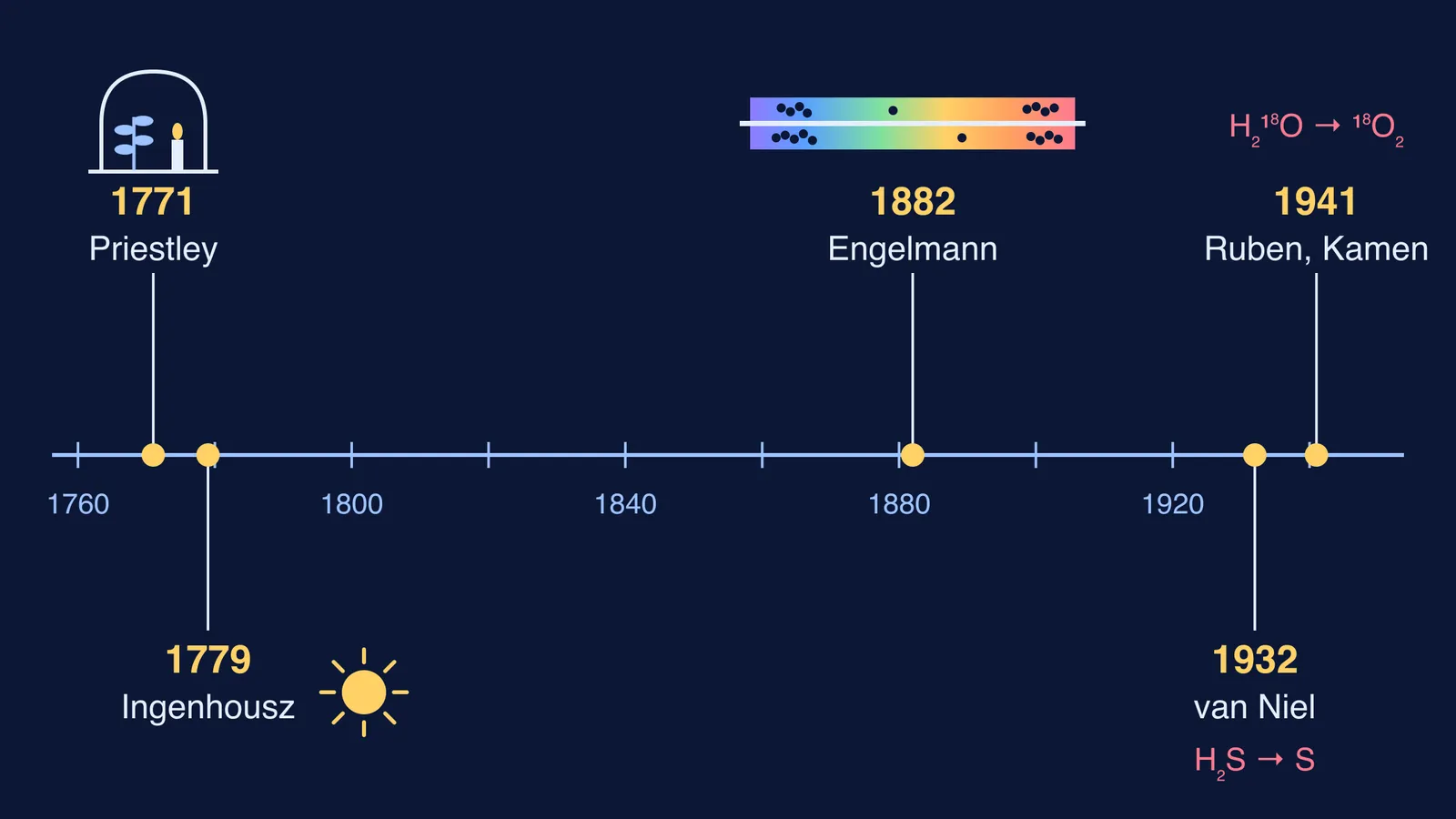
Priestley, Ingenhousz, Engelmann and van Niel are four of the scientists in section 11.2, Early Experiments, of NCERT's chapter Photosynthesis in Higher Plants. In time order they make one argument: plants restore air, they need light, some colours work better, and the oxygen comes from water.
What did Priestley's bell jar experiment show?
Joseph Priestley saw that a candle in a closed bell jar soon went out and a mouse soon suffocated; as NCERT summarises, he concluded that both somehow damage the air. When he put a mint plant in the same jar, the mouse stayed alive and the candle kept burning.
His own account is exact about dates. Priestley wrote: "on the 17th of August 1771, I put a sprig of mint into a quantity of air, in which a wax candle had burned out, and found that, on the 27th of the same month, another candle burned perfectly well in it" (Experiments and Observations on Different Kinds of Air, Project Gutenberg text). He first described these air experiments in Observations on different kinds of air (Philosophical Transactions, 1772). His hypothesis: plants restore to the air whatever breathing animals and burning candles remove.
How did Ingenhousz show that sunlight matters?
Jan Ingenhousz used a set-up like Priestley's but placed it once in the dark and once in sunlight, and showed that sunlight is essential for the plant process that purifies air fouled by candles or animals (NCERT, section 11.2). With an aquatic plant, he saw small bubbles form around the green parts in bright sunlight but not in the dark. He later identified the bubbles as oxygen, which showed that only the green parts release it.
He published in 1779 as Experiments upon Vegetables; the Linda Hall Library's account of Ingenhousz adds that a green plant in darkness gave off carbon dioxide, just as animals do.
What did Engelmann's aerobic bacteria experiment prove?
Theodor Wilhelm Engelmann used a prism to split light into its colours and shone that spectrum onto a green alga, Cladophora, lying in a suspension of aerobic bacteria (NCERT, section 11.2). Aerobic bacteria crowd where there is oxygen, so they worked as oxygen detectors. They gathered mainly in the blue and red parts of the spectrum.
An action spectrum is a graph of how fast a process runs at each wavelength of light. NCERT says Engelmann's result described a first action spectrum of photosynthesis, and that it roughly resembles the absorption spectra of chlorophyll a and b (NCERT, sections 11.2 and 11.4). The paper appeared in the Botanische Zeitung in 1882 (citation in his biography); a later review describes his technique as "a sensitive method for tracing the photosynthetic oxygen production of unicellular plants by means of bacterial aerotaxis" (Drews, Photosynthesis Research, 2005).
If the two spectra still blur together, look each up in the Fermi Concept Library, where every biology concept has its own lesson and its place in the map.
Why did van Niel's H₂S idea change the equation?
Cornelius van Niel studied purple and green sulphur bacteria, and his long paper on them appeared in Archiv für Mikrobiologie (1932). NCERT explains what he showed: photosynthesis is a light-dependent reaction in which hydrogen from an oxidisable compound reduces carbon dioxide, written as 2H₂A + CO₂ → 2A + CH₂O + H₂O.
In green plants the hydrogen donor is water, oxidised to oxygen. In sulphur bacteria the donor is H₂S, and the product is sulphur or sulphate, not oxygen. So van Niel inferred that plant oxygen comes from water, not carbon dioxide. In 1941 Samuel Ruben, Martin Kamen and colleagues used heavy oxygen (¹⁸O) as a tracer in photosynthesis, and NCERT states that isotope methods proved the oxygen comes from water. That is why the balanced photosynthesis equation has 12 water molecules.
How do you remember the experiments in order?
Use a four-word chain: air, light, colour, water. For each experiment, learn what was changed, watched and concluded, and what it did not yet show; tricky exam options come from that last part.
Priestley (1771; NCERT says 1770). Changed: plant or no plant. Watched: candle and mouse. Concluded: plants restore air. Not shown: any role for light.
Ingenhousz (1779). Changed: light or dark. Watched: bubbles on green parts. Concluded: sunlight and green parts are needed. Not shown: which colours work.
Engelmann (1882). Changed: colour of light. Watched: where aerobic bacteria gathered. Concluded: blue and red light give the most oxygen. Not shown: where the oxygen comes from.
van Niel (1932 paper). Compared: H₂S with water as hydrogen donor. Watched: sulphur, not oxygen, as product. Concluded: oxygen comes from water, later confirmed with isotopes.
Cover everything after each name and say it aloud. If you cannot say what an experiment did not show, reread that section.
Next, read NADPH vs NADH and which one photosynthesis uses, or learn Griffith's transforming principle experiment the same way. For practice on the light reactions, the Fermi Problem Library has worked problems with a step-by-step solver that explains the reasoning rather than printing an answer.