

On this page
You are halfway through a NEET-UG mock and an option reads: the light reaction produces ATP and NADH. It is wrong by one letter, and that letter carries the whole chapter. Here is how to keep the two carriers apart for good.
What is the difference between NADPH and NADH?
Both are electron carriers: small molecules that pick up high-energy electrons in one reaction and drop them off in another, as OpenStax Biology 2e explains. NAD⁺ is the empty (oxidised) form, and NADH is the loaded (reduced) form after it has accepted two electrons and a proton.
NADP⁺ is the same molecule with one extra phosphate group. A 2018 review in Antioxidants and Redox Signaling by Wusheng Xiao and colleagues describes how cells make NADP⁺ by moving a phosphate from ATP onto the 2′-hydroxyl of the adenosine ribose in NAD⁺.
That phosphate is a tag that enzymes read, so the two carriers do different jobs. In the OpenStax wording, NAD⁺ (with FAD) is used extensively in extracting energy from sugars, while NADP plays an important role in anabolic reactions and in photosynthesis in plants.
Where is NADPH made in photosynthesis?
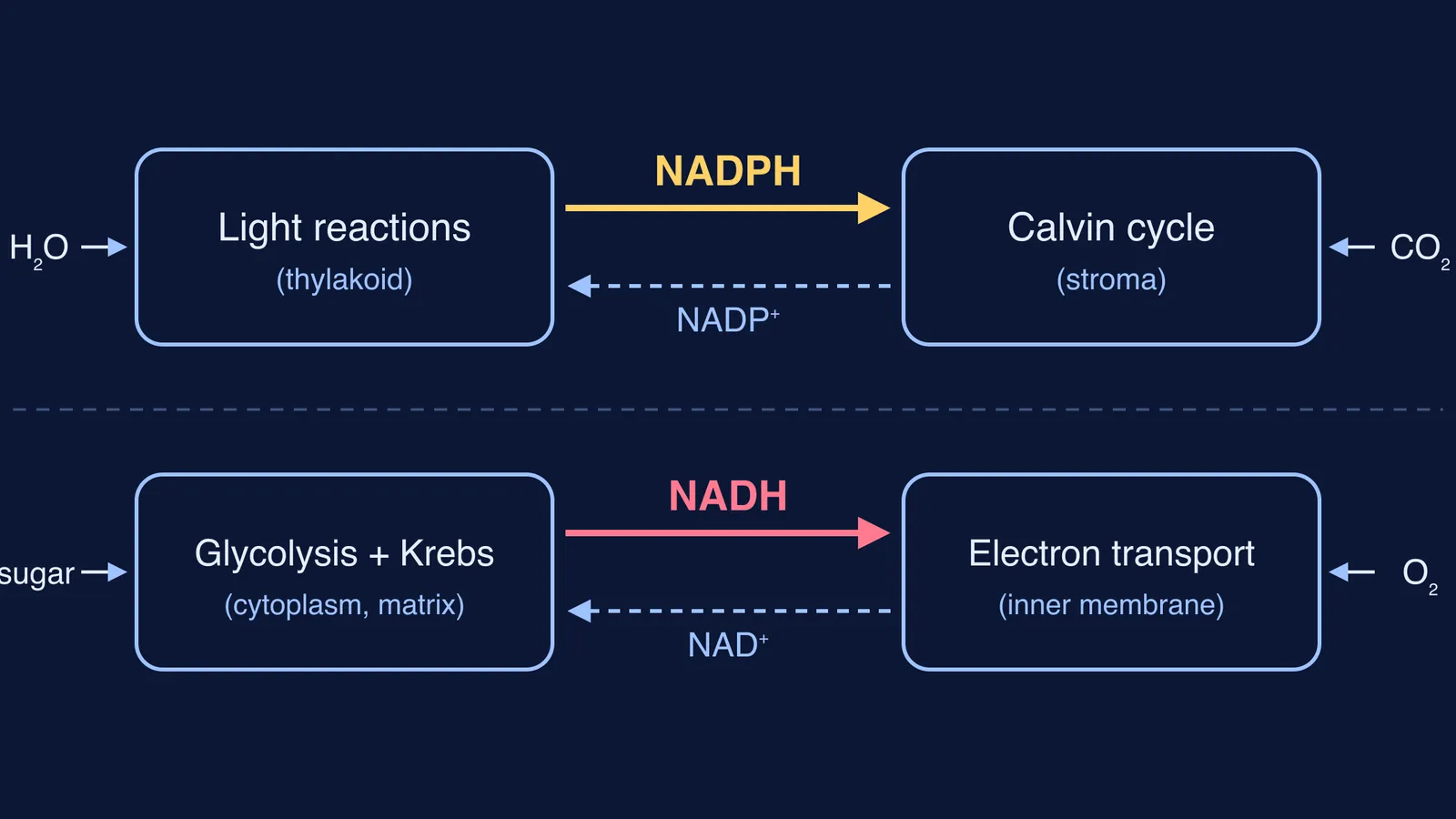
In the light reactions, on the thylakoid membrane. Electrons taken from water pass through Photosystem II and then Photosystem I, which hands them to the enzyme NADP⁺ reductase to convert NADP⁺ into NADPH, according to the OpenStax chapter on the light-dependent reactions.
The Calvin cycle, in the stroma, spends it. OpenStax counts the bill: three turns of the cycle fix enough carbon to export one G3P, using 6 NADPH and 6 ATP in the reduction stage plus 3 more ATP to regenerate RuBP. NADP⁺ and ADP then return to the light reactions to be reloaded.
For the electron path drawn out, see our post on the Z-scheme of electron flow, and for both outputs together, what the light reaction produces.
Where is NADH made in respiration?
In the steps that break glucose down. Glycolysis runs in the cytoplasm and makes NADH at its sixth step, when glyceraldehyde-3-phosphate is oxidised, giving two NADH per glucose. Pyruvate oxidation and the citric acid cycle run in the mitochondria: one NADH forms as each pyruvate becomes acetyl CoA, and each turn of the cycle forms three NADH and one FADH₂.
NADH then delivers its two electrons to complex I of the electron transport chain, which passes them along until they reduce oxygen to water. The proton gradient built on the way drives ATP synthase. Our explainer on the electron transport chain complexes goes through each one.
Worked example: count the carriers for one glucose
You have to keep two ledgers apart. The figures come from OpenStax on glycolysis, the citric acid cycle and the Calvin cycle.
Respiration, the NADH ledger. Glycolysis gives 2 NADH. Pyruvate oxidation gives 1 per pyruvate, so 2. The citric acid cycle gives 3 per turn over two turns, so 6. Total: 10 NADH, plus 2 FADH₂.
Photosynthesis, the NADPH ledger. One G3P (three carbons) costs 6 NADPH and 9 ATP. Glucose has six carbons, so double it: 12 NADPH and 18 ATP.
Check the letters. No NADPH should appear in step 1, and no NADH in step 2. If one does, you have mixed the ledgers.
Why does the cell keep two separate pools?
Because the two jobs need opposite conditions. Breaking food down needs a steady supply of empty NAD⁺ to accept electrons. OpenStax notes that NADH must be continuously oxidised back to NAD⁺ to keep glycolysis going, and without oxygen, fermentation does that job. Building needs a steady supply of loaded NADPH ready to give electrons away.
The Xiao review reports that over 95% of mitochondrial NADP⁺ is reduced, that is, held as NADPH. It gives the redox potential of NADPH/NADP⁺ in mitochondria as −400 mV, more negative than the −300 mV of NADH/NAD⁺, so NADPH is the stronger electron donor there. It also links NADPH to making fatty acids and nucleic acids and to keeping redox balance.
A 30-second check before you mark an answer
Is the process building something, such as sugar or fatty acids? Expect NADPH.
Is it breaking food down for ATP? Expect NADH, with FADH₂.
Is oxygen the final electron acceptor? That is respiration, so NADH.
Is water the electron source? That is the light reaction, so NADPH.
Chloroplast stroma: NADPH spent. Mitochondrial matrix: NADH made.
The Fermi Concept Library gives every biology and chemistry concept its own lesson and its place in the map, so you can see how photosynthesis and respiration connect. For carrier-counting questions, the Fermi Problem Library has worked problems with a step-by-step solver that explains the reasoning rather than printing an answer.


