

On this page
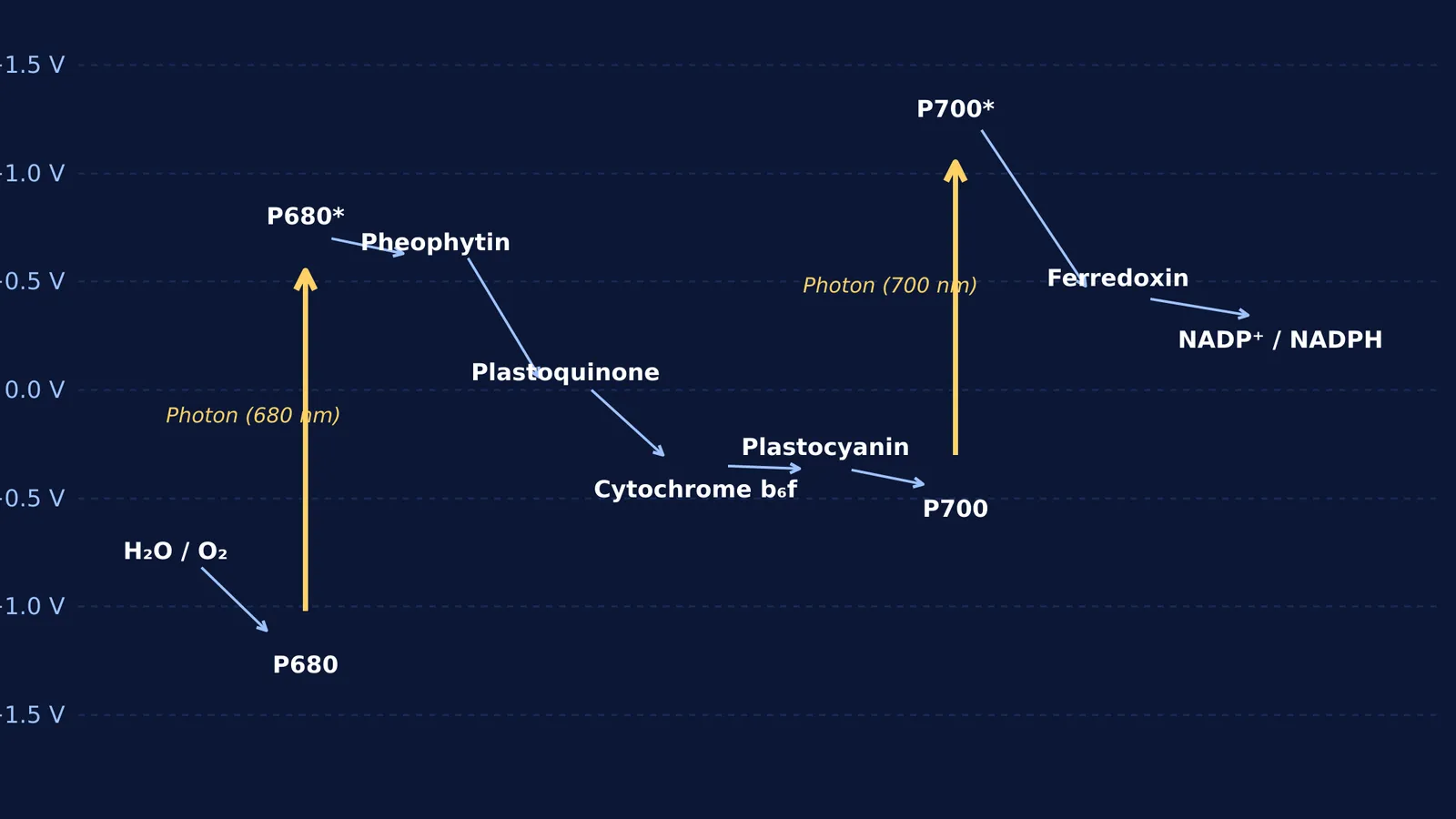
In short The Z-scheme of photosynthesis shows electron flow from water to NADP⁺, plotted against the redox potential of each carrier. Light excites Photosystem II (P680) from +1.17 V to −0.70 V, driving the uphill transfer that powers the electron transport chain.
The Z-scheme is one of the most famous diagrams in biology, but it is often misunderstood. It is not a map of where proteins sit in the chloroplast. Instead, it is an energy diagram that plots the path of electrons against a redox scale.
If you just memorise the carrier names—Plastoquinone, Cytochrome b₆f, Plastocyanin—you might struggle when exam questions ask about energy changes or spontaneous flow. By looking at the redox potentials instead of just the names, the entire sequence of non-cyclic photophosphorylation makes perfect physical sense.
What is the Z-scheme of photosynthesis?
The Z-scheme represents the pathway of non-cyclic photophosphorylation. It tracks how electrons are stripped from water and eventually handed to NADP⁺ to form NADPH, which provides the reducing power needed for the Calvin cycle.
The vertical axis of the Z-scheme is the midpoint redox potential (Eₘ) at pH 7.0. By convention in bioenergetics, lower (more negative) potentials are placed at the top of the graph. A negative potential means the molecule has higher energy and a stronger tendency to donate electrons. Positive potentials, which represent a stronger pull on electrons (acting as oxidising agents), are placed at the bottom.
According to standard measurements of excited-state redox potentials in the Z scheme90059-3), water is oxidized at a potential of +0.82 V. To pull electrons away from water, Photosystem II relies on P680. This chlorophyll complex is one of the strongest biological oxidants known, because its ground state sits at an incredibly strong +1.17 V.
How does electron flow from PS II to PS I work?
The "Z" shape (which actually looks more like an "N" when plotted on standard axes) is formed by two uphill energy jumps driven by light, connected by a downhill slide through the electron transport chain, all following the measured redox potentials90059-3).
When light at 680 nm hits Photosystem II, P680 absorbs the photon's energy and is excited to a new state called P680*. This shifts its redox potential dramatically to roughly −0.70 V. Because −0.70 V is much more negative than the carriers that follow, the electron can now flow "downhill" spontaneously.
It jumps first to Pheophytin (−0.61 V), and then moves through the electron transport chain. It passes to Plastoquinone (roughly 0.00 V), then Cytochrome b₆f (+0.35 V) and finally Plastocyanin (+0.37 V). With every step, the potential becomes more positive. This means the electron is losing energy. The chloroplast does not let this energy go to waste; the Cytochrome b₆f complex uses it to pump protons across the thylakoid membrane, building the gradient that will ultimately synthesize ATP.
By the time the electron reaches Photosystem I (specifically the P700 reaction centre), its potential has dropped to +0.45 V. Here, another photon of light (at 700 nm) excites P700 to P700* at a staggering −1.20 V. From this highly energetic peak, the electron falls downhill once again to Ferredoxin (−0.42 V) and finally reduces NADP⁺ to NADPH at −0.32 V.
How to draw the Z-scheme without mistakes?
If you are asked to sketch the Z-scheme in a board exam or draw it for a revision note, use this mental checklist to get the physics right:
Draw the Y-axis first: Label it "Redox Potential" with negative values at the top (−1.5 V) and positive values at the bottom (+1.5 V).
Plot the light reactions as vertical jumps: P680 and P700 must shoot straight up. They are the only parts of the process where energy is actively absorbed from light.
Draw the downhill slopes: Every intermediate carrier (Pheophytin → Plastoquinone → Cytochrome b₆f → Plastocyanin) must sit lower than the one before it. If you draw a flat, horizontal line across the page, you are implying that there is no energy change, which breaks the laws of thermodynamics.
When practicing these pathways for exams, Fermi's AI tutor can work out what you already know and build a plan for the session, ensuring you don't just memorise the carrier names but understand the physics of redox potentials behind them. If you are struggling to connect these light-dependent reactions to the dark reactions of the Calvin cycle, the Fermi Concept Library breaks down the entire process of photosynthesis with clear, step-by-step energy maps.
For more on plant physiology, read how Photorespiration: why RuBisCO wastes energy in C3 plants limits efficiency, or review Respiration as an amphibolic pathway: where fats and proteins enter to see how cells extract energy.


