

On this page
The final stage of cellular respiration is where the massive payout of energy happens. Glycolysis and the Krebs cycle strip high-energy electrons from food molecules, storing them in NADH and FADH₂. The electron transport chain (ETC) takes these electrons and uses their energy to build a proton gradient, which ultimately powers the synthesis of ATP.
Understanding this sequence is a staple of biology exams. Here is a breakdown of how the complexes work together on the inner mitochondrial membrane.
What is the electron transport chain?
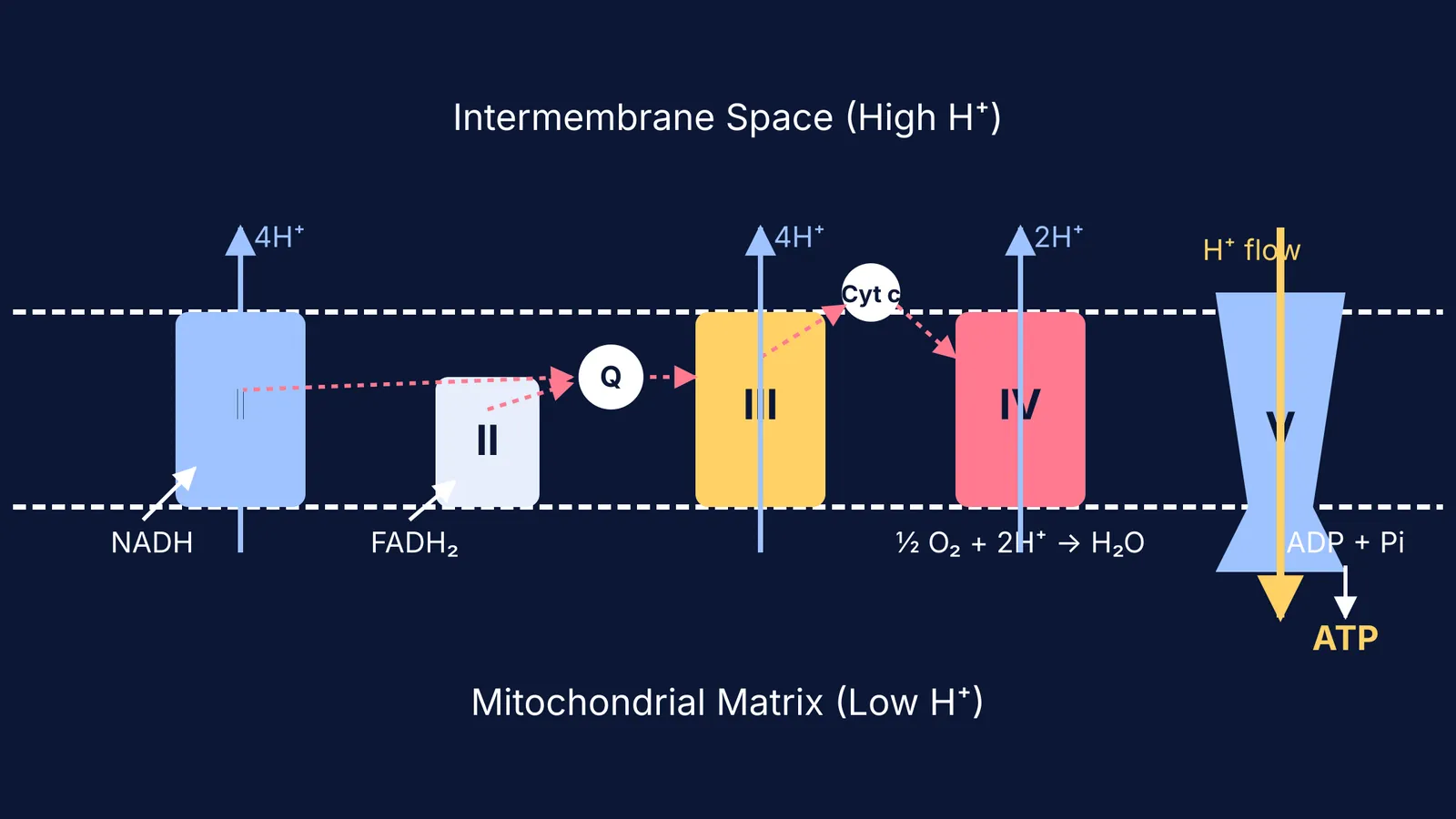
The electron transport chain is a series of four large protein complexes (I to IV) and two mobile carriers embedded in the inner membrane of the mitochondrion. As electrons move from one complex to the next, they drop to lower energy states. According to the National Center for Biotechnology Information (NCBI), the energy released by these electron transfers is used to pump protons (H⁺) from the mitochondrial matrix into the intermembrane space.
This creates an electrochemical gradient, often called the proton motive force. The inner membrane is otherwise impermeable to protons, so they can only flow back into the matrix through a specialized enzyme called ATP synthase, which harnesses that flow to generate ATP. For students who find abstract metabolic pathways hard to picture, the Fermi Simulation Lab offers interactive simulations where you can watch the proton gradient build up and drive ATP production.
How are electron transport chain complexes I to IV explained?
The journey of an electron depends on whether it arrives via NADH or FADH₂. As outlined by the NCBI, here is the step-by-step path through the four main complexes.
Complex I (NADH dehydrogenase): This is the entry point for electrons carried by NADH. Complex I oxidizes NADH back to NAD⁺, capturing two electrons. As these electrons pass through the complex, the energy released pumps 4 protons from the matrix into the intermembrane space. The electrons are then handed off to ubiquinone.
Complex II (Succinate dehydrogenase): This complex is unique because it is also an enzyme in the Krebs cycle. It accepts electrons from FADH₂. Because FADH₂ has slightly less energy than NADH, Complex II does not pump any protons across the membrane. Instead, it directly passes its electrons to ubiquinone. This bypass is why FADH₂ yields fewer ATP molecules overall than NADH.
Ubiquinone (Coenzyme Q): This is a small, lipid-soluble mobile carrier. It travels freely within the hydrophobic core of the inner membrane, collecting electrons from both Complex I and Complex II and ferrying them to Complex III.
Complex III (Cytochrome bc1 complex): When Complex III receives electrons from ubiquinone, it passes them to the next carrier. In doing so, it pumps another 4 protons into the intermembrane space for every electron pair that moves through it.
Cytochrome c: Unlike ubiquinone, cytochrome c is a small, water-soluble protein that slides along the outer surface of the inner membrane, carrying electrons from Complex III to Complex IV.
Complex IV (Cytochrome c oxidase): This is the final stop in the chain. Complex IV transfers the electrons from cytochrome c to molecular oxygen. As it does this, it pumps 2 protons across the membrane.
Oxygen's high electronegativity is what pulls the electrons down the entire chain. When oxygen accepts these electrons, it also picks up protons from the matrix to form water (H₂O).
How does Complex V make ATP?
While Complexes I through IV create the proton gradient, they do not make ATP. That job belongs to Complex V, better known as ATP synthase.
Because of the continuous pumping, the intermembrane space becomes highly acidic (high H⁺ concentration) and positively charged compared to the matrix. This electrochemical imbalance drives protons forcefully back into the matrix. They can only pass through the channel provided by ATP synthase. As protons flow through this enzyme, they physically spin a rotor inside it. This mechanical rotation provides the energy needed to force adenosine diphosphate (ADP) and inorganic phosphate (Pi) together, forging the high-energy bond of ATP.
If you are revising these pathways and struggling to connect them, Fermi's AI tutor can work out what you already know and build a plan for the session, testing your recall step-by-step. You can also explore definitions and related biochemical cycles in the Fermi Concept Library.
Exam checklist for the ETC
When preparing for exams like NEET or board biology, you must keep the numbers and locations straight. Use this quick checklist to test your memory:
Proton count: According to the NCBI, one molecule of NADH results in 10 protons pumped (4 at I, 4 at III, 2 at IV). One molecule of FADH₂ results in 6 protons pumped (0 at II, 4 at III, 2 at IV).
Final acceptor: Molecular oxygen (O₂) is the ultimate electron acceptor, forming water.
Mobile carriers: Ubiquinone (CoQ) carries electrons to Complex III; Cytochrome c carries them to Complex IV.
Location: The entire chain is embedded in the inner mitochondrial membrane.
For more on how to count the total energy yield, see our guide to respiration in plants: how to count ATP from glycolysis to ETS. You can also read about how different macromolecules feed into this process in our overview of respiration as an amphibolic pathway.


