

On this page
Photosynthesis in green plants unfolds in two interdependent stages: the photochemical light reactions and the biosynthetic dark reactions. When tracing this biochemical machinery, you can explore the Fermi Concept Library, where every concept in physics, chemistry, biology, mathematics and computing has its own lesson and its place in the map. The light reactions do not make sugars; instead, they convert solar photons into chemical intermediates while releasing oxygen into the atmosphere.
What are the products of the light reaction in photosynthesis?
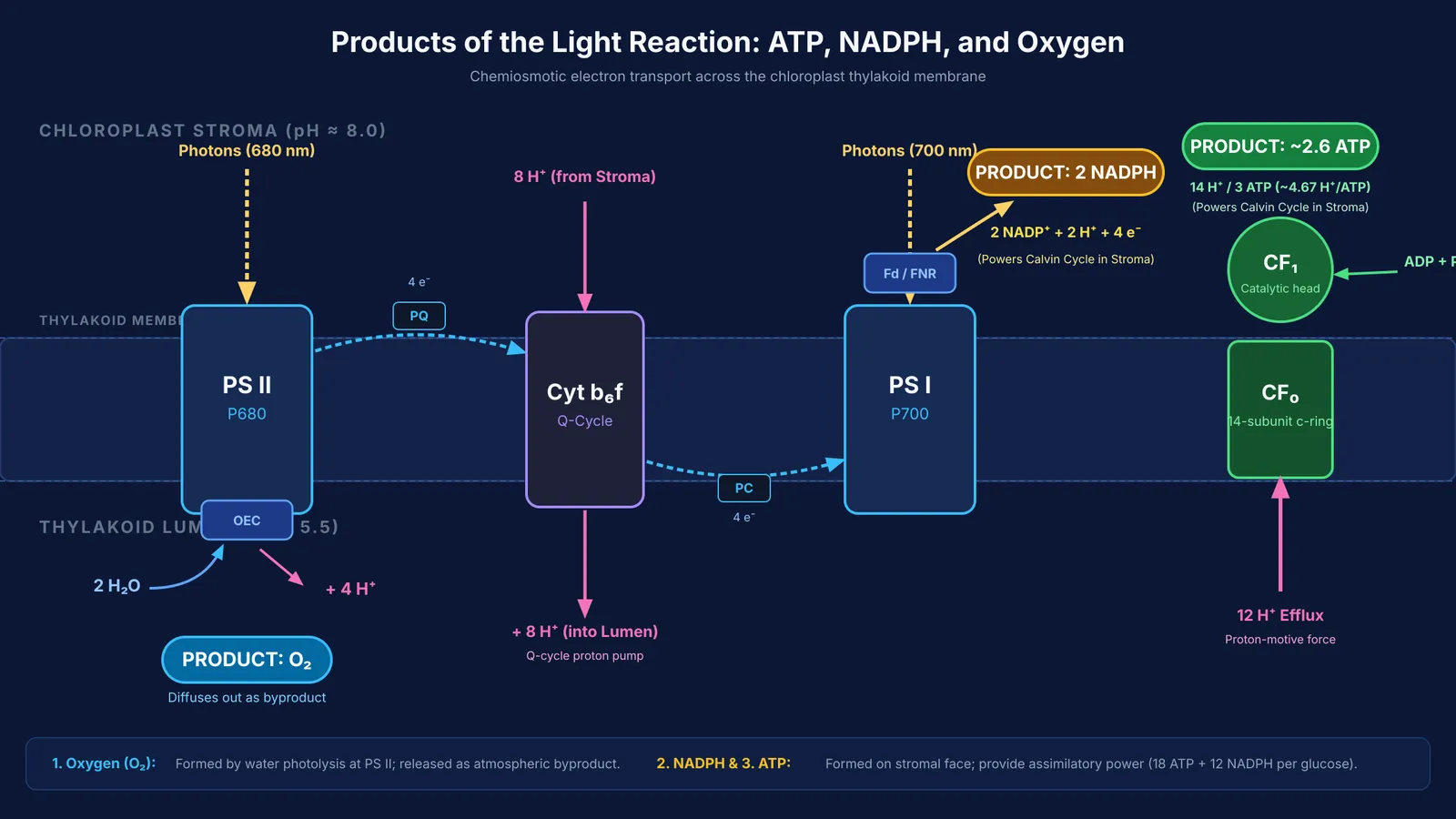
The light-dependent reactions produce exactly three primary substances: adenosine triphosphate (ATP), reduced nicotinamide adenine dinucleotide phosphate (NADPH), and molecular oxygen (O₂).
Molecular oxygen is produced in the thylakoid lumen by the oxygen-evolving complex at Photosystem II (PS II). As established in the NCERT Class 11 Biology textbook, the photolysis of water follows this balanced reaction: 2 H₂O → 4 H⁺ + O₂ + 4 e⁻
Here, water replaces the electrons ejected from reaction centre P680. The evolved oxygen gas diffuses out through stomata as a byproduct, a phenomenon demonstrated by Robert Hill's experiments demonstrating oxygen evolution from isolated chloroplasts.
The remaining products, ATP and NADPH, stay in the chloroplast to provide the assimilatory power needed to build carbohydrates.
Where do the light reactions take place in the chloroplast?
The light reactions occur within the thylakoid membranes of the chloroplast, organized into stacked grana and unstacked stroma lamellae.
This spatial organization couples electron flow to chemical synthesis. In their two-system working hypothesis published in Nature, Robin Hill and Fay Bendall showed that electrons move along the non-cyclic Z-scheme. Electrons travel from PS II through plastoquinone, the cytochrome b₆f complex, and plastocyanin to Photosystem I (PS I).
At PS I, electrons reduce NADP⁺ via the stromal enzyme ferredoxin-NADP⁺ reductase (FNR): NADP⁺ + 2 e⁻ + H⁺ → NADPH
Simultaneously, electron flow establishes a proton gradient. In Nature, Peter Mitchell showed that proton accumulation creates a proton-motive force across the thylakoid membrane. Protons build up in the lumen via water oxidation and the cytochrome b₆f Q-cycle. They re-enter the stroma through CF₀-CF₁ ATP synthase, driving ATP formation. Because both CF₁ and FNR face the stroma, ATP and NADPH emerge directly where the Calvin cycle takes place.
How do ATP and NADPH carry energy to the Calvin cycle?
Synthesized in the stroma, ATP and NADPH power carbon dioxide fixation. First mapped by Melvin Calvin and colleagues in the Journal of the American Chemical Society, the Calvin cycle uses them in two main stages:
Reduction: Each CO₂ fixed yields 2 molecules of 3-phosphoglycerate (3-PGA). Phosphorylation consumes 2 ATP (1 ATP per 3-PGA) to form 2 molecules of 1,3-bisphosphoglycerate, which 2 NADPH then reduce to glyceraldehyde-3-phosphate (G3P).
Regeneration: Regenerating ribulose-1,5-bisphosphate (RuBP) consumes an additional 1 ATP per CO₂.
Under the NCERT Class 11 Biology curriculum, fixing 1 molecule of CO₂ consumes 3 ATP and 2 NADPH. Building 1 glucose molecule (C₆H₁₂O₆) requires 6 turns of the cycle, totaling 18 ATP and 12 NADPH. Fixation rates remain governed by Blackman's law of limiting factors in photosynthesis, while photorespiratory losses can waste energy, as detailed in how photorespiration wastes energy in C3 plants.
Why does the chloroplast need cyclic photophosphorylation?
Chloroplasts compensate for stoichiometric imbalances through cyclic photophosphorylation, identified by Daniel Arnon and colleagues in Nature. Excited electrons from PS I return to the cytochrome b₆f complex via ferredoxin, returning to PS I through plastocyanin.
This alternative pathway is necessary because linear electron transport yields an ATP:NADPH ratio of roughly 1.28:1, falling short of the 3:2 (1.5:1) ratio required by the Calvin cycle. Cyclic electron flow produces no NADPH and splits no water, but it pumps additional protons across the membrane to generate the extra ATP needed to reach 18 ATP per 12 NADPH.
How does the energy accounting work from water to ATP and NADPH?
To master thylakoid bioenergetics, trace the stoichiometric cascade established in Nature from splitting 2 water molecules:
Water oxidation: Splitting 2 H₂O at PS II produces 1 O₂, 4 H⁺ in the lumen, and 4 e⁻.
NADPH formation: The 4 e⁻ traverse the Z-scheme, reducing 2 NADP⁺ and consuming 2 stromal H⁺ to yield 2 NADPH.
Proton pumping: Passing 4 e⁻ through cytochrome b₆f translocates 8 H⁺ into the lumen via the Q-cycle, creating a total lumen accumulation of 12 H⁺ (4 from water + 8 from Q-cycle).
ATP yield: Chloroplast ATP synthase has a 14-subunit c-ring, requiring 14 H⁺ per rotation to yield 3 ATP (~4.67 H⁺ per ATP). Passing 12 H⁺ generates ~2.57 ATP.
To reach the 3.0 ATP needed per 2 NADPH in carbon fixation, cyclic photophosphorylation supplies the remaining proton flux.
For multi-step numericals on bioenergetics, the Fermi Problem Library provides worked problems with a step-by-step solver that explains the reasoning rather than printing an answer.


