

On this page
A leaf in bright sun on a cold morning, a tomato plant in a greenhouse, a sprig of *Hydrilla* next to a lamp: in each case, which factor sets the rate of photosynthesis? Blackman's law of limiting factors answers that, and graph questions on it are common. This post explains the law from NCERT, shows how to read the light-response curve, works a lamp experiment with numbers, and explains why CO₂ is still the usual limit for C3 plants.
Where is this in the syllabus?
The NMC syllabus for NEET (UG) 2026 lists "Factors affecting photosynthesis". The NCERT Class 11 chapter Photosynthesis in Higher Plants (reprint 2026-27) covers it in Section 11.10: internal factors such as leaf number, chloroplasts and chlorophyll, and external factors such as light, temperature, CO₂ and water. F. F. Blackman's paper, Optima and Limiting Factors, appeared in the Annals of Botany in 1905. Check the syllabus for your exam year.
What does Blackman's law say?
NCERT states it like this: "If a chemical process is affected by more than one factor, then its rate will be determined by the factor which is nearest to its minimal value: it is the factor which directly affects the process if its quantity is changed."
NCERT's example: a green leaf with optimal light and CO₂ may still not photosynthesise if the temperature is very low, and it starts once given the right temperature. Think of a queue at a ticket counter with one slow clerk. Adding more clerks elsewhere changes nothing until the slow one speeds up.
How do you read the light curve?
NCERT's Figure 11.10 shows the rate rising in a straight line at low light, then levelling off as other factors become limiting. Three facts from the text:
Light saturation occurs at about 10 per cent of full sunlight, so light rarely limits plants in nature, except in shade or dense forest.
Very high light breaks down chlorophyll and lowers the rate.
On the rising part, light is limiting. On the flat part, something else is.
If raising CO₂ lifts the flat part, CO₂ was the limit there.
Worked example: Hydrilla and a lamp
Sample numbers for a hypothetical class experiment. A lamp is placed 40, 30, 20 and 10 cm from a sprig of *Hydrilla* in water, and bubbles are counted per minute.
Light at each distance. Treat the lamp as a point source, so intensity varies as 1/d². Taking 40 cm as 1, the relative intensities are 1, (40/30)² ≈ 1.78, (40/20)² = 4 and (40/10)² = 16.
Sample counts: 5, 9, 20 and 26 bubbles per minute.
If light were the only limit, bubbles would scale with intensity: 5, about 8.9, 20 and 80.
Compare. Counts match the prediction up to 20 cm, so light was limiting there. At 10 cm the count is 26, not 80: the curve has flattened, and another factor is limiting.
Test the suspect. Add sodium hydrogencarbonate to the water at 10 cm to supply more dissolved CO₂. If the count rises (say to 38), CO₂ was the limit. At 40 cm the same addition should change little, because light is still the limit there.
A trap: a lamp at 10 cm also warms the water. If light and temperature change together, you cannot tell which one mattered. Keep a thermometer in the water, or put a water screen between lamp and plant.
Why is CO₂ the major limiting factor?
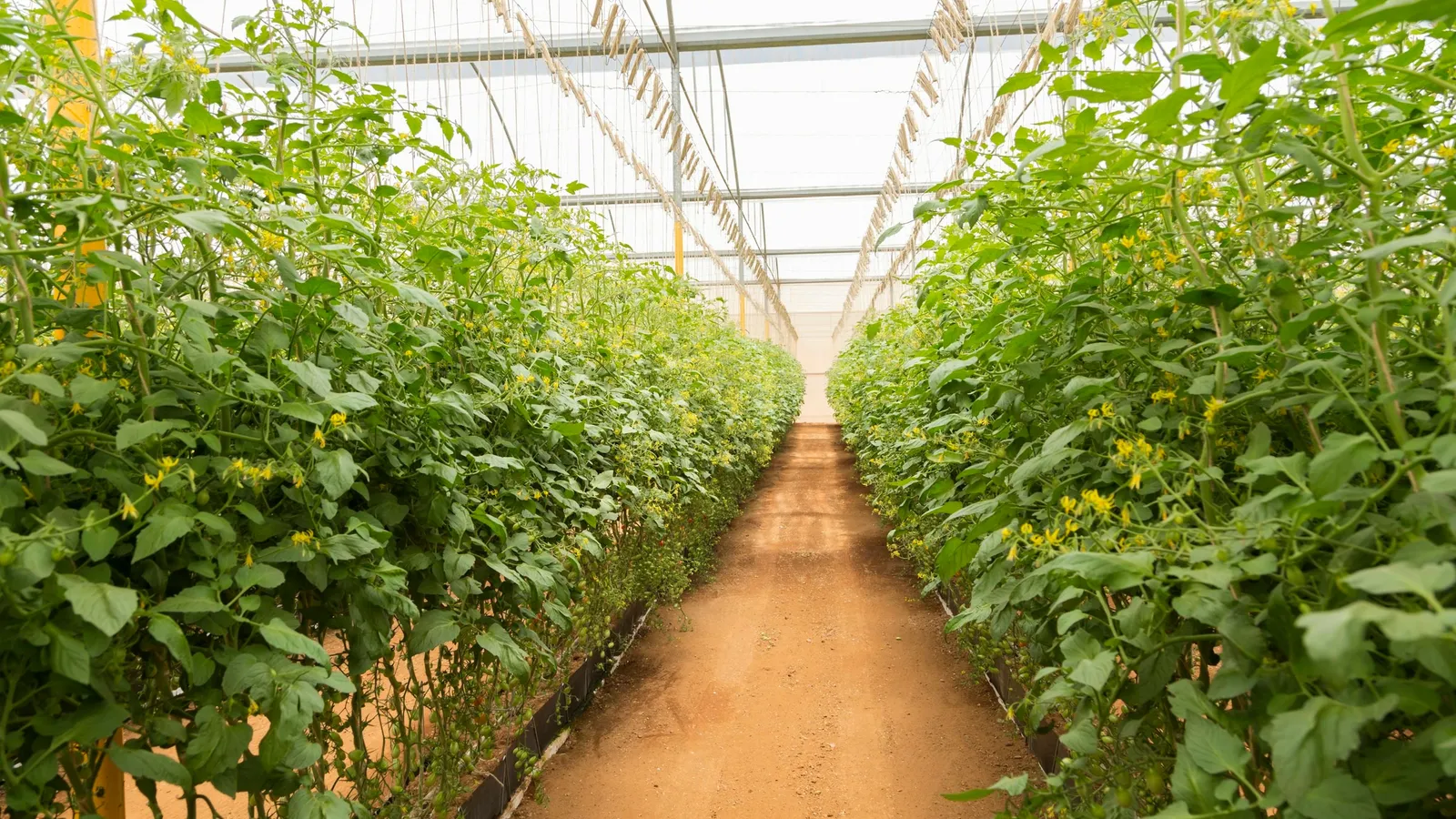
NCERT calls CO₂ "the major limiting factor for photosynthesis". It quotes atmospheric CO₂ as 0.03 to 0.04 per cent and says C4 plants saturate at about 360 µL/L, while C3 plants respond up to beyond 450 µL/L. That is why greenhouse tomatoes and bell peppers are grown in CO₂-enriched air for higher yields. It also warns that levels much above 0.05 per cent can become damaging over longer periods.
The atmosphere has moved since that range was written. NOAA's Mauna Loa record shows a monthly mean of 426.07 ppm for September 2026, which is 0.0426 per cent. That is above NCERT's quoted range but still below 450, so NCERT's conclusion holds: current CO₂ is limiting for C3 plants.
Temperature and water. The dark reactions are enzymatic, so they depend on temperature; C4 plants have higher temperature optima than C3 plants. Water acts mainly indirectly: water stress closes stomata, which cuts CO₂ supply, and makes leaves wilt.
Which mistakes cost marks?
Saying light is the usual limit in nature. NCERT says light saturates at about 10 per cent of full sunlight.
Reading a plateau as "photosynthesis stopped". The rate is steady, set by another factor.
Changing two factors at once in an experiment.
Treating water as a direct limit. Its main effect is through stomata.
Assuming more CO₂ always helps. NCERT warns about long-term damage beyond about 0.05 per cent.
For the light reactions and Calvin cycle behind these rates, see our guide to photosynthesis for NEET. The first experiments linking light and plant gases are in our post on Jan Ingenhousz.
A practice routine
Sketch the light curve at two CO₂ levels on one set of axes. Label where light limits and where CO₂ limits.
Rewrite Blackman's law in your own words, then check it against NCERT's wording.
Make five scenario cards (shade plant, cold morning, greenhouse tomato, wilting leaf, maize at noon) and name the likely limiting factor for each.
Redo the worked example with the lamp at 15 cm. (Relative intensity: (40/15)² ≈ 7.1.)
When the shape of a rate curve is hard to picture, the Fermi Simulation Lab has interactive simulations for the ideas that are easier to see than to read.
Today, draw the light curve from memory and mark the point where light stops being the limiting factor.


